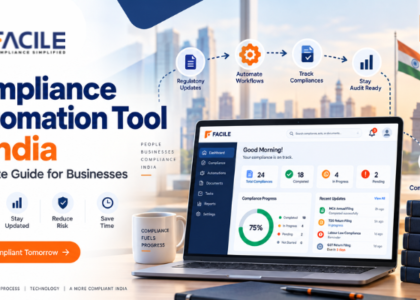


Managing labour law compliance in India requires organisations to track a wide range of statutory obligations across employees, contractors, establishments, factories, payroll processes, licences, registers, returns, inspections and regulatory updates.
A Labour Law Compliance Application helps businesses organise these obligations through a structured digital platform. Instead of depending on spreadsheets, emails and manual trackers, compliance teams can monitor applicable laws, due dates, statutory documents, audit observations and multi-location requirements from one system.
For companies operating across multiple States or managing contractors and vendors, a dedicated labour law compliance application can significantly improve visibility and reduce compliance risk.
A Labour Law Compliance Application is software designed to help organisations monitor and manage statutory obligations under applicable labour and employment laws.
It can help businesses manage:
The goal is to provide a centralised view of labour law compliance across the organisation.
Labour law compliance is complex because requirements may vary by:
Manual compliance tracking can create problems such as:
A Labour Law Compliance Application helps reduce these risks by providing structured workflows and centralised compliance information.
A good application should help determine which labour laws apply to each establishment, unit or location.
Applicability can depend on factors such as:
This helps organisations avoid both under-compliance and unnecessary compliance.
A central compliance calendar should show:
This helps compliance teams track monthly, quarterly, half-yearly and annual obligations.
Labour laws may require organisations to maintain prescribed registers.
These can include records relating to:
A compliance application should help maintain or generate these records in a structured format.
Businesses may need to submit different statutory returns depending on the applicable law and jurisdiction.
The application should support:
Labour compliance may involve various licences and registrations.
The application should help manage:
This helps businesses avoid expired or outdated licences.
The application should help businesses monitor compliance for offices, branches, commercial establishments and other locations.
Important areas can include:
For manufacturing organisations, the application should support:
Payroll compliance should be integrated with labour law requirements.
The application can help monitor:
Minimum wage compliance varies by State, zone, skill category and industry.
A Labour Law Compliance Application should help businesses monitor:
This helps identify employees whose wages may fall below statutory requirements.
Contractor compliance is a major risk area for principal employers.
The application should help monitor:
The application should support EPF-related checks such as:
The system should help manage:
Professional Tax requirements vary across States.
The application should help track:
The application should help organisations manage State-specific LWF requirements such as:
Labour law compliance involves many supporting documents.
The application should provide central storage for:
A dashboard should provide management with visibility over:
For organisations operating across India, the application should provide State-wise visibility.
It should help manage different requirements relating to:
A Labour Law Compliance Application should support audit workflows.
The system can help record:
This provides a structured audit trail.
All labour law obligations can be monitored from a single platform.
Teams spend less time updating spreadsheets and checking due dates manually.
Dashboards provide clear visibility over pending and overdue items.
Documents, registers and returns remain organised and easy to retrieve.
Principal employers gain greater visibility into contractor compliance.
Businesses can monitor compliance across branches, factories and units from one system.
Compliance gaps can be identified earlier and corrective actions can be tracked.
Multi-state businesses face different regulatory requirements in each location.
A central application can structure compliance as:
Company → State → Establishment → Applicable Law → Compliance Activity → Due Date → Document → Status
This allows management to monitor compliance both location-wise and organisation-wide.
A useful dashboard can show:
This helps management focus on high-risk areas.
Businesses should regularly verify:
It is suitable for:
FACILE ONE helps organisations manage labour law compliance through a centralised statutory compliance platform.
Businesses can use FACILE ONE to support:
Labour law compliance requires coordination between HR, payroll, compliance, finance, factory teams, contractors and management.
FACILE ONE provides a structured platform that helps bring these activities together.
Key capabilities include:
Before selecting a compliance application, businesses should evaluate whether the platform supports:
The best platform should provide visibility over what is applicable, what is due, what is completed and where the compliance risk exists.
A Labour Law Compliance Application helps businesses manage complex statutory obligations in a structured and centralised manner.
For organisations operating across multiple States, establishments, factories and contractors, FACILE ONE can help improve compliance visibility, reduce manual tracking and maintain stronger audit-ready documentation.
A Labour Law Compliance Application is software used to manage statutory labour obligations such as licences, registrations, payroll compliance, EPF, ESIC, minimum wages, registers, returns and contractor compliance.
It helps businesses reduce missed deadlines, improve statutory tracking, manage multiple locations and maintain audit-ready records.
Yes. A good application can support different Central and State labour law requirements across establishments and locations.
Yes. Multi-state compliance is one of the key use cases for businesses operating across India.
Yes. It can help track establishment registration, renewal, returns, registers and other applicable requirements.
Yes. Factory licences, working hours, safety records, returns, inspections and registers can be monitored.
Yes. It can support minimum wages, EPF, ESIC, PT, LWF, overtime, attendance and payroll document validation.
Yes. Contractor licences, wages, attendance, EPF, ESIC, payslips, payment proof and statutory documents can be monitored.
Yes. Compliance calendars and reminders can help businesses track upcoming statutory deadlines.
Yes. A Labour Law Compliance Application can support statutory register management based on applicable requirements.
Yes. It can track return applicability, filing dates, status, acknowledgements and historical filings.
Yes. Licence numbers, effective dates, expiry dates and renewal status can be monitored.
Yes. It can maintain observations, corrective actions, closure records and supporting documents.
HR, payroll, legal, compliance, finance and vendor-management teams can use it.
Yes. FACILE ONE supports labour law compliance monitoring across establishments, factories, payroll, contractors, statutory documents, audits and multi-state operations.


Facile Management Services (OPC) Private Limited is committed to delivering seamlessly integrated HR and compliance solutions designed for the evolving