

The High Court of Jammu & Kashmir and Ladakh held that a principal employer remains liable for the minimum wages and overtime of contract security guards working on its site, even when the contract says the agency pays the wages.

Bottom line: The contractor may have to hand out the wages, but who finally bears the cost depends on the contract and the labour laws read together. A clause saying “the agency is responsible for all wages and compliance” does not protect a principal employer that controls the guards’ deployment, shifts and working hours.
Background
M/s Parmar Security & Placement Services (the Agency), run by Col. R.S. Parmar (Retd.), supplied security guards to AFCONS Infrastructure Ltd. (the Principal Employer) at its Jammu–Udhampur NH-1A road project. The work was governed by a series of agreements and work orders.
During an inspection, the Labour Enforcement Officer found three problems:
Two writ petitions, one judgment
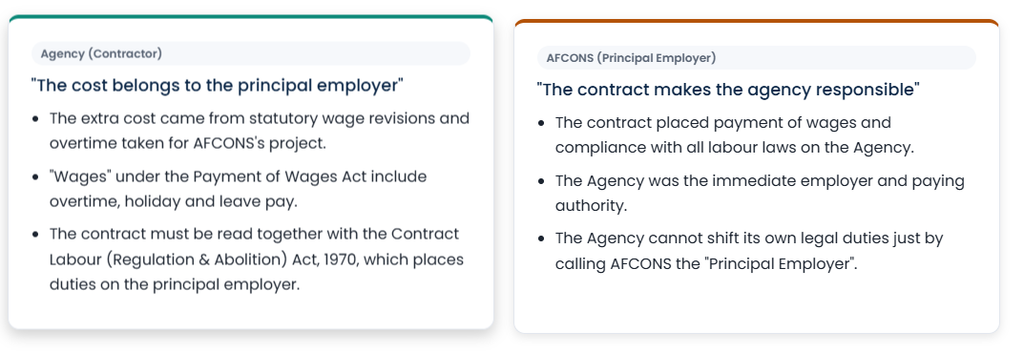
Filed by the Agency against the award of 27.03.2014 under Section 20(3) of the Minimum Wages Act, which made the Agency alone pay differential wages, compensation, rest-day wages and overtime. The Agency asked that AFCONS bear the cost.
Filed by AFCONS against the award of 31.10.2017, which made AFCONS and the Agency jointly liable for overtime and compensation to the remaining nine guards.
The dispute
Nobody seriously disputed that the guards were owed the money. The fight was over who must finally pay it.
The Court’s reasoning
Clauses placing wage payment on the contractor cannot be read in isolation or in a way that cancels the principal employer’s statutory duties. The agreement has to be read with the Minimum Wages Act 1948, the Payment of Wages Act 1936 and the Contract Labour Act 1970, and these laws must be interpreted to advance worker protection, not defeat it.
“The contractual arrangement must yield to, and be construed consistently with, the mandatory requirements of labour welfare legislation.” (Para 24)
Sub-section (1) puts the first duty to pay on the contractor. Sub-sections (2) and (3) require the principal employer’s authorised representative to be present at, and certify, wage payment. Sub-section (4) makes the principal employer pay if the contractor fails or short-pays, with a right to recover from the contractor. The principal employer cannot stay detached from wage payment.
The guards worked only at AFCONS’s site. Their attendance, deployment, shifts and use were largely controlled by AFCONS. Wages were to be paid in the presence of AFCONS’s representative, and wage-cum-muster rolls went to its personnel department for certification. The work order of 01.09.2011 said duty hours were “not allowed beyond eight hours” and priced an 8-hour shift. If longer hours were nonetheless taken for AFCONS’s project, it cannot escape the overtime cost under Section 14 of the Minimum Wages Act.
The immediate obligation to disburse wages and the final liability to bear the financial burden are different things. Who ultimately pays depends on the nature of deployment, operational control, working hours, and how the extra wage liability arose.
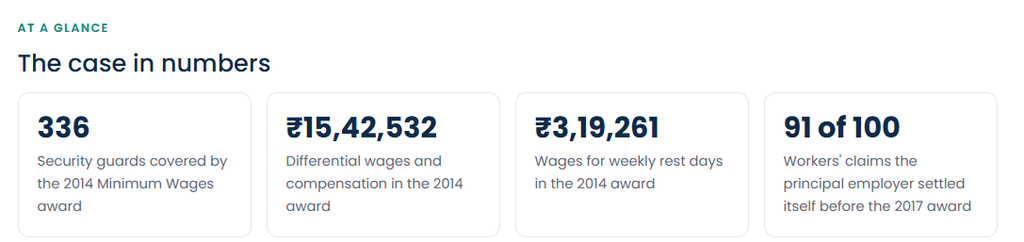
AFCONS had itself settled the claims of 91 of the 100 workers in the 2017 dispute. If the liability truly rested only with the Agency, there was no reason to do that. AFCONS could not take an inconsistent position against the nine workers who chose adjudication instead of settlement. Their claims had the same source and character.
Outcome
| Petition | Award challenged | Result |
|---|---|---|
| OWP 698/2014 by the Agency | 27.03.2014: ₹15,42,532 (differential wages + compensation, 336 workers) and ₹3,19,261 (weekly rest days), all on the Agency | Allowed. Final liability lies with AFCONS as principal employer. But AFCONS was a necessary party and was never heard by the Authority, so the award was set aside and remanded. AFCONS is to be impleaded, may file pleadings, and a fresh award will be passed after hearing both sides. Money deposited with the Registry goes back to the Authority and is held in an interest-bearing fixed deposit in the meantime. |
| OWP 2126/2017 by AFCONS | 31.10.2017: overtime and compensation for the remaining 9 workers, jointly on AFCONS and the Agency | Partly allowed, but only in the Agency’s favour. No ground to interfere with the workers’ entitlement. Fastening liability on the Agency was an error, so the award is modified: AFCONS must satisfy the award in full. |
Practical lessons
For principal employers / clients
For contractors / manpower agencies


Facile Management Services (OPC) Private Limited is committed to delivering seamlessly integrated HR and compliance solutions designed for the evolving