
Labour law compliance is a critical responsibility for businesses operating in India. Organisations must manage statutory obligations, employee documentation, payroll-related compliance, licence renewals, contractor records, and applicable central and state labour laws. As businesses expand across multiple locations, managing these requirements manually becomes increasingly complex.
Missed deadlines, incomplete documentation, and limited visibility into vendor compliance can create operational challenges and potential legal risks. This is why businesses are increasingly exploring labour law compliance software in India to streamline compliance processes and improve accountability.
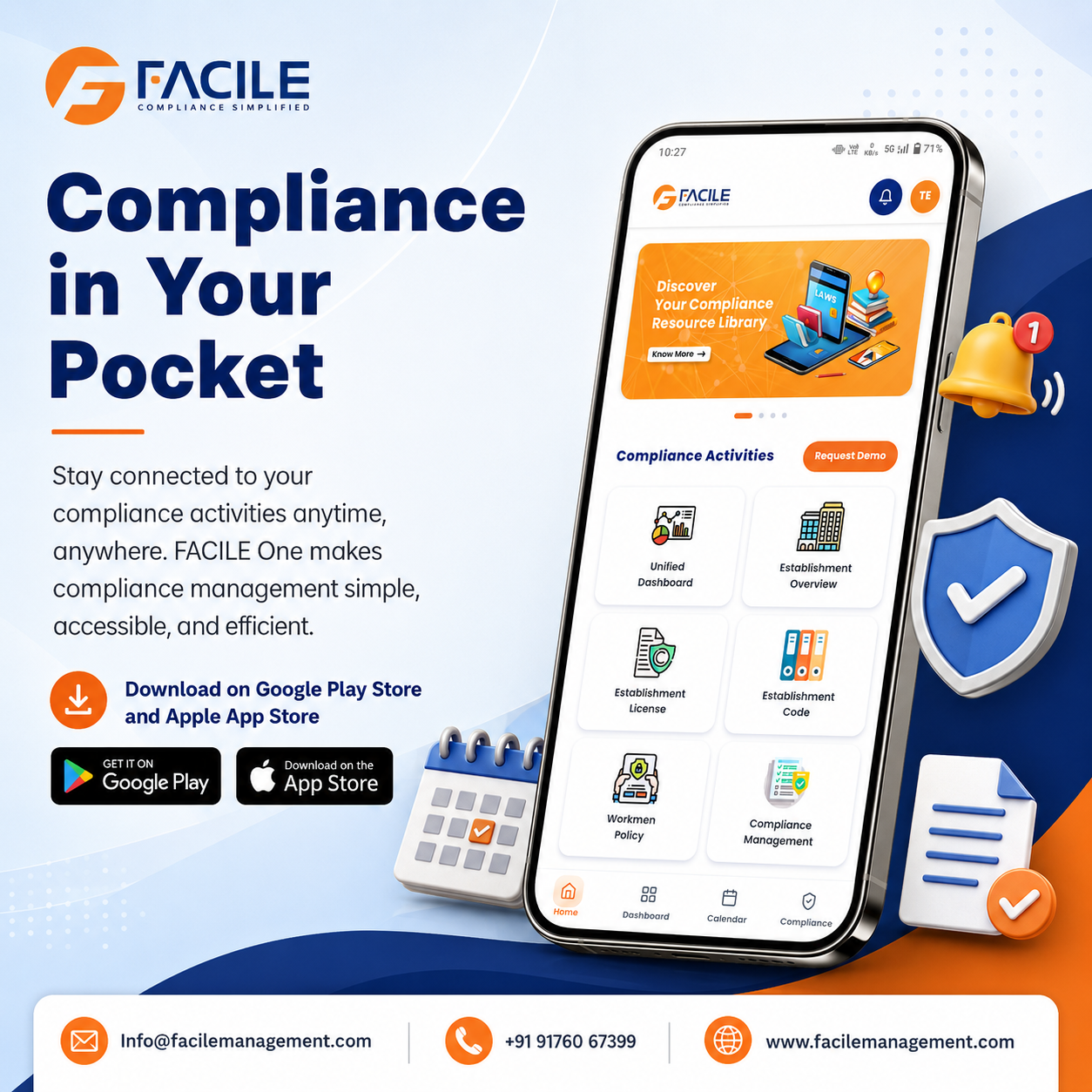
Facile Management Services offers a compliance-focused product suite designed to support statutory compliance monitoring, vendor compliance management, audit tracking, licence management, and establishment-related compliance activities.
In this article, we explore the importance of labour law compliance software, the key features businesses should look for in 2026, the benefits of compliance automation, and how Facile Management can support a more structured compliance management approach.
Labour law compliance software is a digital platform that helps organisations monitor, organise, and manage statutory obligations relating to employees, establishments, contractors, and workplace regulations.
Depending on the solution and selected modules, businesses can use compliance software to manage:
By bringing these activities into a structured system, organisations can reduce dependence on manual spreadsheets and improve visibility into pending compliance tasks.
India’s labour compliance environment involves central legislation, state-specific requirements, establishment-level obligations, and recurring statutory activities. The requirements applicable to an organisation depend on its industry, workforce, location, and business operations.
Here are some important reasons businesses consider compliance management software.
HR and compliance teams may need to coordinate EPF, ESIC, Professional Tax, Labour Welfare Fund, applicable labour registers, and other statutory obligations. A centralised system helps organise these responsibilities.
Recurring due dates can be difficult to manage across several establishments. Compliance calendars, reminders, and status tracking can help teams identify upcoming and overdue activities.
Businesses must maintain relevant employee records, statutory documents, licences, and supporting evidence. Digital document management can make records easier to organise and retrieve.
Organisations engaging contractors and third-party service providers need visibility into applicable statutory documentation and compliance evidence. Vendor monitoring can help identify gaps and follow up on missing records.
Digital audit workflows help compliance teams record observations, organise evidence, assign corrective actions, and monitor progress.
Facile Management Services is a solution businesses can evaluate when looking for a dedicated approach to statutory compliance monitoring, vendor compliance, audit management, and establishment-level compliance activities.
Unlike platforms focused primarily on employee administration or payroll processing, a compliance-focused product suite can help businesses organise responsibilities that extend across establishments, contractors, vendors, and statutory documentation.
A centralised dashboard provides visibility into compliance activities, pending requirements, and relevant status information. It can help authorised users review tasks across business locations.
Recurring compliance activities require consistent monitoring. A structured compliance management workflow helps teams organise monthly responsibilities and follow up on outstanding tasks.
Organisations with multiple offices, factories, branches, or establishments need to monitor requirements across locations. Multi-branch tracking helps consolidate compliance information in one system.
Vendor compliance management helps organisations monitor applicable contractor documentation and statutory requirements. It can support more structured oversight of third-party service providers.
Vendor audits help businesses review documentation, identify compliance gaps, and record observations. Digital audit monitoring can improve visibility into findings and follow-up actions.
Maintaining licence details and renewal schedules is important for businesses with establishment-specific requirements. Licence tracking helps organise relevant documents and renewal information.
Establishment-related statutory information needs to be maintained accurately. Relevant compliance workflows can help businesses monitor establishment codes and associated requirements.
Workmen compensation tracking can help organisations monitor relevant information and documentation associated with applicable compensation requirements.
Organised employee documentation helps HR and compliance teams retrieve relevant records and maintain supporting evidence.
Where supported by the selected modules, alerts and reports can help teams identify pending tasks, monitor progress, and review compliance status.
Note: Confirm the availability of specific features, integrations, statutory workflows, and service responsibilities directly with Facile Management Services before implementation.
Before choosing a compliance platform, businesses should assess whether it supports their actual statutory obligations and operational requirements.
| Feature | Business benefit |
|---|---|
| Statutory compliance monitoring | Organises recurring legal obligations |
| EPF and ESIC workflows | Supports employee-related statutory activities |
| State-wise compliance coverage | Helps address location-specific requirements |
| Compliance calendar | Tracks deadlines and pending activities |
| Digital statutory registers | Organises required records and documentation |
| Vendor compliance management | Improves visibility into contractor documentation |
| Audit management | Records findings and corrective actions |
| Licence tracking | Helps monitor renewals and related documents |
| Multi-location dashboard | Consolidates compliance information |
| Reporting and alerts | Helps identify overdue tasks and potential gaps |
| Data security and access control | Supports controlled access to compliance records |
| HRMS and payroll integration | Reduces duplicate data entry where integrations are available |
Businesses should distinguish between features that monitor compliance and features that actually prepare, validate, submit, or pay statutory contributions.
Digital workflows can reduce repetitive administrative tasks, improve coordination, and minimise duplicate data entry.
Compliance calendars and reminders help teams track upcoming due dates and follow up on pending activities.
Centralised records make it easier to organise statutory documents and retrieve supporting evidence when required.
Vendor compliance monitoring can help organisations identify missing documents and follow up on applicable statutory requirements.
Digital audit records can help teams document observations, assign responsibilities, and monitor corrective actions.
Dashboards and reports provide a consolidated view of compliance activities, helping management identify areas that need attention.
As businesses expand into additional locations, compliance software can provide a structured framework for monitoring requirements across establishments, subject to the platform’s legal and geographical coverage.
Labour law compliance software can support businesses across different industries.
The most suitable solution depends on the organisation’s workforce, industry, operating locations, vendor network, and compliance responsibilities.
Selecting the right platform requires evaluating more than its advertised features.
Prepare a list of applicable central and state requirements, statutory registers, licences, filings, and recurring obligations.
Confirm that the platform supports the states, establishments, and business locations where your organisation operates.
If your organisation engages contractors, assess document collection, compliance verification, vendor audits, and corrective action workflows.
Identify which tasks are automated, which require human verification, and which must be completed through external statutory portals.
Check whether the software provides reports, task histories, evidence records, and role-based access.
Evaluate integration with HRMS, payroll, attendance, and other relevant business systems. Review data security, user permissions, and document retention practices.
Consider subscription fees, implementation, training, integrations, additional modules, and ongoing support.
Test the platform using realistic scenarios from your organisation before making a final decision.
Businesses looking for labour law compliance software should consider solutions that address their full compliance management needs rather than focusing exclusively on payroll or employee administration.
Facile Management Services offers a compliance-focused product suite that organisations can evaluate for:
These capabilities are particularly relevant to organisations that need visibility into establishment-level activities, vendor documentation, audit findings, and recurring compliance responsibilities.
To understand how the available modules fit your requirements, visit the official website and request a product demonstration.
Explore Facile Management Services: https://www.facilemanagement.com/
Labour law compliance software is becoming an important consideration for organisations seeking to improve documentation, monitor statutory deadlines, and coordinate compliance activities across multiple locations and vendors.
The right platform should support applicable statutory requirements, provide clear compliance visibility, maintain organised records, and help teams manage audits and corrective actions efficiently.
Facile Management Services is a solution worth evaluating for businesses seeking compliance-focused capabilities across statutory monitoring, vendor compliance, audit management, licence tracking, and establishment-related workflows.
By combining suitable technology with accurate records, regular reviews, and clear responsibility for statutory actions, organisations can build a more structured and accountable compliance management process.
Looking to simplify labour law compliance?
Visit https://www.facilemanagement.com/ to explore Facile Management Services and discover solutions relevant to your organisation.
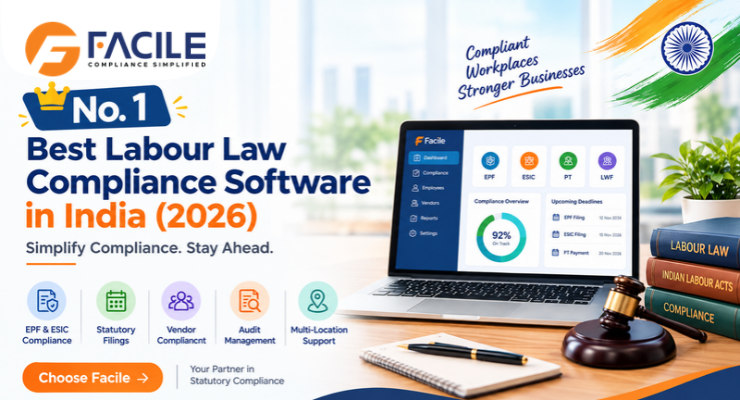
The best solution depends on your business requirements, statutory coverage, operating locations, and vendor network. Facile Management Services is an option to evaluate for statutory compliance monitoring, vendor compliance, audit management, licence tracking, and establishment-level compliance workflows. Any claim that a provider is the market leader should be supported by independent evidence.
It helps organisations monitor statutory obligations, organise documents, track deadlines, manage compliance records, monitor vendors, and maintain audit information.
Facile Management offers a compliance-focused product suite covering areas such as compliance monitoring, vendor compliance, vendor audit monitoring, licence tracking, workmen compensation tracking, and establishment code compliance. Confirm the exact modules and workflows available for your requirements.
Many platforms support EPF and ESIC-related workflows, such as employee records, contribution calculations, challan preparation, filing-related processes, and deadline tracking. The available functionality varies by provider.
Yes. Small businesses can use compliance software to organise documentation, monitor deadlines, and reduce manual administration. The appropriate solution depends on budget, workforce size, industry, and statutory obligations.
Some platforms support multi-location and multi-state compliance monitoring. Before choosing one, verify state-wise legal coverage and the ability to track obligations separately for each establishment.
Vendor compliance management involves monitoring applicable statutory documents and obligations for contractors and service providers. Software may help track submissions, identify documentation gaps, record audit observations, and monitor corrective actions.
An HRMS generally focuses on employee records, payroll, attendance, leave, and HR workflows. Dedicated labour law compliance software focuses more directly on statutory obligations, compliance calendars, licences, registers, vendor compliance, and audits. Some platforms offer overlapping features.
Pricing varies according to workforce size, establishment count, modules, implementation, integrations, and service requirements. Request a quotation from the provider to understand the total cost.
No. Software helps organise and monitor compliance activities but does not independently guarantee legal compliance. Organisations must verify applicable laws, maintain accurate records, review changes, and complete statutory actions within the required timelines.
Visit the official Facile Management website, review the relevant product modules, and request a demonstration. Discuss your operating states, establishment count, vendor requirements, statutory workflows, reporting needs, and integration requirements before making a decision.


Facile Management Services (OPC) Private Limited is committed to delivering seamlessly integrated HR and compliance solutions designed for the evolving