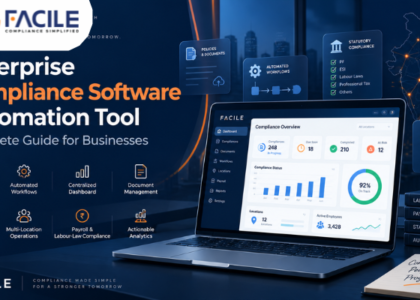


Managing third-party payroll involves more than processing salaries. Businesses must also ensure accurate attendance, wages, deductions, statutory contributions, payslips, bank payment proof, employee records, contractor documentation and compliance with applicable labour laws.
A Third Party Payroll Compliance Application helps organisations manage outsourced payroll and related statutory obligations through a centralised digital platform. This is especially useful for businesses working with large contractor workforces, staffing agencies, vendors and multiple locations.
FACILE’s existing third-party payroll service already covers salary processing, PF, ESIC, Professional Tax, Labour Welfare Fund, TDS, attendance integration, statutory filings and payroll reporting.
A Third Party Payroll Compliance Application is software designed to help businesses monitor and manage payroll and statutory compliance for employees whose payroll is handled by an external agency, staffing partner, contractor or payroll service provider.
It can help manage:
The objective is to maintain clear control and visibility even when payroll operations are outsourced.
Outsourcing payroll can reduce internal administrative work, but it does not eliminate the need for compliance oversight.
Businesses may still face risks such as:
FACILE notes that third-party payroll can become complex because of changing labour laws, multi-location processing, statutory calculations and contractor/vendor payroll requirements.
The application should maintain complete employee payroll information such as:
This provides the base for accurate payroll and compliance processing.
Payroll accuracy depends on attendance.
The system should support:
FACILE’s current third-party payroll offering includes attendance and leave integration as part of its payroll solution.
The application should help calculate:
Payroll calculations should be transparent and supported by statutory records.
Third-party payroll employees must be checked against applicable minimum wages.
The system should compare wages based on:
This helps prevent underpayment and related compliance risks.
The application should help track:
FACILE’s current payroll service specifically covers PF processing and statutory compliance.
The application should support:
For applicable States, the system should help manage:
The application should help monitor LWF obligations by State, including:
The system should generate or maintain digital payslips containing:
Digital payslips are among the payroll records FACILE currently provides through its platform.
Salary disbursement should be supported by clear payment evidence.
The application can maintain:
This is important during payroll audits.
The application should help maintain payroll registers showing:
This creates an audit-ready payroll record.
A Third Party Payroll Compliance Application should provide visibility across multiple payroll vendors or contractors.
It should allow monitoring of:
FACILE’s current service specifically supports contractor and vendor payroll monitoring.
The application should monitor applicable filings such as:
Each filing should ideally show:
A strong application should provide audit workflows to compare payroll documents.
The audit can verify:
This helps identify inconsistencies before an external audit or inspection.
Where a mismatch is found, the application should allow teams to record:
Businesses with employees across multiple States need location-wise compliance.
The system should support variations in:
FACILE’s current offering supports centralised payroll management for businesses operating across multiple locations and States.
A central dashboard can provide visibility over:
This helps management quickly identify high-risk vendors or payroll cycles.
A structured application can help businesses improve payroll accuracy, statutory compliance and vendor control.
Key benefits include:
FACILE also highlights cost efficiency, compliance assurance, data security, scalability and employee satisfaction as major benefits of outsourced payroll management.
Businesses should regularly verify:
It is useful for:
FACILE ONE can help organisations centralise payroll and statutory compliance monitoring for third-party employees, vendors and contractors.
Businesses can use FACILE ONE to support:
FACILE’s existing third-party payroll offering also includes automated payroll processing, real-time dashboards, digital employee records, statutory reminders, payroll gap analysis and audit-ready reports.
Third-party payroll compliance requires coordination between payroll providers, HR teams, contractors, finance teams and compliance teams.
FACILE ONE provides a structured platform where these records and activities can be reviewed centrally.
Key capabilities include:
Businesses should evaluate whether the platform supports:
The best solution should provide clear visibility over who was paid, how much was paid, whether statutory obligations were fulfilled, and whether supporting documents are available.
A Third Party Payroll Compliance Application helps businesses maintain control over outsourced payroll while improving statutory compliance, documentation and vendor visibility.
For organisations managing contractors, staffing partners or payroll vendors across multiple locations, FACILE ONE can help centralise payroll compliance and provide a stronger audit trail.
It is software used to manage and monitor payroll and statutory compliance for employees whose payroll is processed through an external payroll provider, contractor or staffing agency.
Even when payroll is outsourced, businesses need visibility over salary accuracy, minimum wages, statutory deductions, payroll documents and statutory filings.
Yes. It can help monitor employee contributions, employer contributions, ECR, challans, payment records and payroll reconciliation.
Yes. Employee wages can be compared against applicable State, zone, industry and skill-category minimum wage rates.
Yes. Attendance, leave, holidays, weekly offs, overtime and payable days can be integrated with payroll.
Yes. Payroll platforms can generate and store digital payslips for employees.
Yes. Salary transaction details, bank advice and payment proof can be maintained for payroll verification.
Yes. Contractor employees, attendance, wages, EPF, ESIC and related statutory documents can be monitored.
Yes. A central platform can provide vendor-wise and contractor-wise payroll compliance visibility.
Yes. Multi-state payroll compliance is important because minimum wages, PT, LWF and other requirements can vary by State.
Yes. Attendance, wage registers, payslips, payment proof, EPF and ESIC records can be cross-checked through an audit workflow.
FACILE’s existing service covers PF, ESIC, Professional Tax, Labour Welfare Fund, TDS and other payroll/statutory compliance activities.
Yes. FACILE states that its solutions support contractor and vendor payroll compliance monitoring.
Yes. FACILE supports multi-location payroll processing and State-specific compliance monitoring.


Facile Management Services (OPC) Private Limited is committed to delivering seamlessly integrated HR and compliance solutions designed for the evolving