

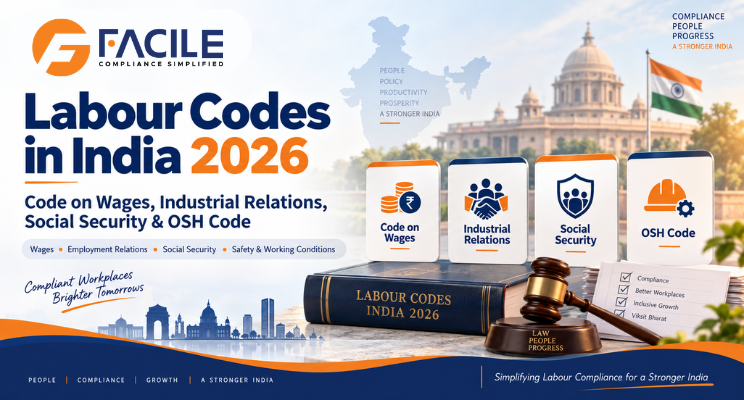
India’s labour-law framework has undergone a major restructuring through the consolidation of 29 Central labour laws into four Labour Codes. The Government brought all four Codes into force from 21 November 2025, making 2026 an important year for employers, HR teams, payroll professionals, factories, contractors and compliance teams to align their policies, payroll structures, registers, records and statutory processes with the new framework.
The four Labour Codes are:
FACILE provides dedicated e-Library references for each Code:
Industrial Relations Code, 2020
Occupational Safety, Health and Working Conditions Code, 2020
India previously had numerous Central labour laws governing wages, industrial disputes, social security, factories, contract labour, occupational safety and employment conditions.
The new Labour Code framework was designed to consolidate and simplify these laws into four broader Codes covering:
| Labour Code | Main Area |
|---|---|
| Code on Wages, 2019 | Wages, minimum wages, bonus and equal remuneration |
| Industrial Relations Code, 2020 | Industrial relations, trade unions, standing orders and industrial disputes |
| Code on Social Security, 2020 | EPF, ESIC, gratuity, maternity and social security |
| OSH & WC Code, 2020 | Safety, health and working conditions |
The Ministry of Labour and Employment states that implementation of the four Codes rationalized 29 existing Central labour laws.
The Code on Wages, 2019 consolidates key wage-related laws and establishes a common framework for wage payments, minimum wages, bonus and equal remuneration.
It affects employers across industries because wage compliance is directly connected with payroll.
The Code broadly covers:
One of the most important aspects of the Labour Codes is the standardized definition of wages.
The structure broadly considers specified remuneration components while excluding certain items subject to statutory conditions and limits.
This can affect:
Employers should therefore review salary structures rather than assuming that historical payroll definitions continue unchanged.
The Code expands the statutory minimum-wage framework and allows governments to prescribe minimum wages based on factors such as:
Employers should continue to monitor Central and State notifications for applicable wage rates and effective dates.
The Central Government may determine a floor wage after considering minimum living standards and geographical differences.
State minimum wages should operate within the framework prescribed under the Code.
Employers must ensure timely payment of wages according to the applicable wage period and prescribed requirements.
Payroll systems should therefore maintain controls for:
The Code also incorporates provisions dealing with statutory bonus.
Employers should verify:
The Code has direct implications for:
Read more:
The Industrial Relations Code, 2020 consolidates laws dealing with trade unions, industrial disputes and standing orders.
The Central Government formally appointed 21 November 2025 as the date on which the Code came into force.
The Code addresses:
The Code provides a framework for:
Where multiple registered trade unions operate within an establishment, the Code contains mechanisms for recognizing bargaining representation.
Industrial establishments meeting the applicable statutory threshold may be required to prepare and maintain standing orders dealing with matters such as:
Employers should review existing standing orders against the Code and applicable rules.
Covered establishments may need to maintain a Grievance Redressal Committee for resolving individual employee grievances.
This makes grievance governance an important part of industrial-relations compliance.
The Code establishes procedural requirements relating to strikes and lock-outs, including notice requirements in applicable circumstances.
HR and industrial-relations teams should therefore maintain structured processes for:
The Code regulates employer obligations relating to:
The Code introduces provisions for a worker re-skilling fund intended to support retrenched workers.
The Industrial Relations (Central) Rules, 2026 were notified on 8 May 2026 and came into force on the date of publication in the Official Gazette.
Employers should nevertheless identify whether the Central Government or a State Government is the appropriate government for their establishment because applicable subordinate rules can vary accordingly.
Read more:
Industrial Relations Code, 2020
The Code on Social Security, 2020 consolidates multiple social-security laws within a common statutory framework.
The Ministry of Labour and Employment confirmed that the Code was enforced from 21 November 2025.
The Code broadly covers:
EPF remains an important employer compliance area.
Employers should monitor:
ESI-related compliance can include:
The Code contains gratuity provisions and introduces important considerations for categories such as fixed-term employees.
Employers should review:
The Code brings maternity-related social-security provisions within the consolidated framework.
Employers should maintain policies and records relating to:
One of the significant features of the Code is recognition of:
The Ministry has specifically highlighted the Code’s goal of extending social-security coverage to organized, unorganized, gig, platform and self-employed workers.
The Central and State Governments may frame schemes under the Code for different classes of workers.
Compliance teams should therefore monitor subsequent:
Read more:
The Occupational Safety, Health and Working Conditions Code, 2020, commonly called the OSH Code, consolidates legislation dealing with workplace safety, health and conditions of employment.
All provisions were brought into force from 21 November 2025. The Ministry’s later draft Central Rules expressly record notification S.O. 5321(E) dated 21 November 2025 as bringing all provisions of the Code into force.
The OSH Code addresses:
Employers are expected to maintain safe workplaces and comply with applicable occupational-health and safety standards.
Compliance may include:
The OSH framework emphasizes formal employment documentation, including appointment letters for employees in covered establishments.
HR teams should therefore ensure employee records are properly documented.
Working hours, rest intervals, spread-over, weekly holidays and overtime requirements must be managed according to the Code and applicable rules.
The Code consolidates major provisions previously governed through separate contract-labour legislation.
Principal employers and contractors should review:
The Code contains specific provisions relating to inter-state migrant workers, including registration and welfare-related requirements in applicable circumstances.
Covered factories and establishments should monitor:
Following commencement of the Code, the Ministry published draft Occupational Safety, Health and Working Conditions Central Rules at the end of 2025 for stakeholder consultation.
Because labour is an area involving both Central and State rule-making, employers should determine the appropriate government applicable to each establishment and monitor the corresponding final rules.
Read more:
Occupational Safety, Health and Working Conditions Code, 2020
| Labour Code | Main Compliance Area | Major Employer Impact |
|---|---|---|
| Code on Wages, 2019 | Wages | Salary, minimum wages, bonus, deductions |
| Industrial Relations Code, 2020 | Industrial Relations | Standing orders, unions, disputes, retrenchment |
| Code on Social Security, 2020 | Social Security | PF, ESI, gratuity, maternity, social-security schemes |
| OSH & WC Code, 2020 | Safety & Working Conditions | Factories, safety, working hours, contract labour |
The Government of India implemented all four Labour Codes with effect from:
21 November 2025
This applies to:
The Ministry’s 2025 year-end review expressly confirms this implementation date and states that the four Codes rationalized 29 Central labour laws.
Implementation does not mean that every establishment follows one identical set of procedural rules nationwide.
The Codes allocate rule-making powers between:
Therefore, employers should monitor both:
Central Rules
Applicable where the Central Government is the appropriate government.
State Rules
Applicable where the relevant State Government is the appropriate government.
This is particularly important for multi-state organizations.
Employers should review:
The Labour Codes can affect payroll through changes involving:
Organizations should therefore align payroll configuration with legal and HR compliance rather than treating Labour Code implementation only as a legal-policy exercise.
Principal employers should also evaluate contractors under the new framework.
Important contractor controls include:
The new framework may alter the form, format or consolidation of statutory records.
Employers should monitor applicable Rules for requirements relating to:
The prescribed forms can differ between Central and State Rules.
A company with establishments in several states cannot rely only on Central-level implementation information.
It should track:
Code → State → Rules → Effective Date → Register → Return → Compliance Activity
For example, the same Labour Code may be in force nationally while individual states prescribe their own procedural forms, registers and authorities through State Rules.
Payroll may continue using historical wage definitions without reviewing the Code.
Employees may be assigned to the wrong skill, zone or scheduled-employment category.
Teams may track Central Rules while overlooking applicable State Rules.
Businesses may continue using superseded statutory formats.
Principal employers may fail to align contractor documentation with the new framework.
A Code, Rule or amendment may be applied from the wrong date.
Draft notifications should not automatically be treated as final enforceable rules.
FACILE can support organizations in organizing Labour Code requirements across:
A centralized compliance workflow helps HR, payroll and legal teams understand which statutory requirement applies to each location.
Explore the four Codes individually:
Code on Wages, 2019
https://www.facilemanagement.com/e-library/code-on-wages-2019
Industrial Relations Code, 2020
https://www.facilemanagement.com/e-library/industrial-relations-code-2020
Code on Social Security, 2020
https://www.facilemanagement.com/e-library/code-on-social-security-2020
Occupational Safety, Health and Working Conditions Code, 2020
https://www.facilemanagement.com/e-library/osh-code-2020
The four Labour Codes represent one of the largest restructurings of India’s labour-law framework.
From 21 November 2025, the four Codes provide the statutory foundation for wage regulation, industrial relations, social security and occupational safety and working conditions.
For employers in 2026, effective compliance requires more than simply knowing that the Codes have commenced. Organizations should identify the applicable Central or State Rules, effective dates, payroll impact, registers, returns, licences, employee categories and contractor obligations for every establishment.
A structured state-wise Labour Code compliance system can help organizations manage these changes while maintaining accurate payroll, statutory documentation and audit readiness.
The four Labour Codes are the Code on Wages, 2019; Industrial Relations Code, 2020; Code on Social Security, 2020; and Occupational Safety, Health and Working Conditions Code, 2020.
All four Labour Codes were implemented with effect from 21 November 2025.
The Ministry of Labour and Employment states that the four Codes rationalized 29 existing Central labour laws.
It broadly covers minimum wages, wage payment, bonus, equal remuneration and the statutory definition of wages.
It governs areas including trade unions, standing orders, industrial disputes, strikes, lock-outs, retrenchment and closure.
It consolidates social-security provisions relating to areas such as EPF, ESIC, gratuity, maternity benefits and schemes for unorganized, gig and platform workers.
It deals with occupational safety, health, working conditions, factories, contract labour, inter-state migrant workers and related establishment obligations.
No. Its wage framework has broad application according to the provisions of the Code and applicable rules.
The Codes introduce a standardized statutory framework for determining which remuneration components are included or excluded from wages. Employers should review the precise statutory definition before restructuring salary.
Potentially yes. The wage definition can affect payroll structure and calculations connected with social-security and employment benefits.
Yes. Minimum-wage regulation is a major component of the Code.
Yes. The Code recognizes gig and platform workers and enables social-security schemes for such categories.
Yes. Contract-labour regulation is incorporated into the OSH and Working Conditions framework.
Yes. Employers should identify whether the Central or State Government is the appropriate government and follow the applicable subordinate Rules.
No. States may prescribe their own Rules, forms, authorities and procedural requirements under the Codes.
Yes. The Industrial Relations (Central) Rules, 2026 were notified on 8 May 2026 and came into force on publication in the Official Gazette.
No. Draft Rules are published for consultation and should not automatically be treated as final enforceable Rules.
Employers should verify applicable Central or State Rules because prescribed register formats and consolidated records may change.
Yes. Contractor payroll, wages, social-security compliance, licensing, safety and worker records can be affected by the Codes.
They should maintain a state-wise framework linking each Code with the applicable Rules, effective dates, registers, returns, licences and compliance activities.
No. EPF continues within the consolidated social-security framework rather than being eliminated.
No. ESI continues as part of the social-security framework.
Yes. Standing orders remain an important area regulated under the Industrial Relations Code.
Yes. Occupational safety and health are central components of the Code.
FACILE provides separate e-Library pages for the Code on Wages, Industrial Relations Code, Social Security Code and OSH Code for easier compliance reference.


Facile Management Services (OPC) Private Limited is committed to delivering seamlessly integrated HR and compliance solutions designed for the evolving