
India offers multinational companies (MNCs) significant opportunities for business expansion, workforce development, and operational growth. However, managing an establishment in India involves navigating a range of legal, employment, payroll, workplace safety, and statutory compliance requirements.
For multinational companies operating across multiple states, compliance can become particularly complex. Different locations may have different registration requirements, employment conditions, reporting obligations, and administrative procedures. Companies must also coordinate their global HR policies with applicable Indian laws.
An Establishment Compliance Checklist for MNCs in India helps organizations organize their legal obligations, monitor important deadlines, maintain documentation, and establish consistent compliance processes across locations.
This guide explains the major compliance areas that multinational companies should review when setting up or managing their Indian establishments.
Establishment compliance refers to meeting the applicable legal and statutory obligations associated with operating a business, office, commercial establishment, factory, or other workplace in India.
Depending on the nature of the business, employee strength, location, and operational activities, these obligations may include:
The requirements applicable to an organization should be determined based on its specific circumstances and the legislation in force.
MNCs often operate through multiple offices, subsidiaries, branches, factories, shared service centres, or outsourced service providers. Managing these operations requires a structured approach to statutory compliance.
Key reasons include:
Organizations must identify and comply with applicable central and state laws, rules, notifications, and regulatory requirements.
A standardized compliance framework helps corporate HR and legal teams monitor obligations across different establishments while accounting for local requirements.
Correct wage payments, social security contributions, safe working conditions, and appropriate workplace policies support employee welfare.
Regular monitoring helps identify missed filings, incomplete documentation, registration gaps, and overdue corrective actions before they develop into larger problems.
Accurate records and clear accountability improve internal reporting, support audits, and help demonstrate that compliance responsibilities are being actively managed.
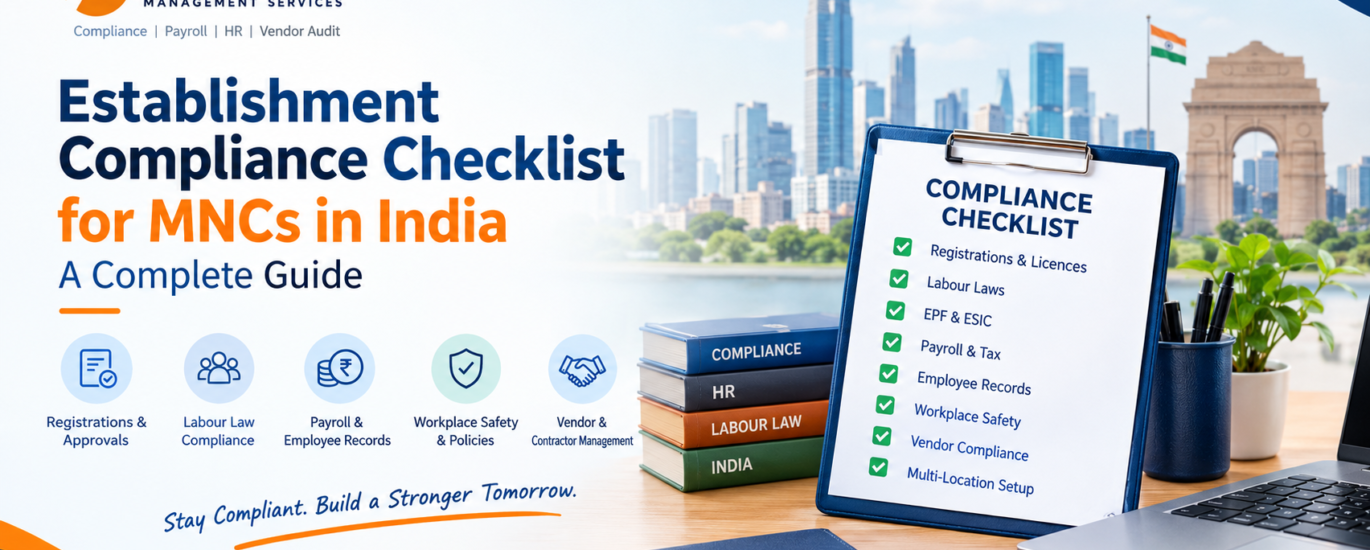
Use the following checklist as a starting point for reviewing your organization’s compliance framework.
Before commencing operations, confirm that the legal entity and each relevant establishment have the registrations and approvals required for their activities.
Checklist:
Requirements depend on the establishment’s business activities, location, workforce, and applicable law. State-specific requirements should be reviewed separately for each location.
Labour law compliance is a major responsibility for multinational employers in India.
India’s four Labour Codes came into effect on 21 November 2025, and the Central Rules were notified on 8 May 2026, according to the Ministry of Labour and Employment. MNCs should review the current framework, applicable rules, notifications, and relevant state-level requirements before finalizing their compliance processes. Official update.
Checklist:
MNCs should not rely solely on a global employee handbook. Indian employment policies and procedures should be reviewed against the applicable Indian legal framework.
Employee social security compliance requires particular attention when hiring employees or opening new establishments.
Checklist:
The Ministry’s published Labour Code guidance identifies EPFO coverage for establishments employing 20 or more employees and mandatory ESIC coverage for establishments with more than 10 employees, with additional provisions for certain hazardous establishments. Actual coverage and transitional requirements should be verified against current law and applicable notifications. Government guidance.
Payroll compliance involves more than calculating monthly salaries. Employers must apply relevant wage requirements, statutory deductions, contribution rules, and tax obligations correctly.
Checklist:
For MNCs, payroll teams should coordinate with HR, finance, tax, and compliance teams to maintain consistency between employee records and statutory reporting.
Accurate employee documentation supports employment administration, statutory reporting, and audit readiness.
Checklist:
Employee information should be collected, stored, used, and retained in accordance with applicable law and the organization’s information security policies.
The Sexual Harassment of Women at Workplace (Prevention, Prohibition and Redressal) Act, 2013, commonly known as the POSH Act, establishes workplace protections and complaint-redressal requirements.
Checklist:
Under the POSH Act, an Internal Committee is generally required at workplaces with 10 or more employees. Employers should also verify applicable Local Committee arrangements and reporting obligations.
MNCs frequently rely on contractors for security, housekeeping, facility management, logistics, manufacturing, and other services. These arrangements require appropriate vendor due diligence and ongoing monitoring.
Checklist:
Principal employers should review their own statutory responsibilities rather than assuming that outsourcing transfers all legal obligations to the contractor.
Workplace safety requirements depend on the type of establishment, work performed, workforce, and applicable legal provisions.
Checklist:
MNCs should ensure that their global health and safety standards are aligned with Indian statutory requirements.
A reliable compliance calendar is essential for monitoring recurring obligations.
Checklist:
A centralized compliance tracker can help teams manage deadlines and documentation across multiple locations.
MNCs operating in several Indian states need a framework that balances central oversight with local legal requirements.
Checklist:
A structured framework helps corporate teams compare compliance status across locations without overlooking state-specific obligations.
Managing compliance through disconnected spreadsheets, emails, and manual reminders can make it difficult to monitor deadlines and obtain a consistent view of risk.
Compliance management software can support a more organized process by helping teams:
The exact benefits depend on the software’s capabilities, implementation, and quality of the information maintained. Software supports compliance management but does not replace legal interpretation, professional advice, or timely action by the employer.
Multinational organizations may encounter several recurring challenges:
Changing regulations: Keeping track of new rules, notifications, and state-level requirements.
Multiple locations: Maintaining consistent compliance processes across different states.
Fragmented records: Managing documentation across HR, finance, legal, procurement, and operations.
Vendor dependency: Obtaining accurate and timely compliance information from contractors.
Missed deadlines: Monitoring renewals, returns, payments, and other recurring obligations.
Limited visibility: Identifying overdue tasks and unresolved issues before they affect operations.
A clear compliance ownership structure, periodic reviews, reliable records, and suitable digital tools can help address these challenges.
An establishment compliance checklist is an important starting point for MNCs operating in India. From business registrations and labour law compliance to payroll, employee documentation, workplace safety, and vendor audits, every applicable obligation needs clear ownership and regular monitoring.
A well-designed compliance framework should combine legal review, location-specific requirements, standardized processes, and reliable documentation. For organizations operating across multiple states, centralized monitoring can help improve visibility while preserving the flexibility required for local compliance.
Facile Management Services helps businesses explore compliance management, payroll, vendor audit, and related statutory compliance support.
Visit www.facilemanagement.com to learn more.
Contact Facile Management Services
Email: Info@facilemanagement.com
Phone: +91 91760 67399
Disclaimer: This article is for general informational purposes and is not legal advice. The applicability of individual laws, rules, registrations, and deadlines depends on the establishment, location, workforce, activities, and current legal notifications. Consult qualified legal or compliance professionals to validate your organization’s obligations.
It is a structured list of applicable registrations, labour law requirements, payroll obligations, employee records, workplace policies, contractor requirements, and statutory filings that a multinational company should review for its Indian operations.
Depending on the business and location, registrations may include incorporation-related registrations, Shops and Establishments registration, EPFO and ESIC registrations, professional tax registration, factory-related approvals, and applicable local permissions.
Yes. Certain employment, commercial establishment, professional tax, and local approval requirements vary by state. MNCs should review the rules applicable to each establishment and its activities.
MNCs should review the four Labour Codes that came into effect on 21 November 2025, the Central Rules notified in May 2026, applicable state rules, subsequent notifications, and any transitional requirements relevant to their operations.
EPF and ESIC compliance helps employers meet applicable social security obligations, maintain accurate employee records, and ensure eligible employees receive relevant statutory benefits.
They can maintain a centralized compliance register, create location-specific calendars, assign accountable owners, standardize evidence collection, conduct periodic reviews, and use suitable compliance management software.
Vendor audits help organizations review relevant contractor documentation, identify potential statutory gaps, monitor corrective actions, and maintain evidence of compliance reviews.
The review frequency should reflect statutory requirements, operational risk, business changes, and internal policies. Many organizations use recurring monthly monitoring alongside periodic comprehensive audits and event-based reviews.
Yes. Suitable software can improve deadline tracking, documentation, task ownership, reporting, and visibility into unresolved issues. Its effectiveness depends on accurate data, appropriate configuration, and timely follow-up.
Facile Management Services offers compliance-related services covering areas such as compliance management, payroll, and vendor audits. Businesses can contact the team to discuss their requirements and determine suitable support.


Facile Management Services (OPC) Private Limited is committed to delivering seamlessly integrated HR and compliance solutions designed for the evolving