
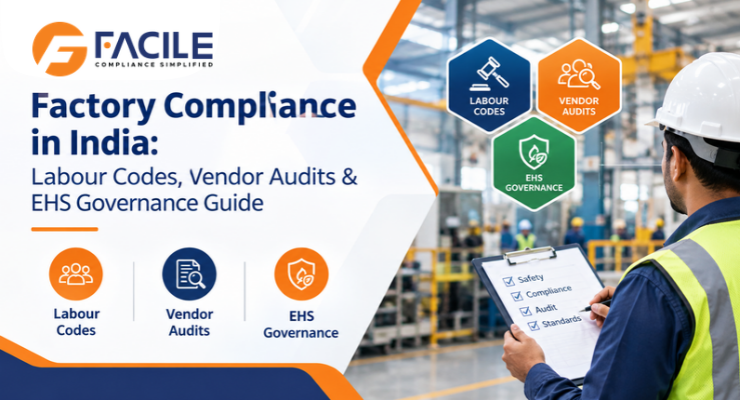
Factory compliance is a critical responsibility for manufacturing businesses in India. It involves meeting applicable labour laws, maintaining statutory records, ensuring employee welfare, monitoring contractors and vendors, and maintaining environmental, health and safety standards.
As manufacturing operations expand, compliance becomes more complex. Factories may need to coordinate multiple departments, contractors, staffing agencies, suppliers and external service providers while keeping documentation accurate and audit-ready.
The implementation of India’s four Labour Codes from 21 November 2025 has made it particularly important for businesses to review their existing compliance processes and align them with applicable central and state requirements.
This guide explains the major areas of factory compliance in India, the role of labour codes, how vendor audits support risk management, and how Environmental, Health and Safety (EHS) governance can strengthen compliance operations.
Factory compliance refers to the processes and controls that help manufacturing establishments meet applicable legal, statutory, employment, workplace safety and operational requirements.
Depending on the factory’s location, workforce size, manufacturing activities and risk profile, these requirements may involve labour regulations, wage payments, social security contributions, factory registration, workplace safety, environmental permissions and contractor management.
Effective factory compliance management helps businesses:
Rather than treating compliance as a monthly paperwork exercise, manufacturers should establish a structured system that connects HR, payroll, legal, procurement, plant operations and EHS teams.
India’s four Labour Codes consolidate provisions from 29 existing central labour laws. The government announced their implementation with effect from 21 November 2025, with subsequent central and state rulemaking shaping the detailed compliance framework.
Manufacturers should review how these codes apply to their establishments, employment arrangements and operating locations.
1. Code on Wages, 2019
Covers the wage-related framework, including minimum wages, payment of wages, bonus and equal remuneration provisions. Factories should review wage structures, payroll calculations, overtime payments and applicable minimum wage notifications.
2. Industrial Relations Code, 2020
Addresses industrial relations, trade unions, standing orders and mechanisms for resolving industrial disputes. Employers should review applicable requirements relating to employee relations, disciplinary processes and workforce changes.
3. Code on Social Security, 2020
Covers the statutory framework for social security benefits, including provident fund, employee state insurance, gratuity and other applicable benefits. Factories should verify coverage, eligibility, contributions, records and filings.
4. Occupational Safety, Health and Working Conditions Code, 2020
Addresses workplace health, safety, welfare and working conditions, including relevant factory and contract labour requirements. Businesses should assess workplace hazards, protective equipment, training, working conditions and applicable registration and licensing obligations.
Reference: Government of India, Ministry of Labour and Employment.
Factories should conduct a structured compliance review covering:
Important: Compliance obligations depend on the applicable law, establishment category, workforce, activities and jurisdiction. Verify current notifications and rules for each factory location rather than relying solely on historical checklists.
Factory statutory compliance extends beyond understanding legislation. It also requires maintaining evidence that the applicable obligations have been fulfilled.
| Compliance area | What to review |
|---|---|
| Factory registration and licences | Applicable registrations, approvals, renewals and licence conditions |
| Payroll and wages | Minimum wages, wage records, overtime and timely payment |
| Social security | Applicable EPF, ESIC and other statutory coverage and contributions |
| Working conditions | Hours of work, rest intervals, leave and other applicable conditions |
| Employee documentation | Appointment records, attendance and employment-related documents |
| Contractor compliance | Contractor records, worker details, wage evidence and applicable statutory documents |
| Safety and welfare | Risk assessments, safety training, protective equipment and incident records |
| Statutory registers and returns | Applicable registers, filings, notices and submission deadlines |
The specific requirements and documents must be mapped to current central legislation, state rules, notifications and the factory’s circumstances. The Ministry of Labour and Employment provides official resources for labour legislation and the new Labour Codes.
Manufacturers frequently engage third-party vendors, contractors, manpower agencies, transport providers, maintenance teams and other service providers.
These relationships can create compliance risks when a vendor fails to maintain accurate workforce records, meet wage obligations, make applicable statutory contributions or provide required safety training.
A vendor compliance audit helps the factory assess whether its service providers meet contractual, statutory and workplace requirements.
Vendor documentation and onboarding
Verify applicable registrations, licences, agreements, authorised representatives, workforce information and required supporting documents before engagement.
Worker attendance and wage verification
Compare attendance, working hours, overtime and wage records. Check whether payments meet applicable legal requirements and whether supporting evidence is available.
Statutory contribution verification
Review applicable EPF, ESIC and other statutory records, challans, returns and supporting evidence to identify discrepancies.
Workplace safety and training
Check site induction, personal protective equipment, permits to work, safety training and other controls appropriate to the contractor’s activities.
The audit frequency should reflect the risk level, the type of work performed, workforce size, past findings and applicable legal or contractual requirements.
A practical approach is to conduct:
Vendor audits should conclude with documented findings, assigned corrective actions, accountable owners and target completion dates.
Environmental, Health and Safety governance helps factories manage workplace hazards, environmental responsibilities and operational risks through defined policies, accountability and monitoring.
Labour compliance and EHS overlap, but they are not identical. A factory may maintain wage records correctly and still have gaps in machine guarding, emergency preparedness, chemical handling or environmental permissions.
Environmental management
Health and safety management
Governance and accountability
The exact environmental requirements depend on the factory’s industry, processes, pollution category and applicable central and state regulations. Workplace safety obligations likewise depend on the applicable legal framework and establishment conditions.
Even businesses with experienced compliance teams can struggle when information is distributed across departments, plants and external vendors.
| Challenge | Recommended improvement |
|---|---|
| Missed filing and renewal dates | Maintain a centralised compliance calendar with reminders |
| Incomplete statutory documentation | Define document owners and standardised checklists |
| Vendor records received late | Establish vendor submission schedules and escalation rules |
| Payroll discrepancies | Reconcile attendance, wage calculations and payment evidence |
| Limited visibility across locations | Use consolidated dashboards and location-wise reporting |
| Repeated audit observations | Track root causes and verify corrective actions |
| Manual spreadsheets and email follow-ups | Introduce controlled workflows and centralised document storage |
The objective is not simply to collect documents. It is to make compliance obligations visible, verifiable and actionable.
Compliance automation can help manufacturing businesses coordinate obligations, evidence, vendors and deadlines through a centralised system.
For factories operating across multiple locations, automation can reduce dependence on individual spreadsheets and manual follow-ups.
Key capabilities to consider include:
Automation supports compliance management, but it does not guarantee legal compliance by itself. Accurate source data, competent review, clear ownership and updates reflecting applicable legal changes remain essential.
Facile Management can position its factory compliance, labour law compliance, vendor audit, payroll compliance and compliance automation services around a unified approach to risk management.
Businesses evaluating compliance support should look for processes that help them:
The most suitable approach depends on the organisation’s factory footprint, vendor network, internal resources and applicable statutory obligations.
Use this practical checklist as a starting point for an internal review. Tailor it to the factory’s applicable legal requirements.
Verify applicable factory registrations, licences and approvalsReview the latest applicable Labour Code rules and state notificationsValidate wage structures, attendance, overtime and payroll recordsReview applicable EPF, ESIC and other statutory contribution evidenceCheck employment and contractor workforce documentationVerify vendor registrations, licences and contractual requirementsReview safety inspections, training and incident recordsCheck environmental consents, monitoring and waste documentationConfirm statutory registers, returns and filing deadlinesAssign owners and due dates for open audit findingsReview renewals, corrective actions and management reports
Reset checklistCopy checklist
Factory compliance in India requires a coordinated approach to labour legislation, payroll, statutory documentation, vendor audits and EHS governance.
As manufacturing operations grow, manual processes can make it harder to monitor obligations, verify vendor records and resolve audit findings on time. A structured compliance framework, supported by well-defined ownership and appropriate automation, can improve transparency and help businesses identify risks earlier.
Manufacturers should periodically review their compliance framework against current central and state requirements, assess contractor and vendor risks, and maintain reliable evidence of their compliance activities.
Facile Management can help businesses explore a more structured approach to factory compliance, vendor audits, payroll compliance and compliance automation.
Factory compliance in India refers to meeting the applicable legal and statutory requirements relating to factory operations, labour, wages, social security, working conditions, workplace safety, environmental responsibilities and documentation.
The four Labour Codes are the Code on Wages, 2019; Industrial Relations Code, 2020; Code on Social Security, 2020; and Occupational Safety, Health and Working Conditions Code, 2020. They were made effective from 21 November 2025, with detailed implementation requirements governed by the applicable rules and notifications.
Depending on the establishment and applicable laws, audits may review registrations, licences, wage and attendance records, employment documents, statutory registers, applicable social security records, contractor documentation, safety training records, environmental approvals and filing evidence.
A vendor compliance audit evaluates whether a supplier, contractor or service provider meets relevant legal, contractual and operational requirements. It may include checks on workforce documentation, wages, statutory contributions, licences and workplace safety.
Contractor compliance helps manufacturers monitor workforce documentation, applicable wage and social security obligations, site safety and contractual requirements. Regular verification can help identify gaps before they develop into larger legal or operational risks.
EHS governance is the system of policies, responsibilities, procedures and monitoring used to manage environmental, health and safety risks. It can include workplace inspections, risk assessments, incident investigations, safety training and environmental monitoring.
Compliance automation can help centralise compliance calendars, document management, vendor submissions, reminders, audit findings and management reporting. Its effectiveness depends on accurate data, appropriate configuration and regular review by responsible personnel.
Audit frequency depends on applicable legal requirements, the factory’s risk profile, contractor activities, customer requirements and previous audit findings. Businesses can combine periodic reviews with additional audits triggered by incidents or identified discrepancies.
Non-compliance may result in statutory penalties, legal disputes, remediation costs, operational disruption, safety incidents and reputational damage. The consequences depend on the specific requirement, facts and applicable law.
Facile Management’s relevant service areas include factory compliance, labour law compliance, vendor audits, payroll and contractor compliance, and compliance automation. Businesses can evaluate these services according to their operational requirements and need for ongoing compliance support.


Facile Management Services (OPC) Private Limited is committed to delivering seamlessly integrated HR and compliance solutions designed for the evolving