
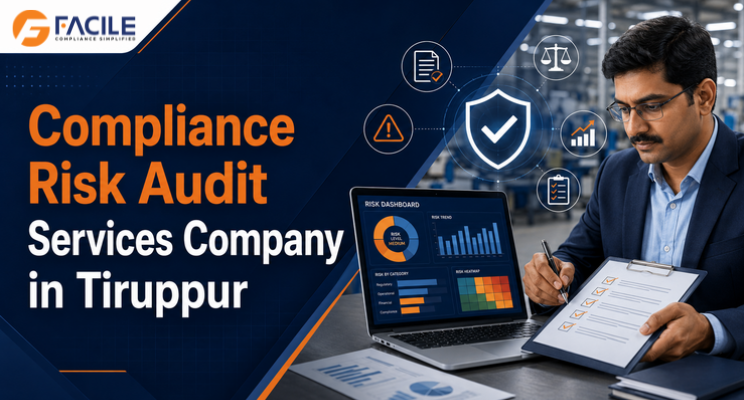
Every business faces compliance risks. These risks may arise from delayed statutory payments, inaccurate payroll, incomplete employee records, expired licences, contractor non-compliance, missing registers or ineffective internal monitoring.
A minor documentation issue can develop into a larger concern when it remains unidentified for several months. Repeated non-compliance may result in employee grievances, financial exposure, operational interruptions, audit observations and reputational damage.
Businesses in Tiruppur often manage large workforces, multiple factories, contractors, vendors, shifts and statutory obligations. Monitoring every requirement through spreadsheets and manual follow-ups can be difficult, particularly when compliance information is distributed across departments and locations.
An experienced compliance risk audit services company in Tiruppur can help businesses identify weaknesses, assess their potential impact and implement corrective measures before risks escalate.
This guide explains compliance risk audits, the areas generally reviewed, the audit process, common findings and the advantages of obtaining professional compliance support.
A compliance risk audit is a systematic assessment of an organisation’s practices, records and controls against applicable statutory, regulatory, contractual and internal requirements.
The audit is designed to answer important questions:
A compliance risk audit goes beyond confirming whether a document is available. It verifies whether the document is valid, accurate, applicable to the correct establishment and supported by the underlying employee, payroll or operational records.
For example, the availability of a statutory payment challan does not independently establish complete compliance. The audit may also need to confirm whether all applicable employees were included, whether the wage values match payroll and whether the payment relates to the correct period.
Compliance requirements affect many areas of a business, including recruitment, attendance, wages, social-security contributions, working conditions, contractor management and licence renewals.
When responsibilities are divided between HR, payroll, finance, administration, factory management and external vendors, important activities can be overlooked.
A structured compliance risk audit helps businesses:
The Ministry of Labour and Employment has published an employer compliance handbook under India’s labour-code framework. The handbook itself states that it is a reference document and that the applicable legislation prevails if there is any discrepancy. Businesses should therefore verify the latest Central and Tamil Nadu notifications before applying a specific requirement. Ministry of Labour and Employment compliance handbook
Tiruppur is known for textiles, garment manufacturing, dyeing, printing, exporting, engineering, logistics, warehousing and supporting service industries.
Many establishments operate through:
These operating conditions can create compliance risks if employee information, attendance, payroll, contractor documents and statutory records are not regularly reconciled.
Common concerns include employees appearing in attendance but missing from payroll, wage rates not reflecting the applicable classification, contractors exceeding approved headcount, statutory wages differing from payroll and licences expiring without timely renewal.
A professional audit brings these records together and provides management with a consolidated view of the organisation’s compliance position.
The exact audit scope depends on the business, workforce, industry, locations and applicable requirements. The following areas are commonly reviewed.
The audit verifies whether required registrations, licences, certificates and approvals are available and valid.
The review may include:
The auditor may compare licence details with actual operations and workforce deployment. Differences in the establishment name, address, nature of work or employee strength may require further review.
Employee information forms the foundation of payroll and statutory compliance.
The audit may examine:
Employee records should be consistent across HR, attendance, payroll and statutory systems.
Attendance directly affects wages, overtime, leave and statutory calculations.
The audit may review:
Unapproved changes or inconsistencies between attendance and payroll should be documented and investigated.
Payroll auditing examines whether employees have been paid correctly based on approved attendance, wage rates and salary structures.
The review may cover:
The wage register, payslip and payment record should show consistent employee-wise amounts. Manual adjustments should have proper explanations and approvals.
Employees should be mapped to the appropriate category, skill level, industry and work location before the applicable wage requirement is assessed.
The audit may identify:
Applicable rates and notifications can change. Businesses should verify current official notifications before completing the audit or processing corrections.
Where EPF requirements apply, payroll information may be compared with employee-wise contribution records.
The audit may check:
For contract workers, EPFO provides an online facility through which principal employers can link outsourced contracts with contract employers and monitor relevant compliance information. EPFO principal-employer facility
EPFO’s employer guidance also indicates that principal employers should confirm that contractors have enrolled and complied for eligible contract employees before clearing their bills. EPFO employer FAQs
Where ESIC applies, the audit may compare employee eligibility, payroll wages and contribution records.
The review may include:
The governing framework also requires prescribed records to be maintained by principal and immediate employers. Businesses should confirm the current applicability and procedures through the Employees’ State Insurance Corporation.
Where applicable, the auditor may review:
The correct treatment may vary by state, local jurisdiction and employee circumstances.
Contractors can create significant compliance exposure when their records are accepted without verification.
A contractor audit may cover:
Attendance, payroll, payment and statutory records should be compared employee by employee wherever practical.
The audit may assess whether required records are maintained accurately and are available for the correct establishment and period.
Depending on applicability, the review may include:
The required format and retention period should be confirmed according to the applicable legal framework.
A broader risk audit may also examine operational and workplace controls such as:
Technical safety inspections should be conducted by appropriately qualified professionals wherever specialist certification is required.
The audit begins by understanding the organisation’s:
This information helps determine the audit scope and applicable checklist.
Applicable compliance activities are mapped by law, establishment, department, frequency and responsible person.
Each requirement may be classified as:
The compliance register should also identify the required document, due date, reviewer and supporting evidence.
The organisation provides documents for the agreed audit period. A standard document request list reduces repeated follow-ups and helps departments submit information consistently.
Submitted files are checked for:
This is one of the most important stages of the audit.
The auditor may compare:
Cross-verification helps identify risks that cannot be detected by reviewing documents individually.
Every identified gap is documented with sufficient detail.
A good observation should contain:
Observations may be classified according to their seriousness.
Risk levels should be supported by evidence rather than assigned only through a subjective impression.
Management and the responsible department should agree on:
High-risk observations should not remain open merely because documentation is still being collected.
An observation should be marked as closed only after the submitted evidence has been reviewed.
Evidence may include:
Verbal confirmation alone generally does not provide adequate closure evidence.
The final audit report may include:
The report should enable decision-makers to quickly identify the most significant risks and assign resources accordingly.
Frequently identified issues include:
Regular audits identify non-compliance before it develops into a larger operational or financial problem.
Attendance, wages, deductions and payments are systematically reconciled.
Employee-level verification improves contractor accountability and reduces dependence on declarations alone.
Dashboards and risk reports show critical observations, delayed activities and recurring issues.
The audit identifies weaknesses in approvals, responsibility allocation, document storage and verification.
Organised records and documented corrective actions make information easier to retrieve during reviews.
Root-cause analysis and preventive action help avoid the recurrence of the same non-compliance.
A common audit checklist helps organisations apply consistent compliance standards across different units.
A digital compliance platform can centralise requirements, documents, due dates and audit observations.
Useful features may include:
Technology improves visibility and traceability, while experienced professionals remain important for evaluating applicability and reviewing complex exceptions.
FACILE Management Services supports businesses with structured, evidence-based compliance risk auditing.
Our services can include:
Our objective is to help businesses identify compliance gaps, prioritise corrective actions and maintain reliable, audit-ready records.
Compliance risk management should be a continuous business process rather than an activity performed only after receiving an inspection notice.
Employee records, attendance, payroll, statutory payments, contractor documents, registrations and licences must remain accurate and aligned. Reviewing these areas separately may allow important differences to remain unnoticed.
A professional compliance risk audit services company in Tiruppur can help businesses examine records together, identify high-risk gaps and establish accountable corrective-action processes.
Regular audits give management better visibility, strengthen internal controls and help departments resolve issues before they become recurring problems.
For professional compliance risk audit services, contact FACILE Management Services.
📧 Info@facilemanagement.com
📞 +91 91760 67399
🌐 www.facilemanagement.com
A compliance risk audit is a structured assessment of an organisation’s records, processes and controls to identify statutory, payroll, contractor, licence and documentation risks.
It helps the business identify non-compliance early, prioritise corrective actions, improve internal controls and prepare organised records for management or statutory reviews.
The frequency depends on workforce size, industry, operating risk and compliance history. High-risk areas may require monthly reviews, while broader audits may be conducted quarterly, half-yearly or annually.
Common documents include employee records, attendance, payroll, wage registers, payslips, bank-payment evidence, statutory statements, challans, licences, returns and contractor records.
Yes. Audits can be conducted separately for each unit, with consolidated risk reporting for management.
Yes. The audit can review contractor licences, employee records, attendance, wages, bank payments and employee-wise statutory information.
Yes. Payroll wages and deductions can be compared with EPF, ESIC and other applicable records to identify missing employees and differences.
It is the process of categorising observations as critical, high, medium, low or advisory based on their potential impact and urgency.
The responsible department completes the corrective action and submits supporting evidence. The auditor reviews the evidence before marking the observation as closed.
Yes. Registration and licence validity, renewal dates, permitted headcount and available acknowledgements can be reviewed.
No audit can eliminate every risk. However, a properly conducted audit can identify significant gaps, improve controls and support timely corrective action.
Yes. Previous observations can be compared with current findings to identify repeated issues and overdue corrective actions.
Payroll and employee information should be handled through controlled access, secure transfer procedures and appropriate data-retention practices.
Technology can automate reminders, document tracking, expiry alerts, dashboards and workflow management. Professional review is still needed to assess applicability and interpret exceptions.
FACILE can help organise records, prepare reconciliations and provide factual supporting documentation. Qualified legal advice should be obtained where formal interpretation or representation is required.
Share your industry, employee strength, contractor count, locations, current compliance process and preferred audit period with FACILE. The team can assess the requirements and recommend an appropriate audit scope.


Facile Management Services (OPC) Private Limited is committed to delivering seamlessly integrated HR and compliance solutions designed for the evolving