
Managing labour law, payroll and statutory compliance is a critical responsibility for every growing organisation. Businesses must identify applicable legal requirements, maintain accurate employee records, process wages correctly, complete statutory payments, monitor contractors, renew licences and remain prepared for inspections.
Even when routine filings appear complete, hidden compliance gaps may exist within payroll calculations, employee eligibility, minimum wages, statutory contributions, contractor documents, registers or supporting records. These gaps can result in interest, damages, penalties, employee grievances, customer audit observations and reputational risk.
A Compliance Risk Audit helps an organisation identify these weaknesses before they develop into serious problems. It evaluates not only whether a document has been submitted but also whether the information in that document is accurate, complete, applicable and supported by evidence.
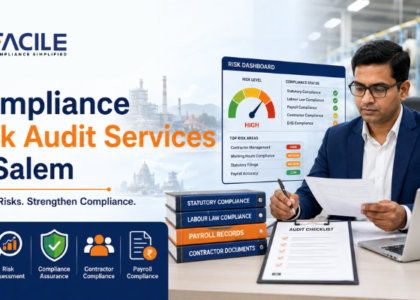
Businesses looking for a dependable Compliance Risk Audit Services Company in Coimbatore can partner with Facile Management Services (OPC) Private Limited for structured audits, payroll validation, contractor compliance reviews, corrective-action monitoring and inspection-readiness support.
A Compliance Risk Audit is a systematic examination of an organisation’s statutory, payroll, employee and contractor records to determine whether applicable legal obligations have been fulfilled correctly.
The audit generally evaluates:
The purpose is not limited to identifying missing documents. A strong audit examines the entire compliance trail, including source data, calculations, payments, filings, approvals and supporting evidence.
For example, the availability of an EPF challan alone does not establish complete compliance. The auditor may also verify whether all eligible employees were included, wages were correctly considered, contribution amounts matched payroll deductions and payment evidence was available.
Coimbatore is a major industrial and commercial centre with businesses operating across sectors such as:
These organisations may employ permanent employees, trainees, apprentices, contract workers, consultants and temporary personnel across different shifts and locations.
Compliance complexity increases when a business:
A compliance framework that was suitable for a small establishment may become inadequate after business expansion. Regular audits help management reassess applicability and ensure that compliance processes grow with the organisation.
Compliance filing focuses on completing a specific return, payment, register or statutory activity. A Compliance Risk Audit evaluates whether the complete process is accurate and legally appropriate.
For example, during an ESIC review, filing may confirm that a monthly contribution was submitted. An audit may additionally check:
Therefore, filing is one compliance activity, while auditing examines the effectiveness and accuracy of the overall compliance system.
The first stage of a risk audit is determining which requirements apply to the organisation.
Applicability may depend on:
The audit should produce or validate an applicability matrix containing:
India’s labour compliance framework has undergone significant changes following the implementation of the four Labour Codes. Employers should review current provisions, rules and official guidance through the Ministry of Labour and Employment’s Labour Codes resource page.
Applicability should be reviewed periodically and whenever the organisation changes its workforce, activity, location or contractor structure.
Businesses may need to obtain and maintain different registrations and licences based on their operations.
The audit may verify:
Common risks include:
The audit should identify approaching expiry dates and recommend a renewal calendar with responsible persons and internal target dates.
Employee records form the foundation of payroll and statutory compliance.
An employee-file audit may review:
Employee names, dates of birth and joining dates should remain consistent across HR, payroll, EPF, ESIC and bank-payment records.
Missing appointment letters, unsigned documents, incorrect dates and incomplete nomination details can create legal and operational risks.
Attendance directly affects wages, overtime, leave and statutory calculations.
The audit may compare:
Attendance should reconcile with payroll. If the attendance record shows 24 payable days while payroll is processed for 26 days, the difference should be supported by a valid explanation.
Leave balances should also be reviewed against approved leave requests, payroll deductions and final-settlement calculations.
Payroll errors can affect employees, statutory contributions, financial accounts and management reports.
A payroll audit may verify:
The auditor should reconcile:
Common payroll risks include incorrect formulas, duplicate employees, omitted employees, unauthorised deductions, incorrect statutory wages and differences between net salary and bank transfers.
Minimum wage verification is an important part of a Compliance Risk Audit.
The applicable wage may depend on:
The employee’s classification should be based on actual responsibilities rather than designation alone.
The audit may compare the applicable minimum wage with:
If a revision has been implemented late, the organisation may need to calculate and document wage differences or arrears, subject to the applicable provisions.
An EPF audit may evaluate:
The audit should compare payroll records with employee-level statutory data rather than relying only on the total challan amount.
Potential observations may include:
An ESIC audit may cover:
The auditor should verify whether employees were added or removed correctly according to the applicable coverage and contribution-period requirements.
A wage increase should not automatically result in the employee’s removal without reviewing the applicable ESIC rules for the relevant period.
Professional Tax and Labour Welfare Fund requirements vary according to the applicable State provisions and employee information.
The audit may review:
Incorrect wage slabs, missed employees, delayed payments and payroll-to-challan differences are common observations.
Depending on applicability, the organisation may need to maintain records such as:
The audit should verify that registers are complete, current and consistent with source information.
Common register-related risks include:
Organisations commonly engage contractors for security, housekeeping, maintenance, transportation, loading, production support, construction and facility management.
The principal employer may face risks when contractor obligations are not adequately monitored.
A contractor audit may examine:
Documents should be reviewed at employee level. A challan submitted by a contractor may relate to multiple customers and may not prove that employees deployed at the principal employer’s location were included.
Contractor compliance can be linked with invoice approval so that material gaps are identified and escalated before payment certification.
Applicable statutory information may need to be displayed at the workplace.
The audit may verify:
Each notice should be current, legible and displayed at the appropriate location and in the required language.
Not every audit observation carries the same level of risk. Observations can be classified as:
Issues involving serious employee impact, significant statutory default, expired mandatory approvals or immediate regulatory exposure.
Material non-compliance requiring prompt corrective action, such as omitted statutory contributions or repeated delayed payments.
Process or documentation weaknesses that may lead to future non-compliance if they remain unresolved.
Minor record inconsistencies or isolated administrative gaps.
A recommendation that strengthens controls even when no direct non-compliance has been identified.
Risk classification helps management prioritise corrective actions and allocate resources effectively.
A structured audit generally includes the following stages:
An effective audit report should clearly state the requirement, issue, affected period, supporting evidence, potential risk, recommendation, responsible person and closure status.
A professional Compliance Risk Audit provides several advantages:
The audit also helps management distinguish between genuine compliance and the mere availability of uploaded documents.
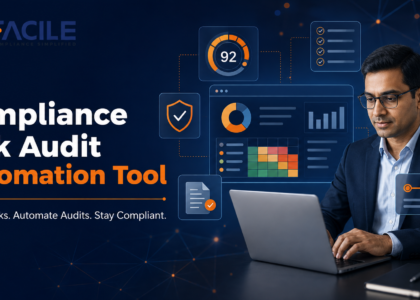
Technology can strengthen the audit process through:
The Government’s Shram Suvidha platform supports certain Central labour registration, licensing and return-related services. Organisations can review available facilities through the official Unified Shram Suvidha Portal.
Technology improves speed and visibility, but audit conclusions still require accurate source data, applicability assessment and professional review.
Facile Management Services (OPC) Private Limited provides structured Compliance Risk Audit Services for businesses in Coimbatore.
FACILE’s support may include:
FACILE combines compliance knowledge, structured audit workflows and technology-supported validation to help organisations identify risks, monitor corrective actions and maintain audit-ready records.
Compliance risk is not limited to missed due dates. It can arise from incorrect employee classifications, inaccurate payroll calculations, unsupported deductions, omitted statutory contributions, expired licences, incomplete registers and weak contractor monitoring.
A Compliance Risk Audit gives management a clear view of these issues and establishes a practical corrective-action process. It helps organisations move from reactive compliance management to a more controlled, measurable and preventive approach.
Businesses searching for a reliable Compliance Risk Audit Services Company in Coimbatore can partner with Facile Management Services (OPC) Private Limited for statutory audits, payroll validation, contractor compliance reviews, risk reporting and inspection readiness.
Facile Management Services (OPC) Private Limited
Phone: +91 91760 67399
Email: Info@facilemanagement.com
Website: www.facilemanagement.com
Compliance requirements depend on the establishment, industry, workforce, location and current Central and State provisions. Organisations should verify current notifications and obtain appropriate professional or legal advice where necessary.
A Compliance Risk Audit is a structured review of an organisation’s labour, payroll, statutory, employee and contractor records to identify non-compliance, process weaknesses and potential legal or financial exposure.
Yes. Facile Management Services (OPC) Private Limited provides compliance audits, payroll validation, contractor reviews, risk reporting and corrective-action support for businesses in Coimbatore.
The audit may cover registrations, licences, employee files, attendance, payroll, minimum wages, EPF, ESIC, Professional Tax, Labour Welfare Fund, registers, returns, challans and contractor records.
Regular filing completes a statutory activity. A risk audit verifies whether the underlying employee data, calculations, payments, documents and filing details are accurate and complete.
Yes. FACILE can compare attendance, payable days, earnings, deductions, statutory contributions, net salary, payslips and bank-payment records.
Yes. FACILE can compare employee classifications and payroll wages with applicable minimum wage requirements and identify potential differences.
Yes. FACILE can review employee eligibility, statutory numbers, wages, contribution calculations, employee-level statements, challans and payment records.
Yes. FACILE can compare payroll deductions and employer contributions with statutory statements, challans and payment evidence.
Yes. FACILE can review contractor licences, employee lists, attendance, wage records, bank payments, EPF, ESIC, challans, returns and supporting documents.
Observations may be classified as critical, high, medium or low risk. Recommendations that strengthen existing processes may be recorded as improvement opportunities.
An observation should identify the requirement, issue, affected period or employees, evidence, risk, corrective action, responsible person, target date and closure status.
The frequency depends on the organisation’s risk profile. Monthly validations, quarterly reviews and an annual comprehensive audit can provide effective monitoring for many businesses.
Yes. FACILE can help assign corrective actions, monitor target dates, review closure evidence and report pending observations.
Yes. FACILE can organise records, identify missing evidence, reconcile compliance information and support response preparation. Legal representation should be handled by an appropriately authorised professional where required.
Yes. Small businesses may also have responsibilities relating to wages, employee records, registrations, statutory contributions and contractor compliance. The audit scope can be based on actual applicability.
Yes. FACILE can support audits across multiple establishments, branches, factories, projects and contractor locations.
No. The challan should be reconciled with employee-level statements, payroll deductions, employer contributions and payment evidence.
An audit cannot guarantee that penalties will never arise, but early identification and correction of gaps can significantly reduce compliance exposure.
Yes. FACILE can provide structured observations, risk classifications, compliance scores, pending-action reports and management summaries.
Call +91 91760 67399, email Info@facilemanagement.com, or visit www.facilemanagement.com to discuss Compliance Risk Audit Services in Coimbatore.


Facile Management Services (OPC) Private Limited is committed to delivering seamlessly integrated HR and compliance solutions designed for the evolving