
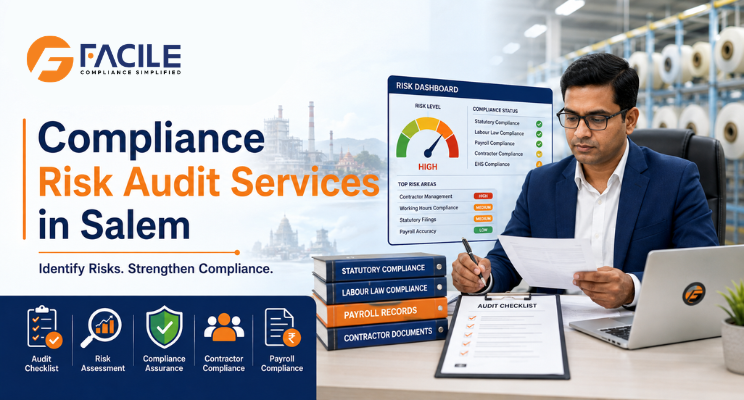
Businesses in Salem operate in a demanding environment shaped by expanding workforces, contractor engagement, changing statutory requirements, customer audits and increasing expectations around employment governance. Whether an organisation runs a steel plant, textile unit, foundry, warehouse, hospital, retail network or corporate office, a missed filing or an unsupported payroll entry can create financial, operational and reputational exposure.
FACILE provides Compliance Risk Audit Services in Salem to help employers identify such gaps before they become serious issues. The service examines the organisation’s labour-law and employment-compliance processes, tests records against available evidence, grades risks and supports responsible teams in tracking corrective action. It is designed to give management a clearer view of compliance across establishments, employees, contractors and reporting periods.
A compliance risk audit is more than a document-collection exercise. It connects licences, employee records, attendance, wages, statutory deductions, remittances, returns, registers and contractor documents. When these records are reviewed together, inconsistencies that remain hidden in routine monthly processing can be detected and addressed.
Salem is an important commercial and industrial centre with steel, textiles, garments, sago and food processing, engineering, transport, healthcare, education, hospitality and retail activities. These sectors often manage shift-based operations, variable wages, overtime, temporary manpower and outsourced services. Many businesses also operate through multiple units or engage several contractors.
This operating model can create compliance risks such as:
Management may receive individual reports from HR, payroll, finance and contractors, yet still lack one consolidated risk picture. A structured compliance audit brings these records together, identifies exceptions and helps prioritise corrective action according to severity.
A compliance risk audit is an independent, evidence-based review of an establishment’s compliance controls and records. It assesses whether applicable obligations have been identified, responsibilities have been assigned, activities are completed within required timelines and supporting records are internally consistent.
The audit typically answers five questions:
The objective is not merely to produce a list of faults. A useful audit explains the nature of each gap, its potential impact, the relevant evidence, the person responsible and the recommended corrective action.
The precise audit scope depends on the establishment type, workforce, industry, locations, contractor model and applicable law. FACILE can structure the review around the following areas.
An effective audit begins with the correct establishment profile. FACILE reviews details such as the nature of business, location, employee and worker strength, use of contract labour, working patterns, registration status and applicable activities.
The applicability review helps determine which compliance areas should be included. It also highlights changes—such as increased headcount, a new manufacturing process, relocation, additional shifts or contractor deployment—that may require a registration, amendment, licence or new compliance process.
Registrations and licences are reviewed for validity, coverage, business particulars and renewal status. The audit may examine establishment registrations, factory-related approvals, contractor and principal-employer documentation, standing orders or other permissions based on actual applicability.
The review checks whether the legal name, address, activity, headcount, contractor details and validity periods match current operations. Where a gap is identified, the observation is recorded with the required corrective action and supporting-document list.
Reliable compliance begins with reliable employee data. The audit compares employee master information with appointment records, attendance, payroll, bank-payment evidence and statutory portal data.
Typical checks include joining and exit dates, designation, category, department, wage structure, UAN, ESIC insurance number, bank details and nominee or identity information where relevant. Duplicate identifiers, missing numbers, unexplained status differences and inconsistent names can be flagged for correction.
Attendance data influences payroll, overtime, leave, weekly-off treatment and statutory records. FACILE examines whether attendance inputs are complete and whether they reconcile with shift rosters, gate records, leave information and payroll days.
The review may cover hours of work, rest intervals, weekly holidays, overtime, compensatory off, leave balances, late joining, early exit and unauthorised absence. Exceptions are tested against source documents rather than relying only on the final payroll output.
Payroll is assessed for both calculation accuracy and statutory alignment. Employee categories, skill classifications, wage components, payable days, overtime, incentives, deductions, arrears and settlements may be reviewed.
The audit can test whether notified minimum wages relevant to the establishment have been considered, whether wage periods and payment timelines are followed, and whether deductions are authorised and supported. Payroll totals can also be reconciled with bank-payment statements, ledgers and statutory contribution records.
Because wage definitions and applicable rates can change, each review should use the notifications and rules relevant to the audit period. The four central labour codes took effect from 21 November 2025, and subsequent official FAQs clarify aspects of the revised wage definition. FACILE therefore evaluates each period using the applicable framework rather than applying one rule to every historical month.
The EPF review can cover establishment registration, employee eligibility, UAN mapping, eligible wages, employee and employer contributions, electronic challan-cum-return data, payment evidence, exits and corrections.
Employee-level payroll values may be matched against the EPF filing. This helps identify employees missing from the return, differences in PF wages, unmatched UANs, incorrect joining or exit dates and contribution variances. Where contractors are involved, their deployed workforce and contribution documents can be tested separately.
The ESIC audit examines employee coverage, insurance numbers, contribution wages, deductions, employer contributions, monthly filings and payment records. Payroll and attendance information can be compared with portal records to find omitted employees, mismatched IP numbers or differences in contribution amounts.
Current official ESIC guidance should be checked for applicable coverage, contribution rates and timelines. An audit report therefore records the period reviewed and the basis used instead of assuming that a current rate automatically applies to every past period.
Professional Tax and Labour Welfare Fund requirements can depend on the state, employee category, wage range, establishment and contribution period. The review tests whether the correct employees and wage values were considered, whether deductions and employer contributions were calculated correctly, and whether payments and returns were completed on time.
The audit also checks that amounts deducted in payroll reconcile with challans, returns and accounting records.
Statutory records are not useful if they are prepared only for an inspection and cannot be traced to source data. FACILE reviews whether required registers, notices and returns are maintained in the prescribed form and whether their contents agree with attendance, wage and employee records.
The review can cover wage registers, attendance or muster records, overtime, leave, deductions, fines, advances, employment details and other applicable records. Missing fields, inconsistent totals, unsigned documents and unsupported entries are recorded as audit observations.
Contract labour can create significant exposure when the principal employer receives only a challan and a summary declaration. FACILE’s contractor review connects deployed-employee data with attendance, wage sheets, bank advice, EPF and ESIC records, licences and supporting registers.
Checks may include:
This approach gives the principal employer better visibility and helps prevent incomplete contractor documents from being treated as sufficient evidence.
Employee exits can involve wages, leave encashment, recoveries, statutory updates, gratuity or other benefits depending on eligibility. The audit checks whether exit dates are consistently reflected across HR, payroll and statutory records and whether settlements are supported by calculations and payment proof.
For factories and other applicable workplaces, the audit can include selected documentation concerning welfare facilities, health and safety records, notices, incident records, training, committees and required appointments. The detailed scope is determined by the nature of activity and applicable occupational-safety requirements.
FACILE uses a structured audit process so that findings are evidence-based, actionable and easy to track.
The establishments, laws, contractors, employee population and audit period are agreed. High-risk locations or vendors can be prioritised when a complete review is not immediately practical.
A tailored checklist is created based on applicability. HR, payroll, finance, administration and contractor teams receive a clear list of records required for the review.
Documents and data are organised by unit, contractor, law and period. Missing or unreadable records are logged so that the audit trail remains transparent.
The review covers both the process control and selected transactions. For example, confirming that an EPF process exists is not enough; payroll employees and contribution wages must also be compared with filing data.
Testing may be performed on the full population where structured data is available or through risk-based samples where manual records are involved.
FACILE compares records across systems and owners. Attendance is matched with payroll, payroll with bank payments, statutory deductions with returns and challans, and contractor deployment with contractor filings. These cross-checks frequently reveal gaps that cannot be seen by reviewing a single document.
Findings can be classified according to severity, urgency, financial exposure, employee impact and recurrence. A practical model may use critical, high, medium and low risk levels, along with observations requiring clarification.
The report describes the observation, evidence reviewed, potential implication, risk rating, recommended action, owner and target date. Supporting schedules can list affected employees, months, contractors or documents.
An audit provides value only when findings are closed. FACILE can support action tracking, evidence review, follow-up discussions and closure reporting. Repeated issues may require a root-cause review or a redesigned control rather than a one-time correction.
Recurring audit findings often include:
Identifying these patterns allows management to correct the immediate issue and strengthen the underlying process.
Decision-makers receive a consolidated view of risks across establishments, laws and contractors rather than isolated compliance updates.
Periodic reviews can identify missing documents, calculation errors and overdue actions before they are discovered during an inspection, customer audit or employee dispute.
Findings are linked to records and reconciliations, making them easier for responsible teams to understand and resolve.
Employee-level checks improve visibility beyond declarations and summary challans, supporting more responsible principal-employer governance.
Risk ratings, owners and target dates help convert observations into a manageable action plan.
Organised records, closure evidence and repeatable controls help businesses respond more efficiently to internal, customer and regulatory reviews.
A standard audit framework makes it easier to compare units, identify recurring weaknesses and monitor compliance centrally.
FACILE’s compliance risk audit approach can be adapted for:
Each sector presents different workforce and regulatory risks. The audit scope must therefore be tailored instead of relying on a generic checklist.
The right frequency depends on workforce size, contractor usage, operational complexity, past findings and management requirements. Monthly reviews may be suitable for payroll and contribution controls, while quarterly or half-yearly audits may cover broader documentation and contractor compliance. A comprehensive annual audit can support management review and planning.
Additional audits may be useful before a regulatory inspection, customer assessment, merger, expansion, new contractor onboarding or major change in the compliance framework.
Compliance risk cannot be managed effectively through scattered spreadsheets, emails and declarations alone. Businesses need defined applicability, connected data, reliable evidence, risk-based review and disciplined corrective-action closure.
FACILE helps organisations in Salem assess these areas through structured Compliance Risk Audit Services. From employee and payroll validation to contractor audits, statutory reconciliations and management reporting, our approach is designed to turn compliance information into practical action.
To discuss a compliance risk audit for your establishment or contractor network, contact FACILE:
Email: Info@facilemanagement.com
Phone: +91 91760 67399
Website: www.facilemanagement.com
Explore: Compliance Risk Audit Services
Compliance risk audit services involve reviewing an organisation’s applicable labour and employment obligations, processes, transactions and supporting documents. The audit identifies gaps, grades risks and recommends corrective actions.
Salem businesses often manage shift operations, contractors, multiple wage categories and several statutory obligations. An audit helps management identify inconsistencies and overdue actions before they create larger financial, employee or regulatory problems.
No. Monthly processing completes activities such as payroll, contributions and returns. A risk audit independently tests whether those activities were accurate, timely, supported and consistent across records.
The requirement varies, but it may include registrations, licences, employee master data, appointment and exit records, attendance, payroll, bank advice, challans, returns, statutory registers, contractor records and previous audit reports.
Yes. The scope can include employee coverage, UAN or IP mapping, contribution wages, payroll deductions, employer contributions, returns, challans, payments, joining and exit details, subject to the agreed audit period and available evidence.
Yes. FACILE can review contractor licences, deployed employees, attendance, wages, bank-payment evidence, EPF/ESIC records, registers and corrective-action status. This supports better principal-employer visibility.
That depends on the scope and data format. Full-population testing may be possible when structured electronic data is available. In other cases, risk-based sampling may be used. The report should clearly state the testing method and limitations.
Findings may be graded as critical, high, medium or low based on factors such as legal exposure, employee impact, amount involved, urgency, recurrence and the strength of existing controls.
FACILE can support corrective-action planning, assignable trackers, evidence review and closure monitoring. The organisation remains responsible for decisions, approvals, payments and statutory submissions applicable to it.
Frequency should reflect contractor headcount, nature of work, prior performance and risk. High-risk or high-headcount contractors may require monthly or quarterly review, while others may be assessed periodically under a risk-based plan.
Yes. A common audit framework can be applied across multiple establishments and contractors, with unit-wise and consolidated reporting. This helps management compare performance and identify recurring issues.
No audit can guarantee that outcome. Compliance depends on complete information, correct applicability, timely management action and continuing adherence to changing requirements. A well-designed audit reduces uncertainty by identifying gaps and improving controls.
This article provides general information and is not legal advice. Labour-law applicability, thresholds, rates, forms, timelines and procedures can vary according to the establishment, workforce, activity, location and audit period and may change through notifications or rules. Businesses should verify current requirements with the appropriate government authority or qualified professional before acting.


Facile Management Services (OPC) Private Limited is committed to delivering seamlessly integrated HR and compliance solutions designed for the evolving