Regulatory compliance is a continuous responsibility for businesses operating across India. Organisations must monitor labour laws, payroll obligations, contractor compliance, factory requirements, licences, statutory records and operational controls across multiple locations.
When compliance audits are managed through spreadsheets, emails and physical documents, critical risks may remain unnoticed. Missing evidence, delayed corrective actions, expired registrations and inconsistent audit practices can increase the organisation’s exposure to penalties, disputes, business interruptions and reputational damage.
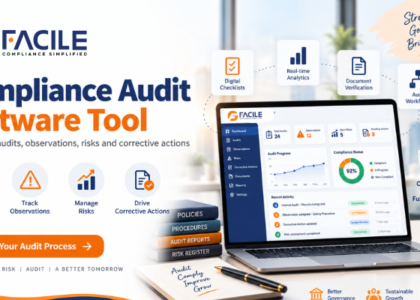
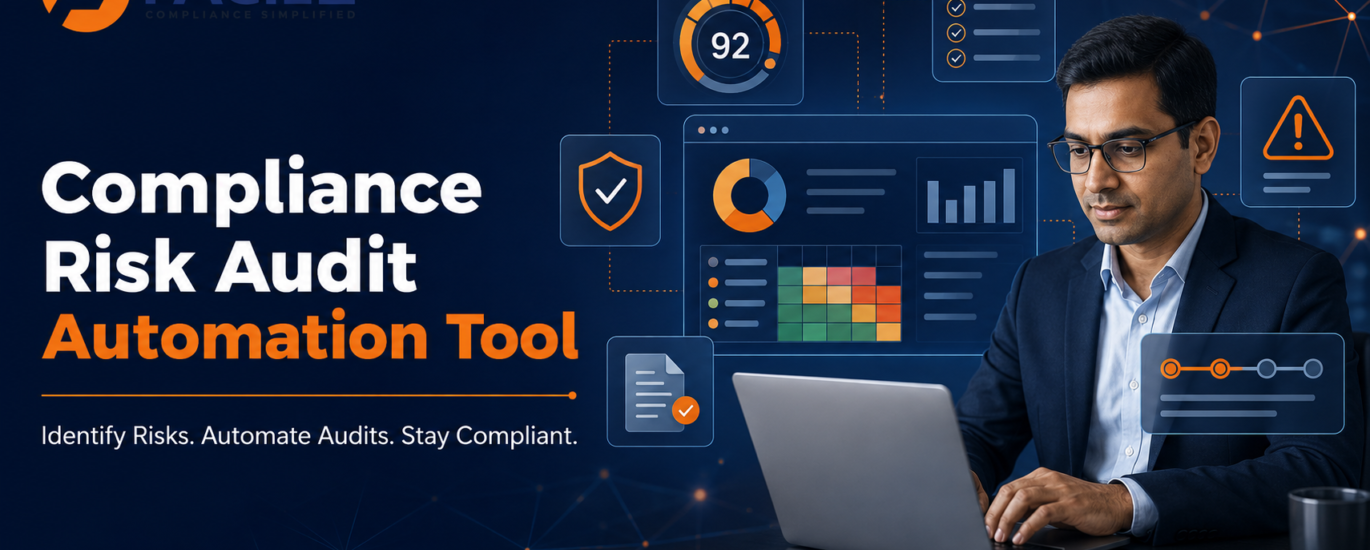
FACILE’s Compliance Risk Audit Automation Tool provides a structured digital platform for planning audits, evaluating compliance, identifying risks, managing observations and tracking corrective actions. It helps organisations transform compliance audits from periodic manual exercises into an organised and continuously monitored process.
A Compliance Risk Audit Automation Tool is a digital solution that enables organisations to assess, monitor and control compliance risks through standardised audit workflows.
It centralises audit requirements, compliance documents, risk classifications, observations, responsibilities and closure evidence. Instead of maintaining separate spreadsheets and files for every location, organisations can manage the complete audit lifecycle through one platform.
FACILE can support:
Compliance risks can arise from incomplete records, missed deadlines, incorrect payroll practices, expired licences, contractor defaults or insufficient internal controls.
A compliance risk audit helps an organisation determine:
Without a systematic audit process, organisations may recognise a compliance problem only after receiving a notice, facing an inspection or experiencing an operational disruption.
FACILE helps identify potential gaps earlier and enables responsible teams to take timely action.
Compliance records may be distributed across HR, payroll, legal, finance, procurement and facility-management departments. Collecting information for an audit becomes time-consuming.
Different auditors may use different checklists, rating methods and reporting formats, making comparison difficult.
Locations, departments, contractors and vendors may not submit evidence within the required timeline.
Management may receive only a final audit report without real-time visibility into emerging risks or overdue corrective actions.
When observations are communicated through email, it may be difficult to identify the person responsible for resolving each issue.
The same observation may appear in multiple audit cycles when root causes and corrective actions are not properly monitored.
Manual systems may not provide reliable information about who submitted, reviewed, approved or changed a record.
Organisations operating across several states may find it difficult to maintain consistent audit standards and consolidated risk reporting.
FACILE manages the complete compliance audit process through a structured digital workflow.
The organisation defines the establishments, departments, contractors, laws, registers, documents and compliance areas to be assessed.
Audit schedules can be created based on location, business unit, risk category, compliance period or contractor.
Relevant compliance checkpoints are assigned to auditors and responsible stakeholders.
Users upload registers, returns, challans, licences, policies, certificates and other supporting documents.
Auditors review the submitted evidence and record compliant, non-compliant, partially compliant or not-applicable outcomes.
Observations can be classified based on severity, probability, financial impact, operational impact and urgency.
Responsible persons receive observations with clearly defined actions and target dates.
Corrective-action documents can be uploaded and reviewed before the observation is closed.
Dashboards and reports provide a consolidated view of compliance performance, risks and overdue activities.
Plan, conduct, review and close compliance audits through one integrated platform.
Create audit checklists based on applicable laws, industry requirements, organisational policies, locations and contractor categories.
Map applicable compliance requirements to individual establishments, departments, contractors or operational units.
Prioritise audits based on previous performance, unresolved observations, workforce size, operational exposure and other risk indicators.
Upload and organise registers, challans, returns, licences, payment proofs, certificates and supporting records.
Assign risk scores and classify observations as critical, high, medium or low based on configured parameters.
View compliance scores, open observations, overdue actions, document status and risk distribution through dashboards.
Record detailed observations with supporting evidence, risk classification, recommendations and responsible persons.
Assign corrective and preventive actions, define target dates and monitor progress until verified closure.
Notify responsible stakeholders about upcoming audits, missing documents, approaching deadlines and overdue actions.
Evaluate contractor and vendor compliance using standard checklists, supporting documents and performance scores.
Compare audit and risk status across branches, factories, warehouses, offices and project locations.
Monitor validity and renewal dates for licences, registrations, approvals and certificates.
Identify observations that repeatedly appear across locations, contractors or audit periods.
Provide appropriate access to auditors, compliance teams, HR departments, contractors, location managers and senior management.
Maintain a traceable record of evidence submissions, reviews, comments, status changes, approvals and closures.
Generate risk summaries, compliance-score reports, overdue-action reports, contractor reports and location-wise audit reports.
Automated tracking and structured audits help organisations identify potential compliance gaps before they escalate.
Common checklists and evaluation methods create consistency across auditors, contractors and business locations.
Management receives a consolidated view of compliance performance instead of waiting for manually prepared reports.
Digital evidence collection, checklist management and reporting reduce the administrative effort involved in audits.
Each observation can be assigned to a responsible person with a target date and escalation workflow.
Automated reminders help teams monitor and close observations within defined timelines.
Recurring-risk analysis helps management address underlying causes rather than repeatedly correcting the same issue.
Compliance records and closure evidence remain organised and accessible for management reviews and inspections.
Organisations can compare contractors based on compliance scores, audit findings and corrective-action performance.
Dashboards help management prioritise high-risk locations, requirements and contractors.
Centralised records make it easier to retrieve documents during internal audits, external reviews and regulatory inspections.
Timely identification and treatment of compliance gaps can help protect business continuity and organisational reputation.
FACILE ONE combines compliance management, risk auditing, contractor monitoring and management reporting through a unified digital platform.
FACILE supports the practical compliance-monitoring needs of organisations operating across different states and establishments in India.
The platform manages audit planning, checklist assignment, evidence review, observations, corrective actions and closure.
FACILE enables organisations to focus management attention on critical and high-risk issues.
Central teams can monitor compliance performance across multiple establishments, contractors and vendors.
Audit checklists, approval processes, risk levels and escalation requirements can be configured according to organisational needs.
Decision-makers can view compliance scores, pending submissions, open observations and overdue actions.
Authorised stakeholders can access important compliance information and audit updates while working across locations.
Role-based permissions and audit histories improve control over sensitive compliance information.
FACILE can support organisations as they add more users, locations, contractors and compliance requirements.
The Compliance Risk Audit Automation Tool is suitable for:
Compliance auditing should provide continuous visibility rather than become a last-minute document-collection exercise.
FACILE connects auditors, compliance teams, establishment managers, contractors and senior management through one structured platform. It enables organisations to monitor compliance risks, collect evidence, manage observations and verify corrective actions efficiently.
With FACILE, organisations can establish consistent audit processes, improve accountability and make informed compliance decisions using reliable data.
Stay connected. Stay compliant. Identify and control compliance risks with FACILE.
It is a digital solution that helps organisations plan compliance audits, assess requirements, collect evidence, identify risks and monitor corrective actions.
FACILE provides configurable checklists, evidence-submission workflows, risk scoring, observation management, automated alerts and management dashboards.
Yes. Organisations can manage and compare audits across factories, offices, warehouses, branches and project locations.
Yes. Checklists can be configured based on applicable requirements, industry, establishment, department, contractor and audit scope.
Yes. Risk scoring can be configured to evaluate compliance performance and classify observations according to severity.
Yes. Observations can be classified into levels such as critical, high, medium or low based on configured assessment criteria.
Yes. Authorised users can upload registers, challans, returns, licences, certificates and corrective-action evidence.
Yes. Corrective actions can be assigned to responsible persons with target dates, reminders and closure-verification workflows.
Yes. FACILE can assess contractors and vendors using standard compliance checklists, document requirements and performance scores.
Yes. Notifications can be configured for upcoming audits, missing evidence, expiring documents and overdue corrective actions.
Yes. Dashboards provide visibility into compliance scores, open risks, pending documents and overdue actions.
Yes. FACILE maintains records of submissions, reviews, approvals, comments, changes and observation closures.
Yes. Historical audit information can help organisations identify repeated observations across contractors, locations and audit periods.
Yes. Internal audit, HR, legal and compliance teams can use FACILE to plan and manage structured compliance reviews.

Facile Management Services (OPC) Private Limited is committed to delivering seamlessly integrated HR and compliance solutions designed for the evolving