
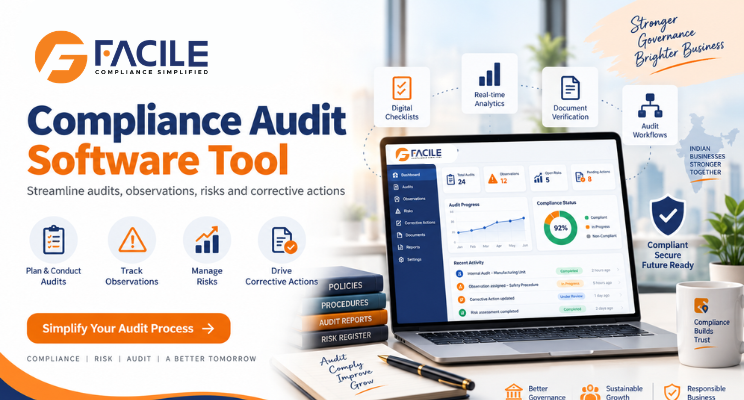
Managing compliance audits manually can become difficult when organisations operate across multiple locations, departments, contractors, vendors and statutory obligations. Audit teams often need to collect documents, verify records, identify gaps, assign observations, monitor corrective actions and report compliance status to management.
A Compliance Audit Software Tool helps businesses digitise and manage the complete audit lifecycle through one structured platform.
It can support statutory audits, payroll audits, contractor audits, vendor audits, licence audits, document verification, risk classification, corrective actions, evidence management and compliance reporting.
A Compliance Audit Software Tool is a digital platform used to plan, perform, monitor and close compliance audits.
It can help organisations manage:
The objective is to replace manual audit trackers and spreadsheets with a structured and transparent audit process.
Manual compliance audits can create several problems:
Compliance Audit Software helps standardise the audit process across the organisation.
The system should allow businesses to plan audits based on:
This creates a structured audit calendar.
Audits can be scheduled for:
Responsible auditors and target dates can be assigned.
The platform should support configurable audit checklists covering:
This helps maintain consistency.
Auditors can review documents such as:
When a compliance gap is identified, the system can record:
Audit findings can be classified as:
This helps teams prioritise serious issues.
The system can calculate audit scores based on:
Scores can be displayed by location, vendor or contractor.
Each audit observation can be linked to a corrective action.
A workflow can follow:
Observation → Owner Assigned → Corrective Action → Evidence Submitted → Verification → Closure
Users can upload supporting evidence such as:
This strengthens audit traceability.
Auditors can review submitted evidence and:
This creates a controlled closure process.
Contractor audits can review:
This gives principal employers stronger visibility.
Vendor audits can include:
Payroll audits can validate:
The software can verify:
Registers can be audited for:
The system can monitor:
Organisations operating across several States can audit:
Audits can be monitored across:
Corporate teams can compare audit performance across locations.
Automated escalations can be generated when:
A central dashboard can show:
A structured digital audit process can look like:
Audit Plan → Checklist → Document Review → Observation → Risk Classification → Corrective Action → Evidence → Verification → Closure
This provides a complete audit lifecycle.
Digital checklists help ensure consistent audit methodology.
Auditors can review documents and record findings digitally.
High-risk findings are highlighted immediately.
Every observation can have a responsible owner and due date.
Supporting documents remain linked to the relevant finding.
Dashboards and reports reduce spreadsheet consolidation.
Historical findings and closure evidence remain traceable.
Contractor compliance can be monitored consistently.
Vendor audit performance can be tracked centrally.
A large organisation can structure audit management as:
Organisation → State → Location → Audit → Observation → Risk → Corrective Action → Closure
This provides both enterprise-level and unit-level visibility.
Businesses should ensure the software supports:
It is useful for:
FACILE ONE can help organisations digitise and centralise compliance audit management.
Businesses can use FACILE ONE to support:
Compliance audits require coordination between auditors, HR, payroll, contractors, vendors, compliance teams and management.
FACILE ONE helps bring these activities into one structured workflow.
Key capabilities include:
Businesses should evaluate whether the system supports:
The system should clearly answer:
What was audited? What failed? How serious is the finding? Who owns the corrective action? What evidence was submitted? Has the observation been verified and closed?
A Compliance Audit Software Tool helps businesses replace manual audit trackers with a structured, digital and auditable compliance process.
By connecting audit checklists, documents, observations, risks, corrective actions and evidence, organisations can improve audit consistency and closure tracking.
For businesses operating across multiple locations, vendors and contractors, FACILE ONE can help create a more transparent, risk-focused and audit-ready compliance environment.
Compliance Audit Software is a digital platform used to plan audits, manage checklists, record observations and monitor corrective actions.
It helps standardise audits, reduce manual tracking and improve visibility over open compliance findings.
Yes. Configurable audit checklists can be maintained for different compliance areas.
Yes. Payroll files, challans, licences, returns, registers and other evidence can be reviewed.
Yes. Observations can include risk level, owner, due date and corrective action.
Yes. Findings can be classified as low, medium, high or critical.
Yes. Scores can be calculated based on compliance checkpoints, findings and risk.
Yes. Every observation can have a corrective-action workflow.
Yes. Supporting evidence can be uploaded for auditor verification.
Yes. Evidence can be approved, rejected or returned for resubmission.
Yes. Contractor payroll, licences, EPF, ESIC and statutory records can be audited.
Yes. Vendor documentation, statutory compliance, risk and corrective actions can be reviewed.
Yes. Attendance, minimum wages, statutory deductions and payment records can be audited.
Yes. Audits can be managed across factories, branches, warehouses and project sites.
Yes. Dashboards can show audit status, open observations, risk levels and overdue actions.
Yes. FACILE ONE can support audit checklists, observations, risk classification, corrective actions, evidence verification and dashboards.


Facile Management Services (OPC) Private Limited is committed to delivering seamlessly integrated HR and compliance solutions designed for the evolving