

Businesses across manufacturing, construction, logistics, facility management, and other industries often depend on vendors and contractors to support daily operations. However, managing third-party compliance can be challenging when documents, payroll records, licences, audit reports, and corrective actions are spread across spreadsheets, emails, and physical files.
Vendor audit compliance tools help businesses organize vendor documentation, conduct structured compliance reviews, identify gaps, track corrective actions, and maintain audit records in a centralized system.
For Indian businesses managing multiple contractors or establishments, these tools can support more consistent monitoring of relevant labour-law requirements, statutory documentation, vendor performance, and audit findings. With a well-defined process, organizations can improve visibility into vendor compliance and prepare more efficiently for internal and external audits.
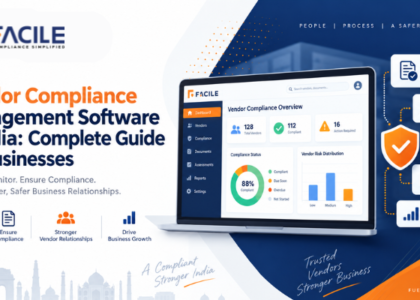
Vendor audit compliance tools are digital solutions that help organizations assess whether vendors, suppliers, contractors, and service providers meet applicable legal, contractual, operational, and internal compliance requirements.
Depending on the platform, these tools may provide:
These tools combine aspects of vendor auditing and compliance monitoring. Their purpose is to help organizations move away from fragmented manual processes toward a more structured and traceable workflow.
Automate Vendor Audits
+1
Businesses may need to collect registration documents, licences, certificates, payroll records, statutory evidence, and other information from vendors. Centralized document management makes records easier to locate and review.
A dashboard can help teams identify missing documentation, pending reviews, expired records, and unresolved audit observations. This gives management a clearer view of areas requiring attention.
Standardized checklists help auditors follow a common process across vendors, projects, and locations while allowing requirements to be tailored to each engagement.
Audit findings need owners, deadlines, supporting evidence, and verification. A digital system can help teams monitor actions until they are reviewed and closed.
Automated reminders, structured forms, and report generation can reduce repetitive administrative work. The actual time saved depends on the solution and how well the workflow is implemented.
Organized evidence and historical records help businesses prepare for audits and internal reviews without having to reconstruct information from multiple sources.
Maintain vendor details, contact information, service categories, establishment locations, relevant contracts, and audit history in one place.
Create checklists according to vendor category, work location, industry, contractual terms, and applicable legal requirements.
For example, a manpower contractor may require checks relating to workforce documentation and payroll, while an equipment supplier may require a different set of records.
Collect and organize required documents, record review status, identify missing information, and maintain supporting evidence for audits.
Track relevant licences, certificates, registrations, and renewal dates. Reminder functionality can help responsible teams follow up before a document expires.
For contractor-related audits in India, relevant checks may include:
The precise requirements depend on the applicable legislation, establishment, state, workforce arrangement, and nature of the contract. A software checklist should be configured accordingly.
Record non-conformities, missing documents, inconsistencies, and other findings. Each observation can be associated with supporting evidence, a risk level, an assigned owner, and a target date.
Track the steps required to resolve audit findings. A structured workflow may follow:
Finding identified → Action assigned → Vendor response → Evidence submitted → Verification → Closure
This helps teams distinguish between a reported correction and a correction that has actually been verified.
Some systems calculate compliance scores using defined criteria, such as documentation status, audit findings, overdue actions, and applicable statutory checks. Scoring criteria should be transparent and appropriate to the vendor category.
Reports can show audit completion, missing documents, open observations, overdue corrective actions, and vendor-wise or location-wise compliance status.
Maintain previous assessments, evidence, approvals, observations, and corrective-action history to support traceability and future reviews.
Indian businesses may engage manpower agencies, housekeeping contractors, security providers, logistics vendors, maintenance contractors, and other third parties. The compliance responsibilities associated with each relationship may differ.
A structured vendor audit compliance process typically includes the following steps.
A digital tool can help coordinate these steps across multiple vendors and locations. However, automation does not by itself establish legal compliance; records and findings still require appropriate review.
| Audit activity | Manual approach | Digital tool-supported approach |
|---|---|---|
| Document storage | Emails, spreadsheets, and folders | Centralized digital repository |
| Audit checklists | Printed forms or separate files | Reusable digital checklists |
| Expiry monitoring | Manual date tracking | Automated reminders, if supported |
| Findings | Separate trackers | Centralized observation management |
| Corrective actions | Email follow-ups | Assigned actions and status tracking |
| Reporting | Manual compilation | Dashboards and generated reports |
| Audit history | Records spread across locations | Searchable historical records, depending on the system |
Digital tools can improve organization and visibility, but their effectiveness depends on accurate information, appropriate configuration, and consistent use.
Before selecting a solution, businesses should evaluate:
Ask for a demonstration that covers the complete audit process—from collecting vendor records to verifying corrective-action closure. Confirm which features are available in the proposed product rather than assuming all vendor compliance platforms provide the same capabilities.
evidash.com
+1
Facile Management provides compliance-focused services and solutions relevant to statutory compliance, vendor audits, contractor compliance processes, licence management, and monthly compliance.
For businesses looking to improve their vendor compliance workflow, areas to explore include:
Businesses should confirm the specific features and services available for their requirements with the Facile Management team.
Simplify vendor compliance. Improve audit visibility. Stay audit-ready.
Vendor audit compliance tools help businesses organize vendor records, standardize audits, monitor compliance gaps, and track corrective actions. They can reduce the administrative burden of manual processes while improving visibility into outstanding issues and audit status.
For Indian businesses managing contractors and suppliers across multiple locations, the right solution should support relevant compliance checklists, reliable document tracking, structured audit observations, corrective-action monitoring, and clear reporting.
Combining appropriate software with competent reviews and consistent follow-up can help organizations build a more transparent and effective vendor compliance process.
Vendor audit compliance tools are digital solutions used to review vendor documentation, assess compliance against defined requirements, record audit findings, track corrective actions, and maintain audit reports.
Vendor audit software focuses on planning audits, evaluating evidence, recording findings, and monitoring corrective actions. Vendor compliance software focuses more broadly on managing requirements, documents, deadlines, and compliance status. Some platforms provide both capabilities.
Some tools support workflows for reviewing applicable wage, payroll, workforce, licence, EPF, ESIC, and other statutory records. The exact coverage varies by platform, and requirements must be mapped to the relevant legal and operational circumstances.
Depending on the vendor relationship, documents may include registrations, licences, certificates, payroll records, attendance records, statutory registers, returns, contribution evidence, contracts, and other required records.
They centralize evidence, maintain historical records, identify missing documents, record audit observations, and help teams track corrective actions. This can make information easier to retrieve when an audit or internal review takes place.
Some platforms support contractor payroll-related checks, including reviews of wage records, attendance, payslips, and applicable statutory contribution evidence. Verify the specific capabilities before selecting a solution.
Yes, where the platform includes these features. Findings can be recorded with responsible persons, due dates, supporting evidence, and closure status.
Yes. Small businesses can use digital checklists, centralized document storage, reminders, and basic reports to organize vendor audits. The solution should match the organization’s vendor count, complexity, and budget.
Frequency depends on vendor risk, applicable legal requirements, contractual obligations, previous audit findings, and internal policy. Higher-risk vendors may need more frequent reviews.
Evaluate statutory compliance support, checklist customization, document tracking, audit workflows, corrective-action management, reporting, access controls, integrations, scalability, and provider support.
No. Software can support documentation, monitoring, and audit workflows, but it cannot guarantee compliance. Organizations must verify records, interpret applicable requirements, and ensure that identified issues are appropriately resolved.
Facile Management offers compliance-focused services and solutions relevant to vendor audits, statutory compliance, licence management, and monthly compliance processes. Contact the team to discuss your requirements and confirm the most suitable available solution.


Facile Management Services (OPC) Private Limited is committed to delivering seamlessly integrated HR and compliance solutions designed for the evolving