Managing compliance across multiple departments, locations, contractors, vendors and statutory obligations can become difficult when data is spread across spreadsheets, emails and separate systems.
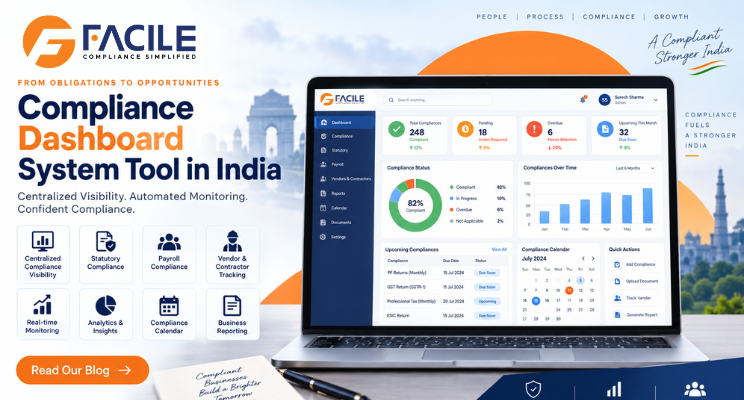
A Compliance Dashboard System Tool helps businesses bring compliance data into one centralized view. It enables management, HR, payroll, compliance, legal and audit teams to monitor pending tasks, overdue activities, licences, audits, contractor status, vendor compliance, corrective actions and risk indicators from one dashboard.
For growing and multi-location businesses, a compliance dashboard can improve visibility, reporting and decision-making.
A Compliance Dashboard System Tool is a digital platform that consolidates compliance information into dashboards, KPIs, charts, alerts and reports.
It can help organisations monitor:
The objective is to give decision-makers a clear and structured view of compliance status.
Manual compliance reporting can create problems such as:
A Compliance Dashboard System Tool helps consolidate this information into one platform.
The dashboard should show key indicators such as:
This provides an immediate organisation-wide snapshot.
For businesses operating across multiple States, the system can show:
Compliance can be monitored by:
This makes it easier to identify locations that require attention.
The tool can classify activities as:
This helps teams prioritise work.
A licence dashboard can show:
Payroll-related indicators may include:
The dashboard can show:
Vendor indicators can include:
The system can show:
Risks can be classified as:
The dashboard can group risk by:
The platform can monitor:
Compliance scores can be calculated using factors such as:
Scores can be viewed by location, vendor or contractor.
Users should be able to filter data by:
This improves dashboard usability.
Different users may require different views.
For example:
Management: overall compliance, risks and trends.
HR: employee and payroll compliance.
Compliance Team: statutory tasks, due dates and documents.
Audit Team: audit observations and closures.
Procurement: vendor and contractor compliance.
The dashboard can highlight:
Trend charts can show:
This helps management understand whether performance is improving.
For multi-state organisations, compliance can be structured as:
India → State → Location → Compliance → Status → Risk
This gives management both national and local visibility.
The system can compare:
This supports performance benchmarking between locations.
The platform can generate MIS indicators such as:
Senior management can use a simplified dashboard showing:
A structured dashboard process can look like:
Compliance Data → Validation → Status Update → Risk Classification → Dashboard → Action → Closure
This converts operational compliance information into management insight.
Management can see important compliance information in one place.
Critical issues can be identified quickly.
Teams spend less time preparing Excel and PowerPoint reports.
High-risk activities can be highlighted immediately.
Pending activities and responsible owners remain visible.
Compliance performance can be compared across units.
Audit findings and corrective actions remain visible and traceable.
Management can monitor external workforce and vendor compliance through dedicated dashboards.
Multi-state businesses can use the dashboard to monitor:
A central system helps management move from enterprise-level information to detailed unit-level records.
Businesses should ensure the dashboard supports:
It is useful for:
FACILE ONE can help organisations consolidate compliance information into structured dashboards.
Businesses can use FACILE ONE to monitor:
Compliance data becomes more useful when teams and management can understand it quickly.
FACILE ONE helps convert compliance records into structured dashboards and reports.
Key capabilities include:
Businesses should evaluate whether the platform supports:
The system should clearly answer:
What is compliant? What is pending? What is overdue? Where is the risk? Which location needs attention? Who owns the action?
A Compliance Dashboard System Tool helps organisations transform complex compliance data into clear, actionable management information.
By consolidating statutory compliance, payroll, licences, contractors, vendors, audits, risks and corrective actions into one dashboard, businesses can improve visibility and reduce manual reporting.
For organisations operating across multiple States and locations, FACILE ONE can help build a more transparent, data-driven and audit-ready compliance environment.
It is software that consolidates compliance information into dashboards, KPIs, charts, status indicators and reports.
It helps management quickly identify completed, pending, overdue and high-risk compliance activities.
Yes. Compliance can be grouped and filtered by State.
Yes. Branches, factories, warehouses and project sites can be monitored separately.
Yes. Upcoming and overdue activities can be displayed.
Yes. Active, expiring, expired and renewal-pending licences can be tracked.
Yes. Minimum wages, EPF, ESIC, PT, LWF and payroll-related compliance can be monitored.
Yes. Contractor workforce, licences, documents, payroll and statutory status can be displayed.
Yes. Vendor documentation, audit status, risks and corrective actions can be tracked.
Yes. Open, overdue, verified and closed observations can be displayed.
Yes. Risks can be classified as low, medium, high or critical.
Yes. Scores can be calculated and shown by organisation, location, vendor or contractor.
Yes. Different views can be provided for management, HR, compliance, audit and other teams.
Yes. Multi-state and multi-location monitoring is a major use case.
Yes. Dashboard data can support periodic management and compliance MIS reporting.
Yes. FACILE ONE can support State-wise, location-wise, payroll, contractor, vendor, audit, risk and management dashboards.

Facile Management Services (OPC) Private Limited is committed to delivering seamlessly integrated HR and compliance solutions designed for the evolving