

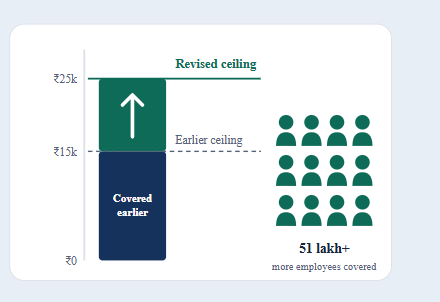
The wage ceiling under EPFO is the maximum monthly wage taken into account for determining mandatory EPF, EPS and EDLI coverage under the Code on Social Security, 2020. It has now been revised from ₹15,000 to ₹25,000 per month, bringing a larger number of employees within the ambit of mandatory coverage, subject to the applicable provisions of the schemes.
The statutory wage ceiling has been increased from ₹15,000 per month to ₹25,000 per month.
Employees drawing wages of up to ₹25,000 per month will now be mandatorily required to become members of the EPF, EPS and EDLI schemes, and both employees and employers will contribute on wages up to ₹25,000. This extends social-security coverage to more employees and enhances the quantum of benefits available under EPF and EPS
The ceiling had remained unchanged at ₹15,000 since September 2014, even as wages and minimum wages rose substantially over the following years. Across at least eight major States and Union Territories, the statutory minimum wage for unskilled workers already exceeds ₹15,000, meaning even minimum-wage earners were falling outside social-security coverage.
Trade unions and employer representatives had also highlighted that the minimum wage and average wage had increased across states and sectors, and that the unchanged ceiling was resulting in a number of employees being excluded from EPF coverage. The revision brings the statutory threshold more in line with prevailing wage levels and extends social-security coverage to more employees and their families, including many existing members who were contributing only on ₹15,000 despite earning more.
Yes. The revised wage ceiling expands the statutory coverage framework under EPF, EPS and EDLI.Q6Who will benefit from the revised wage ceiling?
Employees drawing wages above ₹15,000 and up to ₹25,000 per month, who satisfy the applicable statutory conditions, will come within the expanded mandatory coverage. The revision is estimated to bring more than 51 lakh additional employees under mandatory EPFO coverage. Further, the quantum of benefits for existing members having wages exceeding ₹15,000 shall also increase consequent to increased contributions.
No. The revised wage ceiling remains effective from 17 September 2026.
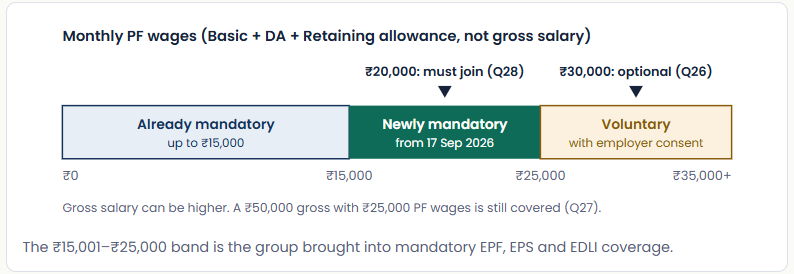
Monthly PF wages (Basic + DA + Retaining allowance, not gross salary)Already mandatoryup to ₹15,000Newly mandatoryfrom 17 Sep 2026Voluntarywith employer consent₹0₹15,000₹25,000₹35,000+₹20,000: must join (Q28)₹30,000: optional (Q26)Gross salary can be higher. A ₹50,000 gross with ₹25,000 PF wages is still covered (Q27).The ₹15,001–₹25,000 band is the group brought into mandatory EPF, EPS and EDLI coverage.
Yes, the revised ceiling expands mandatory coverage up to ₹25,000 per month, but this remains subject to the applicability and conditions of the EPF Scheme and other relevant statutory provisions, and must be read together with those provisions.
Yes. The principal effect of the revision is to extend the mandatory coverage threshold from ₹15,000 to ₹25,000 per month, bringing eligible employees in this wage range within the expanded statutory coverage.
For example, an employee joining today at a monthly wage of ₹20,000 is currently outside the EPF and EPS system; under the revised ceiling, such an employee would be required to be enrolled in both, creating a more robust social-security safety net for the employee and their family.
No. The wage ceiling and gross salary are not synonymous. PF contribution continues to be determined with reference to PF wages and the contribution provisions applicable under the EPF Scheme and related statutory provisions, not the entire gross salary.
No. The wage ceiling is determined with reference to wages as defined under section 2(88) of the Code on Social Security, 2020, and not simply the employee’s total gross salary.Q26My gross salary is ₹60,000 per month, but my EPF wages (Basic + DA + Retaining Allowance) are ₹30,000.
No. However, you can voluntarily opt to become a member of EPF with the consent of your employer.
Yes, you are required to be a member under all three schemes: EPF, EPS and EDLI. The fact that your gross salary is ₹50,000 does not by itself exclude you. Your relevant EPF wages are ₹25,000, which is within the revised wage ceiling.Q28I am earning ₹20,000 per month and I am currently an excluded employee.
From the date of the wage-ceiling revision, you are required to become a member of the Employees’ Provident Fund, the Employees’ Pension Scheme and the Employees’ Deposit Linked Insurance Scheme.
The employee is required to be made a member of EPF, EPS and EDLI with effect from 17 September 2026. The employer is required to make contributions for such members from that date.
No. The revised statutory ceiling does not require members to submit any separate application. It will be the statutory responsibility of the employer to enrol such members and start compliance for them.
Yes. It will be the statutory responsibility of the employer to enrol such members and start compliance for them.
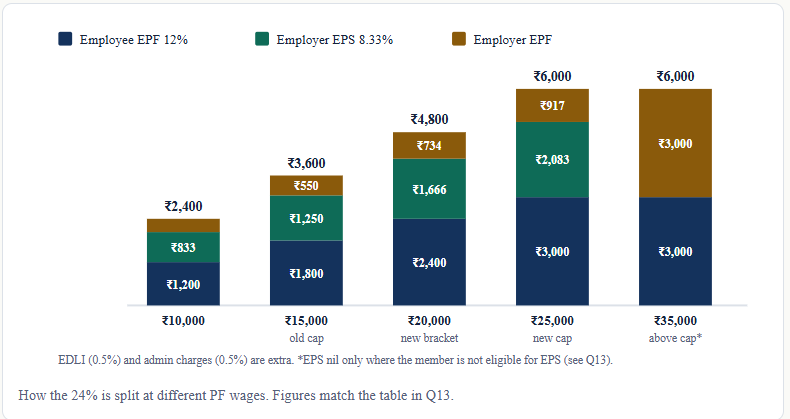
How the 24% is split at different PF wages. Figures match the table in Q13.Q7How will the increase in the ceiling from ₹15,000 to ₹25,000, effective 17.09.2026, affect the contributions of an employee earning ₹20,000 per month? Give illustrations for filing the ECR for September 2026.
For an employee earning wages of ₹20,000 per month, contributions for September 2026 are calculated as follows. The three scenarios are:
| Contribution head, September 2026 | Scenario A | Scenario B | Scenario C |
|---|---|---|---|
| Proportionate wages, 01.09.2026 to 16.09.2026 (16 days) | ₹0Excluded employee till 16.09.2026; wages exceeded ₹15,000 ceiling | ₹10,666.67₹20,000 × 16/30 | ₹8,000.00₹15,000 × 16/30 |
| Proportionate wages, 17.09.2026 to 30.09.2026 | ₹9,333.33₹20,000 × 14/30 | ₹9,333.33₹20,000 × 14/30 | ₹9,333.33₹20,000 × 14/30 |
| Total September wage (EPF) | ₹9,333.33 | ₹20,000.00 | ₹17,333.33 |
| Total September wage (EPS) | ₹9,333.33 | ₹9,333.33 | ₹17,333.33 |
| Employee contribution, EPF (12%) | ₹1,120.0012% of ₹9,333.33 | ₹2,400.0012% of ₹20,000.00 | ₹2,080.0012% of ₹17,333.33 |
| Employer contribution, EPF (A/c 1) | ₹342.533.67% of ₹9,333.33 | ₹1,622.5312% on ₹10,666.67 + 3.67% on ₹9,333.33 | ₹636.133.67% of ₹17,333.33 |
| Employer contribution, EPS (A/c 10) | ₹777.478.33% of ₹9,333.33 | ₹777.47₹0 in period 1 + 8.33% on ₹9,333.33 in period 2 | ₹1,443.878.33% of ₹17,333.33 |
| Employer EDLI (A/c 21, 0.50%) | ₹46.670.50% of ₹9,333.33 | ₹100.000.50% of ₹20,000.00 | ₹86.670.50% of ₹17,333.33 |
| Admin charges (A/c 2, 0.50%) | ₹46.670.50% of ₹9,333.33 | ₹100.000.50% of ₹20,000.00 | ₹86.670.50% of ₹17,333.33 |
| Total statutory remittance for September in respect of the member | ₹2,333.34 | ₹5,000.00 | ₹4,333.34 |
With the increase in the wage ceiling to ₹25,000, you are required to become a member of EPS. The calculations for EPF, EPS and EDLI contributions are illustrated in detail in Q7.
Your employee contribution will be 12% of your EPF wages. The employer will also contribute 12%, of which 8.33% will go towards EPS and the balance towards EPF.
If your EPF wages are ₹20,000, contributions from the October 2026 wage month onwards will be for the full month (for September 2026, see Q7):
| Contribution | Rate | Amount |
|---|---|---|
| Employee’s EPF contribution | 12% | ₹2,400 |
| Employer’s contribution towards EPS | 8.33% | ₹1,666 |
| Employer’s contribution towards EPF | 3.67% | ₹734 |
| Total | 24% | ₹4,800 |
The 12% employee contribution continues, while the employer’s 12% contribution is divided between EPF and EPS as applicable.Q13What are the contributions under each scheme for different salary structures from the October wage month onwards?
| Monthly PF wages (Basic + DA) | Employee EPF (12%) | Employer EPS (8.33%) | Employer EPF (3.67%) | EDLI (0.5%) | EPF admin (0.5%) |
|---|---|---|---|---|---|
| ₹10,000 | ₹1,200 | ₹833 | ₹367 | ₹50 | ₹50 |
| ₹15,000 (old cap) | ₹1,800 | ₹1,250 | ₹550 | ₹75 | ₹75 |
| ₹20,000 (new bracket) | ₹2,400 | ₹1,666 | ₹734 | ₹100 | ₹100 |
| ₹25,000 (new cap) | ₹3,000 | ₹2,083 | ₹917 | ₹125 | ₹125 |
| ₹35,000 (above cap) | ₹3,000 | ₹0* | ₹3,000 (@12%) | ₹125 | ₹125 |
The minimum administrative charges are, however, ₹500 per month for establishments that have at least one contributing member during the month, and ₹75 per month per establishment where the establishment has no active contributing members during that wage month.
Where PF contributions are required to be made on the revised applicable wage, the employee’s contribution may increase, since it is calculated as a percentage of PF wages. For example, at a PF wage of ₹20,000, a 12% employee contribution would be ₹2,400 per month, compared with ₹1,800 on a ₹15,000 wage ceiling.
Not necessarily. The ₹25,000 figure is the revised statutory wage ceiling for mandatory coverage under Chapter III of the Code on Social Security, 2020.
Where an employee’s wages are lower than ₹25,000, contributions are determined with reference to those wages.
Where wages exceed ₹25,000, the statutory contribution may generally be restricted to the prescribed ceiling unless the employee is covered or contributing on higher wages under the applicable provisions and scheme requirements. Employers should therefore examine each employee’s existing PF status and contribution arrangement rather than mechanically applying ₹25,000 to every employee.
The enhancement of the statutory ceiling does not by itself mean that employees already contributing on higher wages need to reduce their contribution to ₹25,000. Existing arrangements for contribution on higher wages continue to be governed by the applicable statutory provisions, scheme provisions and the terms under which such higher-wage contributions were permitted.Q23I earn ₹20,000 per month and am an EPF member but not an EPS member.
With the increase in the wage ceiling to ₹25,000, you are required to become a member of EPS. Your employee contribution will be 12% of your EPF wages. The employer will also contribute 12%, of which 8.33% will go towards EPS and the balance towards EPF.
If your EPF wages are ₹20,000, from the October 2026 wage month the split is ₹2,400 employee EPF, ₹1,666 employer EPS and ₹734 employer EPF, a total of ₹4,800 (24%). See the table in Q12.
Where contributions are made on a higher applicable PF wage, the employer’s statutory contribution may also increase in accordance with the EPF and EPS provisions.
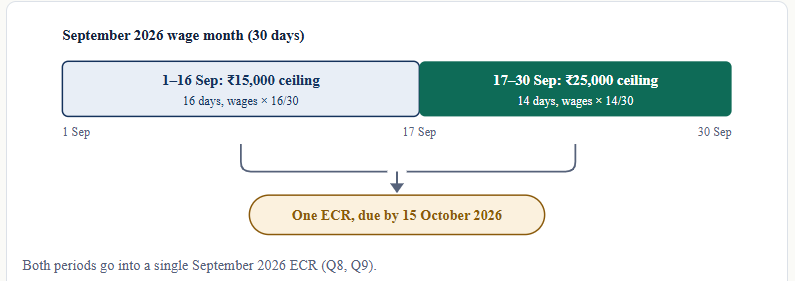
Q8 Will employers have to file two ECRs for September 2026?
No. The September 2026 wage month is to be handled in a single ECR, with the contribution calculated appropriately for the two wage-ceiling periods (see the illustration in Q7). The return for September 2026 is ordinarily due by 15 October 2026.Q9How should an employer report contribution for existing employees in the ECR for the September 2026 wage month?
For an existing employee, the employer should calculate contributions separately for the two periods:
Where an existing employee is an EPF member but excluded under EPS, and his wages are in the ₹15,000–₹25,000 range, the employee must be made a member of EPS w.e.f. 17.09.2026. Accordingly, his EPS contributions start from 17.09.2026.
Illustration: an employee has EPF wages of ₹20,000 per month and was not a member of EPS earlier. He becomes a member w.e.f. 17.09.2026. For September 2026 (see the detailed illustration in Q7):
| Period | Applicable ceiling | EPF wages considered | EPS wages |
|---|---|---|---|
| 01.09.2026 to 16.09.2026 | ₹15,000 | ₹15,000 | Nil |
| 17.09.2026 to 30.09.2026 | ₹25,000 | ₹20,000 | ₹20,000 |
Where additional employee contribution becomes payable from 17 September 2026, the contribution is attributable to the September 2026 wage month and should be reported and remitted through the September 2026 ECR.
Where deduction from salary could not be effected for employees newly made eligible for coverage, employers will be permitted to defer recovery of the Employee Share (EE) to the next payroll cycle for the purposes of member take-home salary computation, without seeking any formal relaxation or prior approval from the Inspector-cum-Facilitator. Instructions in this regard are being issued by EPFO.
However, the employer should still file the ECR for the September wage month on or before the due date, giving full details of employee and employer contribution (see Q7), and remit the contribution within the timeline to avoid interest and penalty.Q11If an Employee Share (EE) deduction cannot be processed in the current payroll, can it be recovered in the next payroll cycle?
Yes. The recovery can be made in the subsequent payroll cycle, for the purposes of member take-home salary computation, without prior approval from the Inspector-cum-Facilitator for the September wage month. As per Paragraph 22 of the Employees’ Provident Funds Scheme, 2026, while the employer is generally expected to deduct the employee’s contribution from the wages of that specific month, provisions exist for recovery from subsequent wages under specific operational contingencies. Note the following for compliance:
CTC is not itself a statutory concept for determining the employer’s PF liability. PF contributions have to be determined with reference to the applicable statutory definition of wages and the relevant provisions. CTC is generally considered the total cost incurred by the employer towards the employee, and represents an arrangement between the employer and the employee.
If contributions were being made on the earlier wage ceiling of ₹15,000 but the actual PF wages were higher, the increase in the wage ceiling will increase the EPF, EPS, EDLI and admin charges accordingly. Employers should view their share of social-security contributions as a way to promote robust HR practice, with the objective of increasing employee satisfaction and retention.
The employer’s contribution and the employee’s contribution are legally distinct. CTC is not itself a statutory concept for determining the employer’s PF liability; PF contributions have to be determined with reference to the applicable statutory definition of wages and the relevant provisions.
The employer’s statutory contribution cannot simply be treated as an employee deduction merely by describing it as part of CTC. Employers should ensure that statutory employer contributions are made correctly and that the employee’s statutory wages are not reduced contrary to applicable law.
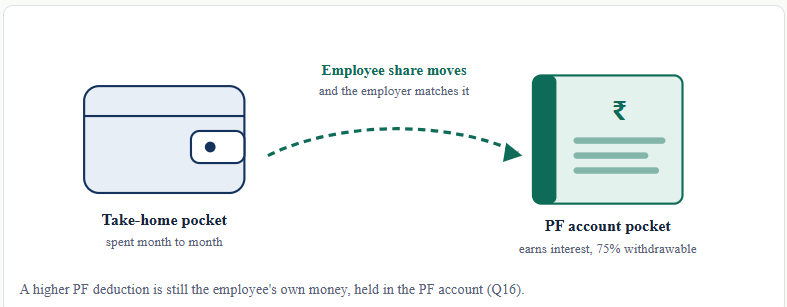
This has to be understood differently. The PF contribution goes to the employee’s own PF account (except the EPS contribution, which is used to provide pension later). Any increase in the employee share of EPF due to the higher wage ceiling is fully matched by the employer, earns consistently better interest, comes with tax benefits, and builds towards a guaranteed pension and free insurance cover: a small trade-off for lifelong security.
This increases guaranteed, steady, compounding savings that belong entirely to the employee and grow every year, safely and reliably. It may be thought of as moving money from the “take-home pocket” to the “PF account pocket” of the employee. It is the employee’s own money and always available to them.
The balance in the PF account is easily accessible and can be withdrawn to the extent of 75% at any time for any need. It is the same as having money in your bank account. At the same time, this money in the PF account earns better returns while providing easy liquidity.
Yes, for employees in the ₹15,000–₹25,000 bracket, or where the employee was earning more than ₹25,000 but contributing on ₹15,000. This can result in higher EPF accumulation along with applicable interest. The actual amount depends on the wage on which contributions are made.
They will be able to contribute on wages up to ₹25,000 and will benefit from a correspondingly higher employer contribution. For example, an employee drawing wages of ₹20,000 would now receive an employer contribution of ₹2,400 instead of ₹1,800 per month, leading to higher accumulation. In addition, the higher wage ceiling increases the pensionable salary considered at the time of retirement, which will increase the pension payable under EPS.
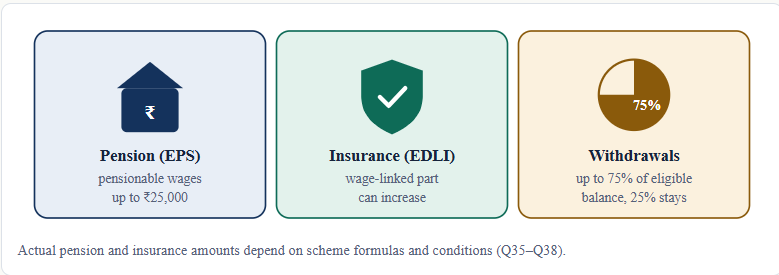
The withdrawal reforms allow withdrawal of up to 75% of the eligible PF balance in specified circumstances, while 25% is retained as a minimum balance, subject to the applicable provisions.Q35Will the revised ceiling increase pension under EPS?
The revised ceiling expands the scope for EPS coverage and permits pensionable wages to be considered up to the revised statutory ceiling, subject to applicable EPS provisions. An individual member’s actual pension will continue to depend on pensionable salary, pensionable service and other applicable conditions.
For an eligible member whose pensionable wage is taken at a higher level under the revised provisions, the pension amount may be higher, subject to the applicable EPS formula and conditions. However, the revision does not mean every existing pensioner or member will automatically receive a proportionate increase.
The Government’s EPS contribution remains limited to 1.16% of wages up to ₹15,000 per month. The revision of the statutory ceiling to ₹25,000 does not, by itself, increase the Government’s contribution beyond ₹174 per month per member. This has no impact on the member’s pension, which depends on pensionable wages and pensionable service.
No. The increase in the wage ceiling can increase the wage-linked component used for calculating the EDLI benefit, but the maximum assurance benefit presently payable under EDLI remains ₹7 lakh. For example:
However, the EDLI benefit remains limited to the existing maximum assurance benefit of ₹7 lakh as per the present EDLI Scheme, 2026. An actuarial valuation of the EDLI fund will be undertaken, and based on that analysis, benefits may be decided in future.
It is not limited to increasing EPF accumulation. Because the wage ceiling has gone up, pensionable salary at the time of retirement will also increase, which in turn increases the pension payable on retirement. The revision therefore has wider social-security implications beyond PF savings alone.
Members covered under EPS receive a pension for life on retirement, followed by a spouse’s pension for life. In the unfortunate event of death during service, even after just one month of service, the family becomes eligible for benefits such as a widow’s pension for life, children’s pension for two children up to the age of 25, orphan pension where no parent is alive, and a nominee or dependent-parent pension where there is no spouse or child. The scheme also provides a lifelong pension in case of total and permanent disablement, including for permanently disabled children.
In addition, EDLI members are covered by a life-insurance benefit of up to ₹7 lakh, payable to the nominee or legal heirs in the unfortunate event of death during service. The cost of this insurance cover, 0.5% of wages, is borne entirely by the employer and is free for the employee.
EPF is a highly safe savings instrument offering good returns and tax benefits. It builds disciplined savings through one’s career, yielding handsome compounded returns at retirement, while also allowing a member with at least one year of service to withdraw up to 75% of accumulations to meet unforeseen needs, combining safety, security and liquidity.
EPS provides a pension for life on retirement, followed by a spouse’s pension for life, and, in case of the member’s death even after just one month of service, a widow’s pension for life along with children’s pension up to age 25 (or pension to nominee or dependent parents where there is no family). It also provides a lifelong pension in the event of total and permanent disablement, including for disabled children.
EDLI provides the nominee or legal heirs a life-insurance benefit of up to ₹7 lakh in the unfortunate event of the member’s death during service.
For employers, the additional cost is a predictable, well-understood 12% matching contribution, split as 3.67% towards EPF and 8.33% towards EPS, capped at the revised ₹25,000 wage ceiling. This can be partly offset by the incentive of up to ₹3,000 per month for every additional employment created under PMVBRY.
Beyond the contribution itself, formalising more of the workforce also reflects well on India as an investment destination, since global buyers and investors increasingly favour suppliers with strong, verifiable labour-compliance records.
The rate of contribution for MSMEs is the same as for any other establishment under the Code on Social Security, 2020. The potential costs due to the increase in the wage ceiling can be partly offset by the incentive of up to ₹3,000 per month for every additional employment created under PMVBRY.
No. An eligible first-time employee under Part A will continue to receive a benefit equivalent to one month’s EPF wage, subject to a maximum of ₹15,000, in accordance with the PMVBRY scheme.
Q46 What should employers do immediately?
Q47 What is the key message employers should communicate to employees?
The enhancement of the wage ceiling represents a widening of statutory social-security coverage. Employees who fall within the revised threshold can now receive the benefits of the EPFO framework, including provident fund savings, pension protection and insurance cover, subject to the applicable statutory and scheme conditions.
For existing members, the higher ceiling may also result in contributions on a higher statutory wage base, increasing retirement savings and, where applicable, pensionable wages.
Employees should also understand that a higher PF deduction has a positive impact on their overall finances: it immediately attracts a matching employer contribution into their own PF account, which earns one of the best interest rates available (8.25% per annum in FY 2025-26, compounded on the monthly running balance), along with tax-free savings, a monthly pension and premium-free insurance. The resulting benefits outweigh the higher deduction.Q48What is the most important compliance message for employers?
The revised ₹25,000 ceiling is effective from 17 September 2026. Employers should not wait for the next payroll cycle to begin reviewing their affected employee population.
The immediate priority is to identify, calculate, enrol, report, remit and reconcile. In particular, employers should ensure that employees within the revised mandatory coverage are covered from the effective date and that the September 2026 ECR accurately reflects the applicable contributions.


Facile Management Services (OPC) Private Limited is committed to delivering seamlessly integrated HR and compliance solutions designed for the evolving