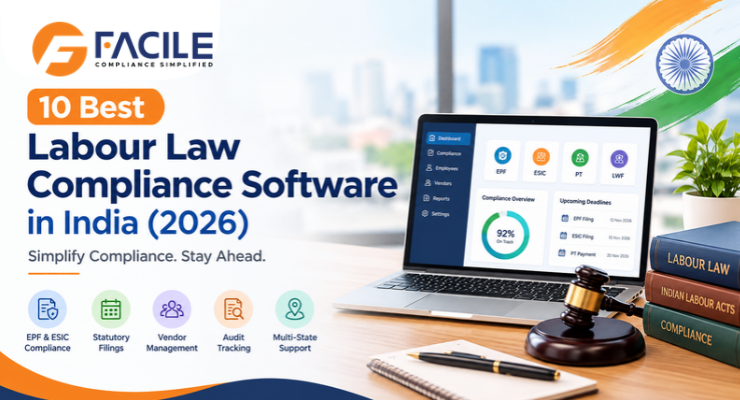
Managing labour law compliance is an essential responsibility for businesses operating in India. Organisations must maintain statutory records, monitor filing deadlines, manage employee-related obligations, track licences, and comply with applicable central and state labour laws. Handling these activities manually can increase administrative workloads and the risk of missed deadlines.
Labour law compliance software helps businesses streamline statutory processes, automate recurring tasks, organise compliance documents, and monitor compliance status through a centralised platform.
For organisations operating across multiple branches, states, contractors, or vendors, choosing the right compliance management software can improve visibility, accountability, and operational efficiency.
In this guide, we explore the 10 best labour law compliance software solutions in India for 2026, their key capabilities, and the factors businesses should consider before selecting a platform.
Labour law compliance software is a digital solution that helps organisations manage statutory obligations related to employment, payroll, employee benefits, workplace regulations, and labour documentation.
Depending on the platform, features may include:
The features and level of automation differ between providers. Businesses should verify that their selected solution supports the applicable laws, locations, and filing responsibilities.
The following list includes dedicated statutory compliance platforms and broader HR and payroll systems. It is a comparison shortlist, not a verified performance ranking. The best option depends on your organisation’s compliance requirements, workforce size, and operating locations.
Best for: Organisations seeking integrated statutory compliance, vendor compliance, and audit management.
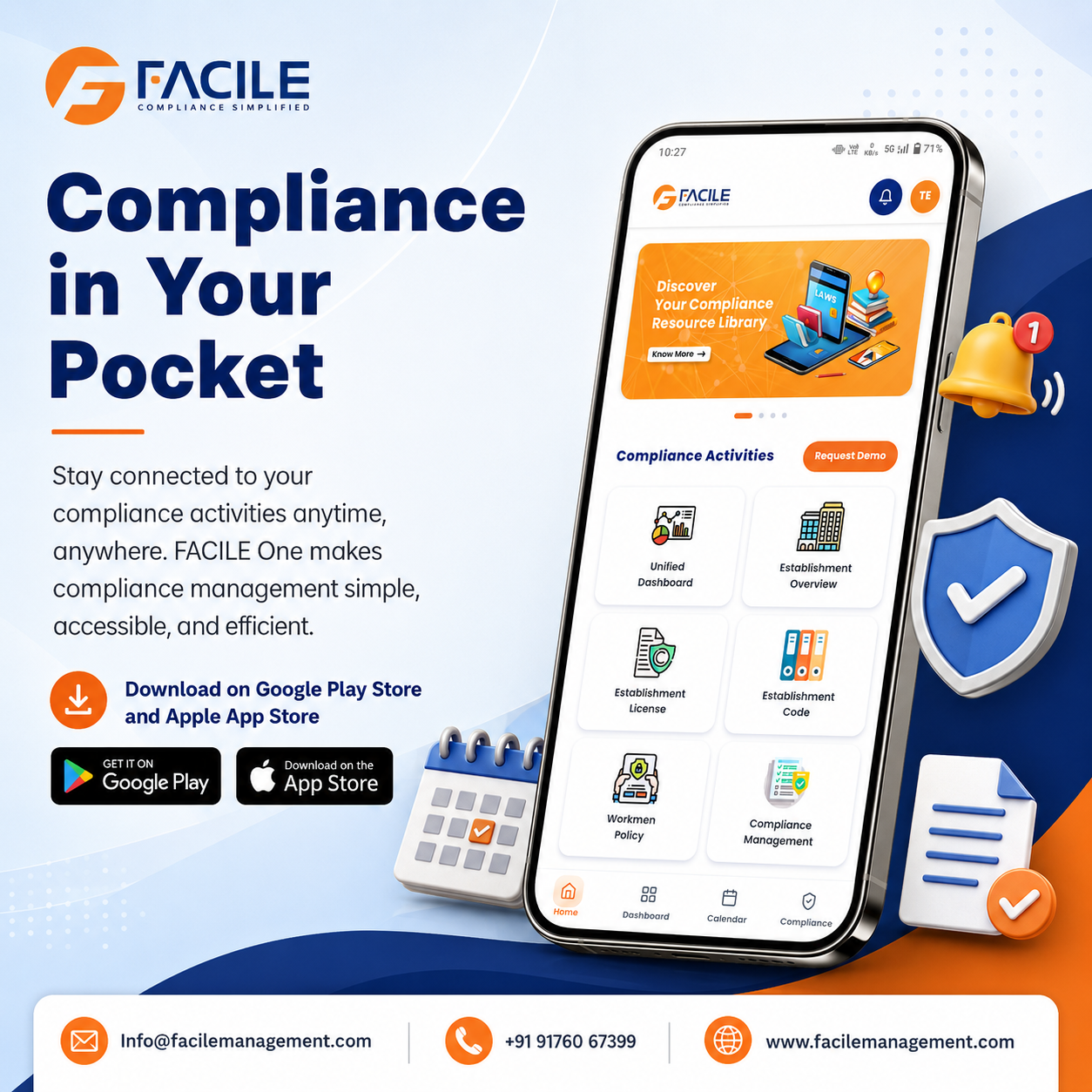
Facile Management Services offers compliance-focused solutions designed to help businesses organise statutory activities and monitor compliance obligations. Its product suite addresses requirements involving establishment compliance, vendor compliance, vendor audits, licence tracking, and workmen compensation tracking.
Key capabilities to explore:
Facile Management is worth considering for businesses that need visibility across establishments, vendors, and recurring statutory obligations rather than relying entirely on manual spreadsheets.
Website: https://www.facilemanagement.com/
Best for: Enterprises requiring broad regulatory compliance management and managed labour compliance services.
TeamLease RegTech offers RegTrack for compliance management and RegService for labour compliance services. Its solutions support regulatory tracking, compliance monitoring, contractor compliance, statutory registers, and inspection readiness.
Key capabilities:
The platform may suit organisations seeking a combination of compliance technology and professional support.
Website: https://teamleaseregtech.com/
Best for: Businesses looking for dedicated statutory compliance and audit management capabilities.
Simpliance is a compliance-focused platform associated with labour law compliance, regulatory information, statutory documentation, and audit processes.
Potential areas to evaluate:
Before selecting a solution, confirm the current product modules, coverage for your operating states, and availability of the specific workflows your business requires.
Website: https://www.simpliance.in/
Best for: HR teams and labour law consultants managing recurring statutory preparation and compliance information.
Komplis provides workflows for preparing statutory documents and monitoring recurring labour compliance activities. Its published features include PF and ESI challan preparation, PT and LWF workflows, due-date monitoring, and state-wise legal resources.
Key capabilities:
Komplis can be considered by teams that want practical tools for recurring statutory work and labour law information.
Website: https://komplis.com/
Best for: Businesses seeking automation across statutory, factory, establishment, payroll, and vendor compliance.
Iztty is a statutory compliance platform that brings together several compliance functions in one system. Its published product information highlights multi-location monitoring, document workflows, statutory registers, and vendor audit management.
Key capabilities:
It may be worth evaluating for organisations with complex statutory obligations across several business locations.
Website: https://iztty.com/
Best for: Organisations seeking technology-led labour law compliance monitoring and statutory register preparation.
Nhancesmart’s Complysmart is presented as a labour law compliance management tool. Its published information describes applicability mapping, compliance register preparation, and support for state-specific labour requirements.
Key capabilities to evaluate:
Businesses should confirm which compliance workflows are available in the selected package and how the platform integrates with existing payroll and HR systems.
Website: https://nhancesmart.com/
Best for: Businesses looking for an HRMS with payroll and employee management capabilities.
HROne provides human resource management and payroll-related functionality. For companies seeking to manage employee information and payroll processes alongside HR operations, an integrated HRMS can reduce duplication of data.
Key capabilities to evaluate:
Confirm whether the selected package supports the specific statutory registers, state-wise compliance tasks, audits, and licence management your organisation needs.
Website: https://hrone.cloud/
Best for: Small and medium-sized businesses looking for integrated HR, payroll, and employee management.
Keka combines HR management and payroll capabilities in a digital platform. It can be useful for organisations that want to consolidate employee records, payroll activities, and HR workflows.
Key capabilities to evaluate:
Keka may be appropriate for businesses prioritising payroll and employee management. Verify whether dedicated compliance audits, vendor monitoring, and establishment-level statutory workflows require additional solutions.
Website: https://www.keka.com/
Best for: Businesses seeking payroll automation and core HR management.
greytHR provides payroll and HR software designed to support recurring employee administration and payroll processes.
Key capabilities to evaluate:
For businesses with complex labour compliance obligations, assess whether the available modules cover their required state-specific registers, establishment licences, contractor records, and audit workflows.
Website: https://www.greythr.com/
Best for: Organisations looking for cloud-based HR management and employee workflow automation.
Zoho People focuses on HR processes and employee management. It may suit businesses that need a centralised employee database and integration with other business applications.
Key capabilities to evaluate:
Zoho People is primarily an HR management option to assess alongside dedicated statutory compliance software. Verify the availability of India-specific compliance functions and any integrations or additional tools required.
Website: https://www.zoho.com/people/
| Software | Primary focus | Best suited for |
|---|---|---|
| Facile Management Services | Statutory, vendor, and audit compliance | Businesses managing establishments and vendors |
| TeamLease RegTech | Regulatory and labour compliance | Enterprises with broad compliance requirements |
| Simpliance | Statutory compliance and audit workflows | Compliance teams |
| Komplis | Statutory preparation and due-date tracking | HR teams and labour law consultants |
| Iztty | Multi-domain statutory compliance | Multi-location businesses |
| Nhancesmart Complysmart | Labour compliance and register preparation | Organisations with state-specific requirements |
| HROne | HRMS and payroll | Businesses consolidating HR processes |
| Keka | HR and payroll management | Small and medium-sized businesses |
| greytHR | Payroll and core HR | Payroll-focused organisations |
| Zoho People | HR management and workflows | Businesses using cloud-based HR systems |
Note: This comparison describes the providers’ broad product focus. It does not represent independently tested performance scores or guarantee that every listed feature is available in every subscription. Confirm current functionality, integrations, coverage, and pricing directly with each provider.
Choosing the right platform requires more than comparing software prices. Businesses should assess how effectively each solution supports their statutory responsibilities.
Look for support for applicable employee records, contribution calculations, challan preparation, filing workflows, and payment tracking. Confirm which activities are automated and which require manual review or portal submission.
Businesses operating in different states must account for applicable state-specific requirements. Choose a platform that maps compliance obligations to the correct establishment and location.
A compliance calendar with reminders can help teams track recurring deadlines, pending activities, and upcoming licence renewals.
Digital register preparation and document storage can reduce manual effort and make it easier to retrieve records during internal reviews or inspections.
Organisations engaging contractors should evaluate tools for collecting supporting documents, tracking contractor licences, monitoring statutory submissions, and documenting audit findings.
Digital checklists, evidence collection, observations, corrective actions, and audit trails can help compliance teams identify and address gaps systematically.
A centralised licence register with expiry alerts can help organisations track registrations, renewals, and related documentation across multiple establishments.
Dashboards should help authorised users identify overdue tasks, missing documents, outstanding observations, and location-level compliance status.
Assess integration with existing HRMS, payroll, attendance, and accounting systems. Review access controls, backup arrangements, data retention, and security practices.
Implementing suitable compliance software can offer several operational benefits:
Software supports compliance management, but it does not independently guarantee legal compliance. Organisations still need accurate data, appropriate internal controls, qualified review, and timely completion of statutory obligations.
Before finalising a platform, follow these steps:
Facile Management Services provides a compliance-focused product suite for organisations seeking to manage statutory activities, vendor obligations, audits, and establishment-related requirements.
Its compliance management offering is relevant to businesses looking to centralise compliance monitoring and improve visibility across multiple locations and vendors.
Businesses evaluating Facile Management can explore the product suite to understand which modules match their specific requirements, including:
To determine suitability, request a demonstration and confirm the applicable modules, statutory coverage, implementation scope, and service responsibilities.
Explore Facile Management Services: https://www.facilemanagement.com/
The best labour law compliance software in India depends on your organisation’s size, industry, operating locations, contractor network, and statutory requirements.
Dedicated platforms such as TeamLease RegTech, Simpliance, Komplis, Iztty, and Nhancesmart Complysmart are worth evaluating for compliance-focused workflows. HRMS platforms such as HROne, Keka, greytHR, and Zoho People can be considered when payroll and employee management are key priorities. Facile Management Services is another option to assess for establishment, vendor, and audit compliance management.
Before making a decision, compare the available features, state-wise coverage, regulatory update process, integrations, support, and total cost of ownership.
Looking to simplify labour law compliance? Explore Facile Management Services to understand how its compliance management solutions can support your organisation’s compliance processes.
Website: https://www.facilemanagement.com/
The best software depends on your requirements. Facile Management Services, TeamLease RegTech, Simpliance, Komplis, and Iztty are options to evaluate for compliance-focused workflows. HRMS platforms such as Keka and greytHR may be suitable when payroll and employee management are primary needs.
It helps businesses organise statutory obligations, monitor deadlines, prepare supported registers and documents, track licences, maintain evidence, and monitor compliance activities.
Many platforms support some EPF and ESIC workflows, such as contribution calculations, challan preparation, employee records, and filing-related activities. Confirm the exact features and whether filing and payment are automated or require authorised user action.
Yes. Small businesses can use compliance software to organise statutory records, track deadlines, and reduce manual administrative work. The appropriate solution depends on workforce size, locations, complexity, and budget.
Some platforms support multi-state compliance management. Businesses should confirm coverage for each operating state, applicable central and state requirements, location-specific registers, and update processes.
An HRMS generally focuses on employee records, attendance, leave, payroll, and HR workflows. Dedicated labour law compliance software focuses more directly on statutory obligations, compliance calendars, registers, audits, licences, and regulatory monitoring. Some platforms combine both types of functionality.
Depending on the platform, it can help collect contractor documents, monitor submissions, track applicable statutory records, record audit observations, and follow corrective actions.
Pricing varies by provider, employee strength, number of establishments, modules, implementation requirements, and service scope. Request a customised quotation and compare the total cost rather than only the subscription fee.
No. Software can support monitoring and documentation, but compliance depends on accurate information, correct legal applicability, timely action, and appropriate review. Organisations remain responsible for meeting their legal obligations.
Identify your statutory requirements, operating states, workforce structure, vendor obligations, and reporting needs. Request demonstrations, verify available features and legal updates, review integrations and security, and compare support and pricing before selecting a platform.

Facile Management Services (OPC) Private Limited is committed to delivering seamlessly integrated HR and compliance solutions designed for the evolving