
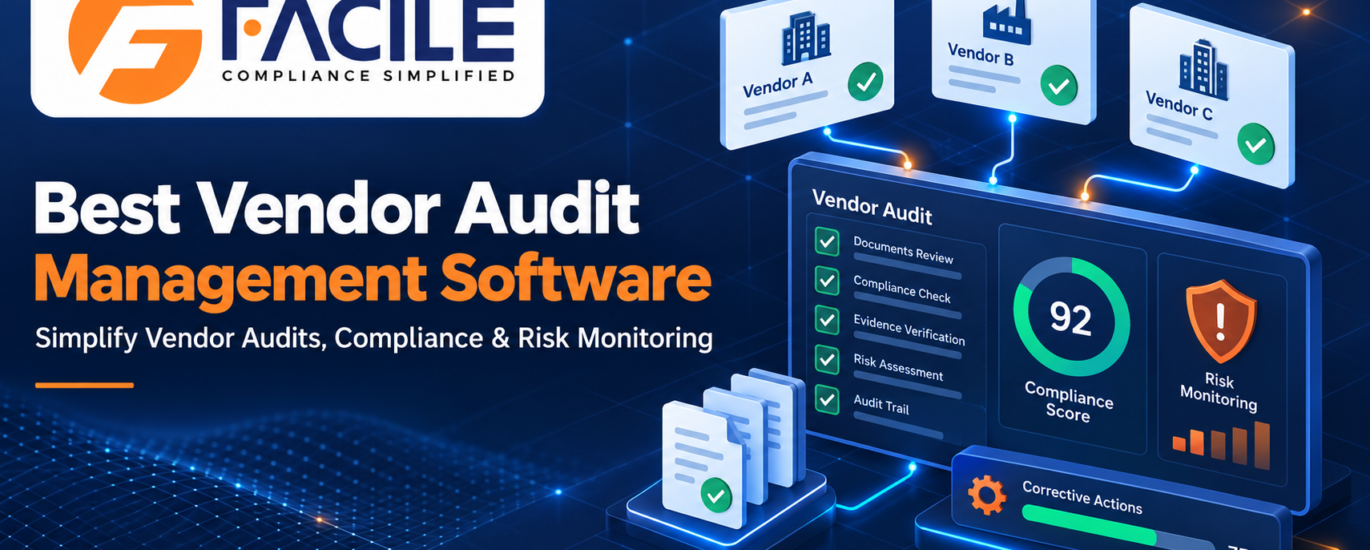
Vendors and contractors support many essential business activities, including manpower supply, security, housekeeping, facility management, transportation, logistics, construction, maintenance and technical services. Although these relationships improve operational flexibility, they can also introduce compliance, financial and reputational risks.
Organisations must verify whether vendors are maintaining required licences, paying wages correctly, depositing statutory contributions, submitting prescribed records and resolving identified compliance gaps. When these audits depend on spreadsheets, emails and physical files, document collection becomes time-consuming, findings are difficult to monitor and corrective actions may remain unresolved.
The best vendor audit management software should centralise audit planning, checklist management, document collection, record validation, observations, risk classification, compliance scoring and corrective-action tracking.
FACILE ONE helps organisations conduct structured vendor and contractor compliance audits across multiple locations and periods. It connects vendors, auditors, compliance teams and management through a controlled digital workflow, improving transparency, accountability and audit readiness.
Vendor Audit Management Software is a digital platform used to plan, conduct, document and monitor audits of vendors, contractors, suppliers and service providers.
It enables organisations to configure audit checklists, request supporting evidence, review submitted records, document findings, calculate compliance scores and track corrective actions through closure.
A comprehensive vendor audit platform can support:
Organisations may engage several vendors across factories, warehouses, offices, branches, retail outlets and project locations. Each vendor may have different contractual obligations, statutory requirements, workforce numbers and document-submission responsibilities.
The principal employer may also need visibility into whether contractors are complying with applicable employment, wage, social-security, safety and licensing requirements.
A structured vendor audit process helps organisations verify:
Vendor audit software makes this process more consistent, traceable and easier to monitor across the organisation.
Audit plans, checklists, working papers, vendor documents and observations may be stored in separate spreadsheets, folders and email conversations. This makes audit information difficult to retrieve and review.
Vendors may submit registers, returns, challans, licences and payroll records through multiple channels. Auditors must then organise the files and follow up repeatedly for missing information.
Different auditors or locations may use different assessment criteria. This can make vendor scores and audit results difficult to compare.
A document may be marked as submitted without verifying its completeness, period, relevance or consistency with related records.
Attendance, wage registers, payslips, bank statements, challans and statutory returns may not be reconciled systematically.
Audit findings may be recorded without assigning a responsible vendor representative, internal owner or target completion date.
Observations may remain unresolved because responses, supporting evidence and closure approvals are not monitored through a structured workflow.
Management may receive a summary only after the audit is completed, preventing early intervention in high-risk issues.
Comparing compliance performance across vendors becomes challenging when each audit follows a different format or scoring approach.
Spreadsheet changes and email approvals may not provide a reliable record of who submitted, reviewed, modified or approved audit information.
A vendor audit management system connects every stage of the audit lifecycle through a structured process.
The organisation defines the vendor, location, audit period, audit type, scope, applicable requirements and planned completion date.
Audit checklists are configured according to the vendor category, service type, contractual obligations, applicable laws and organisational requirements.
Auditors, reviewers, vendors and responsible internal stakeholders receive suitable responsibilities and access permissions.
The system communicates the documents and evidence required for each audit point or compliance period.
Authorised vendors upload registers, returns, challans, licences, certificates, payroll records and other supporting documents.
Auditors review submitted records for completeness, accuracy, relevance and consistency with related documents.
Audit findings are recorded against the relevant checklist point with comments, supporting evidence, recommendations and risk information.
Observations are classified according to severity, urgency, statutory exposure, financial impact or operational consequences.
Corrective actions are assigned to responsible users with deadlines, instructions and evidence requirements.
Auditors review vendor responses and supporting evidence before accepting, rejecting or reopening an observation.
Vendor performance is evaluated using configured audit parameters, observation results and scoring rules.
Dashboards and reports provide visibility into audit progress, open observations, vendor scores, high-risk findings and overdue actions.
Create checklists according to applicable laws, vendor categories, contracts, work locations, service types and internal policies.
Maintain audit plans, checklists, evidence, observations, responses, approvals and final reports in one controlled system.
Plan monthly, quarterly, half-yearly, annual or event-based vendor audits and monitor completion status.
Allow authorised vendors to upload requested documents, provide clarifications and submit corrective-action evidence.
Collect registers, returns, challans, licences, payroll records, certificates and supporting evidence against specific audit requirements.
Review whether submitted records are complete, relevant to the audit period and consistent with connected compliance information.
Compare attendance, wages, overtime, deductions, payslips, bank-payment evidence and statutory contribution records.
Review contribution records, challans, payment confirmations, employee details and other supporting documents based on applicable requirements.
Monitor contractor licences, registrations, insurance documents, agreements and other time-sensitive records.
Record findings against individual audit points with comments, recommendations, evidence and responsible users.
Classify observations according to severity, priority, financial exposure, legal impact or operational consequences.
Calculate vendor scores using configured assessment criteria and present results through clear performance indicators.
Assign corrective and preventive actions with owners, deadlines, responses, evidence and closure status.
Enable auditors to review responses, request clarification, accept evidence or reopen observations requiring further action.
Notify responsible stakeholders about pending documents, approaching deadlines, unresolved findings and overdue corrective actions.
Configure audit review, approval and escalation levels according to organisational responsibilities.
Monitor audits across multiple vendors, contractors, factories, branches, warehouses and project locations.
Compare vendor scores, risks, submission performance and corrective-action closure rates across locations and periods.
Generate detailed reports and view audit status, risk exposure, compliance scores and observation trends through dashboards.
Maintain a traceable history of document submissions, audit decisions, comments, changes, approvals and closures.
Provide suitable permissions to vendors, auditors, compliance teams, HR departments, procurement teams and management.
The documents required for a vendor audit depend on the nature of the service, workforce deployment, contractual conditions and applicable statutory requirements.
Commonly reviewed documents may include:
The exact checklist should be configured according to the organisation’s requirements and the vendor’s statutory applicability.
A flexible vendor audit management platform can support different audit programmes.
FACILE ONE can support workflows associated with:
Standard checklists and workflows help auditors apply uniform assessment criteria across vendors and locations.
Centralised evidence collection and structured review processes reduce delays caused by scattered documents and repeated follow-ups.
Management can monitor audit progress, compliance scores, open observations and high-risk findings from a common dashboard.
Each submission, clarification and corrective action can be linked to a responsible vendor representative and completion date.
Potential compliance gaps can be identified before they result in penalties, disputes, operational interruptions or reputational damage.
Observations remain visible until the required response, evidence, review and closure stages are completed.
The platform provides improved visibility into contractor payroll, statutory records and compliance performance.
Digital workflows reduce manual document sorting, spreadsheet consolidation, email follow-ups and report preparation.
Consistent scoring parameters help organisations compare compliance performance across vendors and periods.
Documents, auditor comments, vendor responses and closure evidence remain connected to the appropriate audit point.
Structured records make it easier to retrieve evidence during management reviews, customer assessments or regulatory inspections.
Historical audit data helps organisations identify recurring findings, high-risk vendors and areas requiring stronger controls.
The best vendor audit management software should align with the organisation’s vendor network, audit scope, compliance responsibilities and internal review process.
The platform should allow checklists to be configured by vendor category, applicable law, service type, location and audit period.
Documents should be collected against specific audit requirements instead of being stored as unrelated attachments.
The software should help auditors review completeness, relevance and consistency across vendor records.
Findings should be classified and prioritised according to their compliance, financial and operational impact.
The platform should support responsibility assignment, deadlines, responses, evidence, review and closure.
Scoring methods should be consistent, configurable and easy for management teams to understand.
Businesses should be able to monitor audits centrally while retaining vendor-wise and location-wise visibility.
The solution should clearly present pending audits, overdue actions, critical risks, vendor scores and performance trends.
Access should be controlled according to the responsibilities of vendors, auditors, reviewers and management users.
The system should maintain a reliable history of activities, submissions, comments, decisions and changes.
Auditors and vendors should be able to submit evidence, record findings and respond to observations without unnecessary complexity.
The platform should support additional vendors, locations, users, audits and records as the organisation grows.
Where required, the solution should support data exchange with payroll, attendance, HR, procurement, ERP or document-management systems.
The software provider should understand vendor compliance audits and assist with checklist configuration, process mapping and user onboarding.
FACILE ONE brings vendor audits, document management, compliance monitoring, risk assessment and corrective-action tracking into one integrated platform.
FACILE ONE supports structured reviews involving vendors, contractors, statutory documents, payroll records and multiple establishments.
Audit types, checklists, scoring rules, risk levels, reviewer responsibilities and approval processes can be configured according to organisational requirements.
Auditors and authorised users can access submitted records, comments, observations and responses from a common repository.
Findings can be recorded against individual audit points with supporting evidence, risk classifications and recommended actions.
The platform supports the structured review of attendance, wage records, payslips, challans, statutory returns and payment evidence.
Organisations can evaluate vendor performance through configured audit parameters and compliance results.
Responsibilities, target dates, vendor responses, supporting evidence and closure decisions can be tracked through a controlled process.
Central teams can monitor audit status and risks across multiple vendors, factories, branches, establishments and project sites.
Management can view pending audits, high-risk observations, overdue actions, vendor scores and recurring compliance gaps.
Role-based access and complete audit trails provide greater control over confidential vendor and audit information.
FACILE ONE can support expanding vendor networks, audit programmes, business locations and compliance requirements.
FACILE ONE is suitable for:
Organisations can strengthen vendor audits by combining the right software with clearly defined audit procedures.
Recommended practices include:
Vendor audits should not depend on disconnected spreadsheets, repeated emails and physical documents.
FACILE ONE connects vendors, contractors, auditors, compliance teams and management through one digital audit platform. From checklist configuration and document collection to risk classification, compliance scoring and corrective-action closure, every stage becomes more structured and visible.
With FACILE ONE, organisations can reduce administrative effort, improve audit consistency, strengthen vendor accountability and maintain better control over third-party compliance risks.
Stay connected. Stay compliant. Manage vendor audits effectively with FACILE ONE.
Vendor Audit Management Software is a digital platform used to plan vendor audits, collect evidence, record findings, assess risks, calculate compliance scores and monitor corrective actions.
The best Vendor Audit Management Software is a configurable platform that supports the complete audit lifecycle, including planning, checklists, evidence collection, observations, risk classification, corrective actions and reporting.
FACILE ONE provides configurable checklists, structured document collection, audit observations, risk classification, compliance scoring, corrective-action tracking and management dashboards.
Yes. Organisations can manage audits for multiple vendors, contractors, service providers and manpower agencies through one centralised platform.
Yes. Audits can be organised and monitored by factory, establishment, branch, warehouse, project or other operational location.
Yes. Authorised vendors can upload requested records, provide clarification and submit corrective-action evidence through controlled workflows.
Yes. Checklists can be configured according to vendor category, applicable requirements, contract terms, service type and location.
The platform supports the structured review of attendance, wages, overtime, deductions, payslips, registers, challans and available payment evidence.
Yes. Applicable contribution records, challans, payment confirmations and supporting employee information can be collected and reviewed.
Yes. Vendor licences, registrations, agreements, insurance policies and certificates can be reviewed with their validity information.
Yes. Findings can be recorded against specific checklist points with comments, evidence, recommendations, risks and corrective actions.
Yes. Observations can be classified according to configured severity, priority, statutory exposure and business impact.
FACILE ONE can generate performance indicators using configured audit points, document status, observations and scoring parameters.
Yes. Corrective actions can include responsible users, target dates, responses, supporting evidence and closure status.
Yes. An observation can remain open or be reopened when the submitted response or evidence does not adequately address the finding.
Yes. Alerts can be configured for missing documents, approaching deadlines, overdue actions and unresolved audit findings.
Yes. Dashboards and reports can compare vendor scores, risk levels, open observations, document status and corrective-action performance.
Yes. Authorised users can review previous audit findings, responses, scores and closure information to identify recurring issues.
Yes. FACILE ONE can maintain traceable records of submissions, reviews, comments, modifications, approvals and closure decisions.
Yes. The platform can support multiple vendors, locations, users, audit types and large volumes of compliance records.
No. The software improves audit workflow, documentation, monitoring and reporting. Professional judgement remains essential when reviewing evidence and interpreting requirements.
No. The platform supports compliance monitoring and record control. Organisations should obtain professional advice when interpreting legal obligations or managing complex compliance matters.


Facile Management Services (OPC) Private Limited is committed to delivering seamlessly integrated HR and compliance solutions designed for the evolving