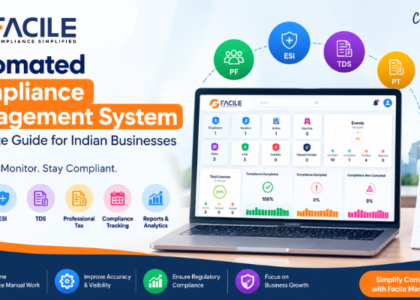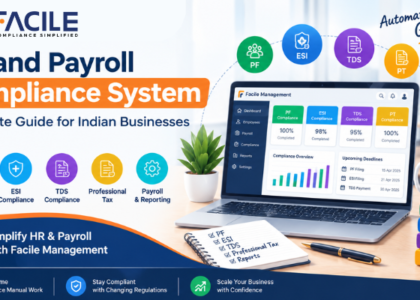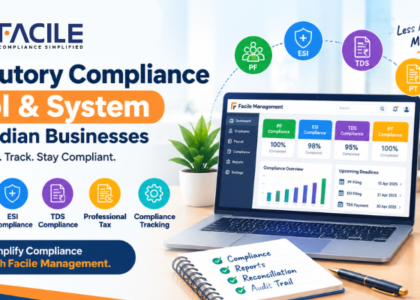
Managing business compliance manually can become difficult as an organisation grows. HR and payroll teams may need to monitor statutory requirements, employee records, payroll data, filing activities, deadlines, documents and compliance reports across multiple processes.
A compliance automation platform brings these activities into a centralized digital system. Instead of depending heavily on spreadsheets, emails and manual reminders, businesses can use technology to track, monitor, automate and report compliance activities.
For Indian businesses, this can be particularly useful for managing payroll-related statutory requirements such as PF, ESI, TDS and Professional Tax, along with compliance calendars, reports, exceptions and audit records.
A compliance automation platform is software that helps businesses manage compliance-related processes through a centralized system.
Depending on the platform, it can help organisations:
The objective is not simply to store compliance information. The platform should help teams move from manual compliance management to structured and trackable compliance operations.
Compliance activities can involve multiple employees, payroll cycles, statutory calculations, documents, deadlines and government reporting requirements.
Manual processes can create challenges such as:
Automation can reduce repetitive administrative work and provide a central view of compliance activities.
For example, the Income Tax Department currently states that payroll and ERP systems need to reflect the new section numbering, terminology and reporting requirements under the Income Tax Act, 2025, applicable to relevant TDS events from April 1, 2026.
This illustrates why compliance technology needs to support regulatory updates rather than relying entirely on static spreadsheets and manual processes.
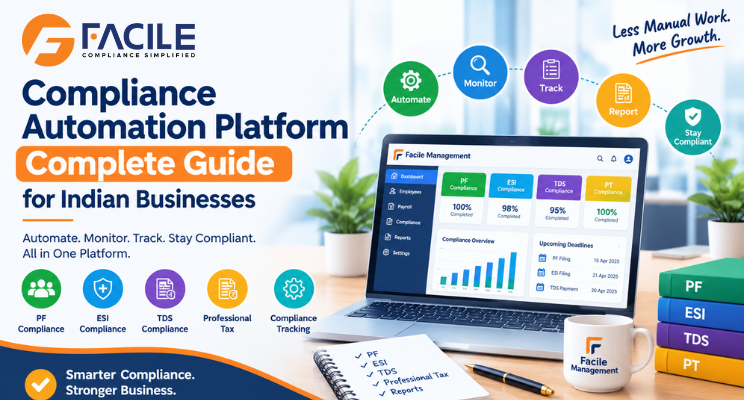
A dashboard can provide a single view of:
This helps HR, payroll and management teams understand compliance status without searching through multiple files.
For organisations covered by applicable EPFO requirements, a compliance platform can help manage PF-related payroll information and reporting workflows.
EPFO provides electronic challan-cum-return processes for employers, making accurate payroll data and structured submission processes important parts of compliance operations.
A platform can help teams:
ESI-related activities can also be incorporated into an automated compliance workflow.
A compliance platform can help HR and payroll teams organize:
TDS is an important part of payroll compliance.
An automated platform can help with:
The transition to the Income Tax Act, 2025 also highlights the importance of keeping payroll systems updated. The Income Tax Department states that salary paid from April 2026 onward is governed by the new Act and that payroll systems should reflect the new provisions and section numbering.
Professional Tax requirements can vary by applicable state rules.
A compliance automation platform can help organisations manage:
This is particularly useful for organisations operating across multiple locations.
A compliance calendar gives HR and payroll teams visibility into upcoming activities.
It can show:
Upcoming → Due → Completed → Pending → Overdue
This makes it easier to prioritize compliance tasks and reduce dependency on manual reminders.
Automated notifications can remind responsible users about:
Instead of depending on individuals to remember every deadline, the system can create structured workflows.
Automation should not only identify completed activities.
It should also highlight exceptions.
For example:
Payroll processed → Compliance validation → Exception identified → Assigned to HR → Corrected → Revalidated → Closed
This creates a more structured compliance process.
Management and HR teams may need reports for internal reviews and audits.
A compliance platform can provide reports such as:
An audit trail can help businesses understand:
This creates greater visibility during internal reviews and audits.
| Manual Compliance | Compliance Automation Platform |
|---|---|
| Multiple spreadsheets | Centralized system |
| Manual reminders | Automated notifications |
| Difficult status tracking | Real-time status visibility |
| Repetitive data entry | Workflow automation |
| Manual exception identification | Exception tracking |
| Scattered documents | Centralized records |
| Time-consuming reporting | Automated reports |
| Difficult audit preparation | Structured audit trail |
Automating repetitive activities allows HR and payroll teams to spend less time on manual tracking.
Management can view compliance status from a centralized dashboard.
Validation and structured workflows can reduce errors caused by repetitive manual processes.
Compliance calendars and alerts help teams monitor upcoming activities.
Centralized reports and audit trails can simplify compliance reviews.
As employee count and locations increase, centralized compliance management can become increasingly useful.
A typical workflow can look like this:
Employee & Payroll Data
↓
Compliance Validation
↓
PF / ESI / TDS / PT Checks
↓
Exception Identification
↓
Alerts & Task Assignment
↓
Compliance Action
↓
Reports & Audit Trail
↓
Management Dashboard
This creates a continuous compliance management cycle rather than a once-a-month manual checking process.
Before selecting a platform, businesses can evaluate:
For HR and payroll departments, compliance automation can bring several activities together.
Instead of managing payroll, compliance calendars, reports and audit documentation through separate spreadsheets, teams can use one centralized workflow.
Facile Management can be positioned as an HR and payroll compliance platform that helps businesses simplify compliance management through centralized tracking, automation, reporting and visibility.
Regulatory requirements and reporting systems can change over time. The Income Tax Department’s current guidance confirms the transition from the Income Tax Act, 1961 to the Income Tax Act, 2025 for applicable TDS events from April 1, 2026, including changes to section references and system reporting requirements.
For businesses, this reinforces the importance of having payroll and compliance systems that can accommodate regulatory changes.
A modern compliance platform should therefore combine automation, monitoring, reporting and update management rather than functioning simply as a digital checklist.
A compliance automation platform can help Indian businesses move from fragmented, manual compliance processes to a centralized and trackable approach.
By bringing together PF, ESI, TDS, Professional Tax, compliance tracking, alerts, exception management, reports and audit records, businesses can create a more organized compliance workflow.
For HR and payroll teams, the goal is simple:
Automate. Monitor. Track. Report. Stay Compliant.
Facile Management — Simplifying HR & Payroll.
A compliance automation platform is software that helps businesses automate, monitor and track compliance activities through a centralized system.
Depending on the software, businesses can automate or manage activities related to PF, ESI, TDS, Professional Tax, compliance calendars, alerts, reports, exceptions and audit tracking.
Yes. Small businesses can use compliance automation to centralize compliance activities and reduce dependence on spreadsheets and manual reminders.
Yes, depending on the platform. Payroll integration can allow compliance calculations, validation, reconciliation and reporting workflows to use payroll data.
No. Automation supports HR and payroll teams by handling repetitive workflows and improving visibility. Human review and responsibility remain important for compliance decisions and filings.
Many payroll and compliance platforms support PF and ESI-related calculations, tracking and reporting workflows. The exact capabilities depend on the software.
Yes. A suitable payroll compliance platform can support TDS calculation workflows, validation, reporting and tracking.
Compliance requirements can change. For example, the Income Tax Department says payroll and ERP systems need updates for the Income Tax Act, 2025’s new section numbering, terminology and reporting requirements.
Compliance software may primarily provide tools for recording and monitoring compliance. Compliance automation software adds automated workflows, alerts, validation, task management and reporting to reduce manual work.
Facile Management can help businesses organize HR and payroll compliance through centralized compliance management, tracking, reporting, alerts and automation.

Facile Management Services (OPC) Private Limited is committed to delivering seamlessly integrated HR and compliance solutions designed for the evolving