Managing statutory compliance manually can become increasingly challenging as businesses grow. HR, payroll and finance teams may need to monitor employee records, payroll information, statutory obligations, deadlines, documentation and filing activities across multiple locations.
A statutory compliance monitoring software provides a centralized way to track these activities, identify pending tasks, monitor exceptions and maintain compliance records.
For Indian businesses, such software can support payroll-related compliance areas such as PF, ESI, TDS and Professional Tax, along with compliance calendars, alerts, reports and audit tracking.
Statutory compliance monitoring software is a digital system designed to help businesses track, monitor and manage statutory compliance activities.
Instead of maintaining multiple spreadsheets and manual reminders, HR and payroll teams can use a centralized platform to monitor:
The purpose is to provide better visibility into what has been completed, what is pending and where corrective action may be required.
Statutory compliance involves recurring activities and changing regulatory requirements. Manual monitoring can make it difficult to maintain visibility across multiple employees, locations and payroll cycles.
Common challenges include:
A monitoring system can organize these activities into a structured workflow.
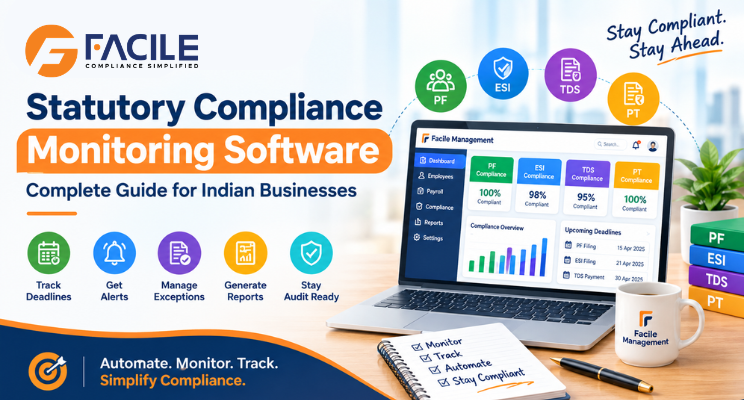
A compliance dashboard can provide an overview of:
This gives HR and payroll teams a single place to monitor compliance.
For applicable employers, PF-related payroll activities can be incorporated into a centralized compliance workflow.
The system can help teams:
The objective is to provide visibility into PF compliance activities rather than relying entirely on manual spreadsheets.
ESI compliance can also be included within the monitoring system.
HR and payroll teams can use the platform to track:
TDS is another important component of payroll compliance.
A monitoring platform can help businesses organize:
The regulatory environment has also changed in 2026. The Income Tax Department states that the Income Tax Act, 2025 applies to relevant TDS events from April 1, 2026, and that ERP and payroll systems need to reflect the new section numbering, terminology and reporting requirements.
Professional Tax requirements can vary according to applicable state rules.
A statutory compliance monitoring system can help businesses organize:
This can be particularly useful for businesses operating across multiple states.
A compliance calendar allows HR and payroll teams to see upcoming activities in one place.
A typical workflow can include:
Upcoming → Due → Completed → Pending → Overdue
This can make it easier to prioritize tasks and monitor deadlines.
A monitoring system can send alerts for:
Automated alerts reduce reliance on manually maintained reminder lists.
An effective compliance monitoring system should identify exceptions rather than simply display completed activities.
For example:
Payroll Data → Compliance Check → Exception → Assignment → Correction → Revalidation → Closure
This creates a structured process for managing compliance issues.
Businesses may require different reports for management reviews and audits.
Common reports can include:
An audit trail helps organisations track compliance activity history.
It can record:
This can make internal compliance reviews more organized.
A typical process can look like this:
Employee & Payroll Data
↓
Compliance Validation
↓
PF / ESI / TDS / PT Monitoring
↓
Exception Detection
↓
Alerts & Task Assignment
↓
Corrective Action
↓
Compliance Reports
↓
Audit Trail & Management Dashboard
This creates a continuous monitoring process instead of relying on periodic manual checks.
| Manual Monitoring | Compliance Monitoring Software |
|---|---|
| Spreadsheet-based tracking | Centralized dashboard |
| Manual reminders | Automated alerts |
| Scattered records | Centralized records |
| Manual status updates | Real-time status tracking |
| Difficult exception tracking | Structured exception management |
| Manual report preparation | Automated reporting |
| Time-consuming audits | Organized audit trail |
| Limited visibility | Centralized compliance visibility |
HR and management teams can see compliance status from a centralized dashboard.
Automated workflows can reduce repetitive tracking and administrative activities.
Compliance calendars and alerts can help teams monitor upcoming obligations.
Teams can identify pending or problematic activities more quickly.
Centralized records, reports and audit trails can simplify compliance reviews.
A centralized system can be useful as employee numbers, locations and compliance activities increase.
Compliance technology needs to keep pace with regulatory changes.
For example, the Income Tax Department’s current guidance confirms that TDS obligations transition from the Income Tax Act, 1961 to the Income Tax Act, 2025 based on when the relevant credit or payment occurs. It also states that payroll and ERP systems should be updated for the new section numbering, terminology and reporting requirements.
This makes compliance monitoring, system updates and accurate reporting important considerations when businesses evaluate compliance software.
Before selecting a solution, businesses can evaluate:
For HR and payroll teams, compliance monitoring becomes easier when payroll and statutory activities are connected within a centralized system.
Facile Management can help businesses bring HR, payroll and compliance monitoring into a structured digital workflow.
The platform can be positioned around five core activities:
Monitor → Track → Automate → Report → Audit
This allows HR and payroll teams to focus less on manual compliance tracking and more on managing their workforce and business operations.
Statutory compliance monitoring software helps Indian businesses organize and monitor recurring compliance activities through a centralized digital platform.
By bringing together PF, ESI, TDS, Professional Tax, compliance calendars, alerts, exception tracking, reports and audit records, businesses can create a more structured compliance management process.
For modern HR and payroll teams, the objective is simple:
Facile Management — Simplifying HR & Payroll.
Statutory compliance monitoring software is a system that helps businesses track, monitor and manage statutory compliance activities, deadlines, exceptions, documents and reports.
Depending on the software, businesses can monitor areas such as PF, ESI, TDS, Professional Tax and other applicable statutory requirements.
Yes, depending on the solution. Payroll integration can help use employee and payroll information for compliance validation, monitoring and reporting.
Yes. Compliance calendars and automated notifications can help HR and payroll teams monitor upcoming and pending activities.
This depends on the specific software and its integrations. Some platforms prepare reports or filing data, while actual submissions may require action through the relevant government portal or supported integration.
Instead of maintaining separate spreadsheets and reminder lists, teams can use centralized dashboards, automated alerts, workflows and reports.
Yes. A centralized compliance system can help small and growing businesses organize recurring compliance activities without relying entirely on manual tracking.
The Income Tax Department states that the Income Tax Act, 2025 applies to relevant TDS events from April 1, 2026, with new section numbering and reporting requirements. Payroll and ERP systems therefore need to support the applicable new framework.
Monitoring focuses on visibility, status and tracking. Automation adds automated workflows, alerts, validation and task management to reduce manual intervention.
Facile Management can provide a centralized approach to HR, payroll and statutory compliance management, helping teams monitor compliance activities, track exceptions, manage reports and improve operational visibility.

Facile Management Services (OPC) Private Limited is committed to delivering seamlessly integrated HR and compliance solutions designed for the evolving