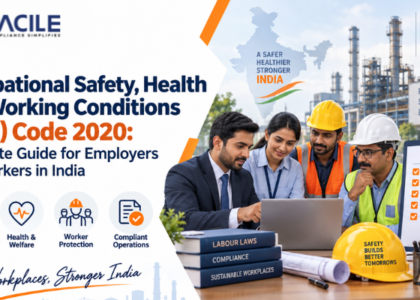

The Occupational Safety, Health and Working Conditions Code, 2020 (OSH Code) is one of India’s four Labour Codes. It consolidates laws dealing with workplace safety, occupational health, working conditions, factories, contract labour, migrant workers, construction workers, mines and related establishments.
The Code is Act No. 37 of 2020, enacted on 28 September 2020. India Code records its enforcement date as 21 November 2025.
The OSH Code aims to:
The Code specifically provides for employer responsibilities relating to cleanliness, hygiene, ventilation, drinking water, lighting, sanitation, waste treatment and other health and safety requirements.
The OSH Code brings together provisions from several earlier central labour laws, including:
| Earlier legislation | Broad subject |
|---|---|
| Factories Act, 1948 | Factory safety & working conditions |
| Mines Act, 1952 | Mine safety |
| Dock Workers (Safety, Health and Welfare) Act, 1986 | Dock workers |
| Contract Labour (Regulation and Abolition) Act, 1970 | Contract labour |
| Inter-State Migrant Workmen Act, 1979 | Migrant workers |
| Building and Other Construction Workers Act, 1996 | Construction workers |
| Working Journalists legislation | Working journalists |
| Cine-workers legislation | Cine workers |
The Code therefore represents a substantial consolidation rather than a completely new standalone safety framework.
For employers, the main compliance areas include:
Specified establishments are required to comply with registration requirements under the Code and applicable rules.
Employers have responsibilities relating to:
The Code provides for formal appointment documentation for employees.
The framework provides for occupational health measures, including health examinations in prescribed circumstances.
The Code allows the appropriate Government to require establishments to constitute a Safety Committee consisting of employer and worker representatives.
Certain thresholds specifically mentioned in the Code include:
Specified establishments must also appoint safety officers as prescribed.
The Code permits women to work in all establishments and allows night work subject to consent and prescribed safety requirements.
The Code contains provisions concerning:
The OSH Code contains specific provisions concerning inter-state migrant workers, including registration and certain welfare-related provisions.
A critical point for compliance teams is that labour is a Concurrent List subject. Consequently, rules under the Labour Codes are made by both the Central Government and State Governments, depending on the establishment and the “appropriate Government.”
The historical draft-rule position is also useful when researching state-wise implementation.
The Ministry of Labour’s published information identified the following jurisdictions as having pre-published draft OSH rules:
| State / UT | OSH Code draft-rule status |
|---|---|
| Andhra Pradesh | Pre-published |
| Arunachal Pradesh | Pre-published |
| Assam | Pre-published |
| Bihar | Pre-published |
| Chhattisgarh | Pre-published |
| Goa | Pre-published |
| Gujarat | Pre-published |
| Haryana | Pre-published |
| Himachal Pradesh | Pre-published |
| Jharkhand | Pre-published |
| Karnataka | Pre-published |
| Kerala | Pre-published |
| Madhya Pradesh | Pre-published |
| Maharashtra | Pre-published |
| Manipur | Pre-published |
| Mizoram | Pre-published |
| Nagaland | Pre-published |
| Odisha | Pre-published |
| Punjab | Pre-published |
| Rajasthan | Pre-published |
| Sikkim | Pre-published |
| Tamil Nadu | Pre-published |
| Telangana | Pre-published |
| Tripura | Pre-published |
| Uttarakhand | Pre-published |
| Uttar Pradesh | Pre-published |
| Chandigarh | Pre-published |
| Dadra & Nagar Haveli and Daman & Diu | Pre-published |
| Jammu & Kashmir | Pre-published |
| Ladakh | Pre-published |
| Puducherry | Pre-published |
The Ministry’s 2024 material identified 31 States/UTs in this category. It identified Meghalaya, West Bengal, Andaman & Nicobar Islands, Lakshadweep and NCT of Delhi as jurisdictions that had not pre-published draft rules at that point.
Important: this table describes the draft-rule publication position at that time, not the current final-rule status. Since the OSH Code became enforceable on 21 November 2025 and state rules have continued to develop, a current compliance matrix should distinguish draft rules, final notified state rules and applicable Central Rules.
For a payroll/HR/compliance platform, I recommend maintaining the following state-wise structure:
| State/UT | OSH Code | State Rules | Establishment Registration | Factory Compliance | Contract Labour | Migrant Labour | Safety/Health | Forms/Returns | Notifications |
|---|---|---|---|---|---|---|---|---|---|
| Andhra Pradesh | ✓ | Check latest | Applicable as prescribed | Applicable | Applicable | Applicable | Applicable | As prescribed | Track |
| Arunachal Pradesh | ✓ | Check latest | Applicable as prescribed | Applicable | Applicable | Applicable | Applicable | As prescribed | Track |
| Assam | ✓ | Check latest | Applicable as prescribed | Applicable | Applicable | Applicable | Applicable | As prescribed | Track |
| Bihar | ✓ | Check latest | Applicable as prescribed | Applicable | Applicable | Applicable | Applicable | As prescribed | Track |
| Chhattisgarh | ✓ | Check latest | Applicable as prescribed | Applicable | Applicable | Applicable | Applicable | As prescribed | Track |
| Goa | ✓ | Check latest | Applicable as prescribed | Applicable | Applicable | Applicable | Applicable | As prescribed | Track |
| Gujarat | ✓ | Check latest | Applicable as prescribed | Applicable | Applicable | Applicable | Applicable | As prescribed | Track |
| Haryana | ✓ | Check latest | Applicable as prescribed | Applicable | Applicable | Applicable | Applicable | As prescribed | Track |
| Himachal Pradesh | ✓ | Check latest | Applicable as prescribed | Applicable | Applicable | Applicable | Applicable | As prescribed | Track |
| Jharkhand | ✓ | Check latest | Applicable as prescribed | Applicable | Applicable | Applicable | Applicable | As prescribed | Track |
| Karnataka | ✓ | Check latest | Applicable as prescribed | Applicable | Applicable | Applicable | Applicable | As prescribed | Track |
| Kerala | ✓ | Check latest | Applicable as prescribed | Applicable | Applicable | Applicable | Applicable | As prescribed | Track |
| Madhya Pradesh | ✓ | Check latest | Applicable as prescribed | Applicable | Applicable | Applicable | Applicable | As prescribed | Track |
| Maharashtra | ✓ | Check latest | Applicable as prescribed | Applicable | Applicable | Applicable | Applicable | As prescribed | Track |
| Odisha | ✓ | Check latest | Applicable as prescribed | Applicable | Applicable | Applicable | Applicable | As prescribed | Track |
| Punjab | ✓ | Check latest | Applicable as prescribed | Applicable | Applicable | Applicable | Applicable | As prescribed | Track |
| Rajasthan | ✓ | Check latest | Applicable as prescribed | Applicable | Applicable | Applicable | Applicable | As prescribed | Track |
| Tamil Nadu | ✓ | Check latest | Applicable as prescribed | Applicable | Applicable | Applicable | Applicable | As prescribed | Track |
| Telangana | ✓ | Check latest | Applicable as prescribed | Applicable | Applicable | Applicable | Applicable | As prescribed | Track |
| Uttar Pradesh | ✓ | Check latest | Applicable as prescribed | Applicable | Applicable | Applicable | Applicable | As prescribed | Track |
| Uttarakhand | ✓ | Check latest | Applicable as prescribed | Applicable | Applicable | Applicable | Applicable | As prescribed | Track |
| West Bengal | ✓ | Verify current rules | Applicable as prescribed | Applicable | Applicable | Applicable | Applicable | As prescribed | Track |
| Delhi | ✓ | Verify current rules | Applicable as prescribed | Applicable | Applicable | Applicable | Applicable | As prescribed | Track |
| Meghalaya | ✓ | Verify current rules | Applicable as prescribed | Applicable | Applicable | Applicable | Applicable | As prescribed | Track |
| Andaman & Nicobar | ✓ | Verify current rules | Applicable as prescribed | Applicable | Applicable | Applicable | Applicable | As prescribed | Track |
| Lakshadweep | ✓ | Verify current rules | Applicable as prescribed | Applicable | Applicable | Applicable | Applicable | As prescribed | Track |
Do not treat “Code applicable” as meaning every provision applies identically to every establishment. The applicable government, establishment type, employee strength, industry and specific provisions determine the actual compliance requirements.
The OSH framework should be read in three layers:
Layer 1 — OSH&WC Code, 2020
The primary legislation.
Layer 2 — Central Rules
Applicable where the Central Government is the appropriate Government or otherwise prescribed.
Layer 3 — State Rules
Applicable where the State Government is the appropriate Government.
This distinction is particularly important for organizations operating across multiple states. The Ministry has historically published model/draft Central OSH Rules, while state governments have their own rule-making responsibilities.
For example, the Maharashtra Labour Department currently provides separate resources for the OSH Code and state OSH draft rules, alongside Central Rules.
A practical employer checklist can include:


Facile Management Services (OPC) Private Limited is committed to delivering seamlessly integrated HR and compliance solutions designed for the evolving