
Statutory compliance involves far more than remembering filing dates. Employers must understand which requirements apply, collect accurate employee and contractor data, validate wages and contributions, maintain prescribed records, monitor licences, submit returns and preserve evidence for inspections. When these activities are managed through spreadsheets, emails and physical files, even an experienced compliance team can struggle to maintain complete visibility.
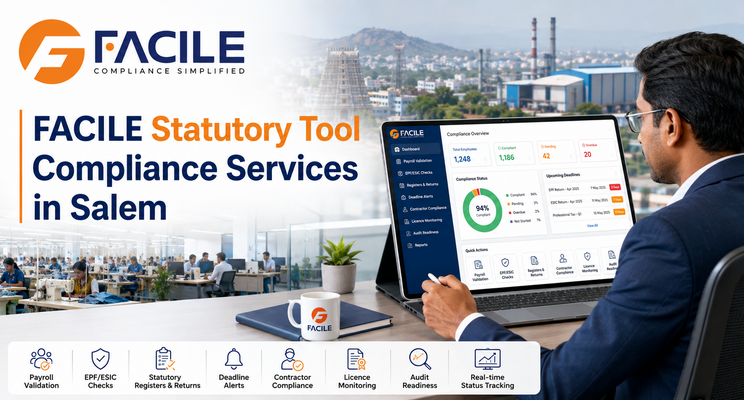
FACILE Statutory Tool Compliance Services in Salem provide a structured digital approach to managing recurring labour and employment compliance. The FACILE platform brings compliance calendars, payroll-linked validations, statutory registers, returns, licences, contractor records, audit observations and management reports into one coordinated environment. This helps employers see what is due, what has been completed, what evidence is available and where corrective action is required.
Salem is home to steel and metal industries, textiles, spinning mills, foundries, engineering units, food and sago processing businesses, warehouses, hospitals, educational institutions, retail operations and professional services. These organisations differ in their workforce, processes, contractors and legal applicability. FACILE therefore supports an applicability-based compliance framework instead of treating every establishment in the same way.
Compliance responsibilities are often distributed across HR, payroll, finance, administration, factory management, contractors and external consultants. Each team may hold only part of the required information. Attendance sits with HR, wage data with payroll, challans with finance, licences with administration and contractor documents with site teams. Without a common platform, it becomes difficult to confirm whether the complete compliance cycle has been closed.
Common challenges include:
A statutory compliance tool helps convert these fragmented tasks into defined workflows with owners, dates, evidence and review controls.
FACILE Statutory Tool Compliance Services combine compliance-domain support with technology-enabled monitoring. The service helps organisations configure their compliance universe, assign activities, collect records, validate data, track completion and produce management information.
Depending on the agreed scope, FACILE may support:
The platform improves control and visibility, but it does not replace the need for accurate source data, responsible management decisions or professional interpretation of complex legal questions.
The foundation of an effective statutory tool is correct applicability. A generic calendar containing every possible activity can create noise and false assurance. FACILE begins by understanding the organisation and configuring obligations relevant to its actual operations.
The assessment may consider:
The resulting compliance matrix links each applicable activity to its frequency, due date, responsible user, reviewer, evidence requirement and escalation path. Whenever the organisation opens a new unit, changes its process, increases workforce or appoints a contractor, applicability can be reviewed again.
The compliance calendar is the operational heart of the system. It converts statutory obligations into scheduled activities that users can monitor throughout the month and year.
Activities can be organised by:
Instead of waiting for the legal due date, organisations can set internal cut-off dates for collecting attendance, payroll, contractor and payment data. Automated reminders and escalation help responsible teams act before an activity becomes overdue.
The calendar may classify tasks as upcoming, in progress, submitted, completed, pending review, rejected, overdue or not applicable. This creates a clear picture of the organisation’s current compliance position.
Statutory deductions and wage compliance depend on the quality of payroll inputs. If employee identity, attendance, wage components, leave, overtime or joining and exit dates are incorrect, downstream contributions and records can also be wrong.
FACILE can help validate:
Exception reports enable the payroll or compliance team to correct inputs before filing or finalising records. This is more reliable than discovering the error during an audit several months later.
Minimum wages may differ by state, scheduled employment, category, skill, zone and effective date. Businesses must use the rate applicable to the employee’s work and location and should review notifications whenever rates change.
FACILE can support minimum-wage compliance by mapping employee or contractor categories to configured statutory rates and comparing payable wage components with the applicable requirement. The tool may highlight:
The final determination should be reviewed by a knowledgeable person because applicability can depend on the wording of the relevant notification and the employee’s actual duties.
Provident-fund compliance requires accurate employee onboarding, wage determination, contribution calculation, filing, payment and record reconciliation. Contractor employees can introduce additional principal-employer risk when contribution evidence is incomplete.
FACILE may help monitor:
The tool can flag differences between payroll records, employee lists and statutory evidence so that teams can investigate them before closing the month.
ESIC compliance also depends on accurate employee coverage, wage data, contribution calculation and timely record maintenance. Changes in wage definition, coverage or employee status need to be applied based on current official requirements.
FACILE can support monitoring of:
Exception-based validation helps the compliance team focus on mismatches rather than manually checking every row.
Professional Tax and Labour Welfare Fund requirements vary by state and may involve different coverage, contribution schedules, slabs and due dates. For organisations operating beyond Salem, the complexity increases because each unit may follow a different state configuration.
FACILE can map units and employees to the relevant compliance setup, track deductions and employer contributions, schedule payments and returns, and retain supporting evidence. The system can also flag missing deductions, unusual amounts and units without uploaded records.
Registers provide a structured record of employment, attendance, wages, leave, overtime, deductions, fines and other prescribed information. The applicable format and retention period depend on the governing legal framework and rules.
FACILE can help generate or organise registers from validated employee, attendance and payroll data. A controlled process reduces repeated manual entry and supports consistency across related records.
The platform may support records relating to:
Before a register is treated as final, the organisation should review its data, format, authorisation and applicability.
Returns may require information from several departments. Delays often occur because data collection begins close to the deadline or because the figures do not reconcile with monthly records.
FACILE helps organisations create a return calendar, define data owners, collect documents, record submission references and preserve acknowledgement evidence. The workflow may include:
Where a portal filing is handled outside FACILE, the final evidence can still be added to the compliance record.
Registrations and licences can have different validity periods, authorities and amendment requirements. FACILE provides a central register for monitoring certificate numbers, issue dates, expiry dates, approved capacity or workforce, renewal applications and supporting documents.
The system can track:
Advance alerts help teams start renewal work early. Management reports can identify licences due soon, expired records, pending clarifications and certificates whose particulars no longer match operations.
Contractors may submit attendance, payroll, bank statements, challans, returns, licences and employee records in different formats. A principal employer needs a systematic way to verify completeness and identify high-risk gaps.
FACILE can create a contractor-wise compliance workspace containing:
Documents can be reviewed against a defined checklist. Missing, invalid or rejected evidence remains visible until corrected. Contractor compliance scores can help management compare performance and prioritise follow-up.
A digital tool is most valuable when it identifies exceptions and supports action. FACILE can assist with periodic audits covering payroll, employee records, contributions, registers, returns, licences and contractor documentation.
Audit observations may be classified by:
Management can view open observations, ageing, repeated findings and overdue actions. This creates accountability beyond the initial audit report.
Compliance cannot be demonstrated without evidence. FACILE helps maintain documents in a structured repository linked to the relevant unit, law, period, contractor and activity.
Typical evidence includes:
Version control, defined access and document naming standards improve retrieval and reduce dependence on individual email accounts or local folders.
Senior management does not need every underlying document each day. It needs a reliable view of risk and completion. FACILE dashboards translate detailed compliance activity into understandable indicators.
Dashboards may show:
Users can move from summary indicators to the underlying activity and evidence where access is permitted.
Waiting for a month-end spreadsheet can delay intervention. FACILE provides ongoing visibility into activities and exceptions as users update them.
The system can notify responsible teams when:
Escalation rules help prevent issues from remaining with one user without management awareness.
Collect information about entities, locations, activities, workers, contractors and existing compliance processes.
Map laws, activities, frequencies, evidence requirements and responsible owners to each unit.
Configure employers, units, vendors, employee categories, payroll components and user roles.
Schedule recurring and event-based activities with internal target dates and escalation paths.
Upload payroll, attendance, contractor and statutory records for the relevant period.
Run configured checks, investigate exceptions and obtain reviewer approval.
Record payment, filing or renewal details and attach authoritative evidence.
Identify gaps, assign actions, monitor ageing and retain closure proof.
Provide dashboards, compliance scores and risk summaries for decision-makers.
Review applicability, rates, masters and workflows whenever law or business conditions change.
Units, laws, activities, contractors and documents are managed through a common framework.
Calendars, reminders, workflows and exception reports reduce dependence on separate spreadsheets.
Payroll, attendance and contribution validations help identify inconsistencies before closure.
Vendor documents, licences, payroll evidence and audit findings remain visible in one place.
The organisation can retrieve evidence and status information faster during audits and inspections.
Every activity and corrective action can have an owner, reviewer, due date and escalation route.
Dashboards highlight overdue activities, high-risk gaps and weak-performing units or contractors.
The same structured model can support one Salem establishment or multiple units across India.
FACILE Statutory Tool Compliance Services can support:
The configuration is adapted to each establishment’s actual workforce and statutory exposure.
Software alone cannot resolve every compliance question. A tool may identify a mismatch, but a knowledgeable reviewer must understand whether it results from incorrect data, a configuration issue or a genuine legal gap. Similarly, a calendar can produce a reminder, but the organisation must supply accurate information and complete the required action.
FACILE combines technology-enabled workflows with compliance support. This approach helps businesses automate routine monitoring while retaining professional review for applicability, exceptions and regulatory change.
A statutory compliance tool should do more than store files. It should help an organisation know what applies, what is due, who owns it, what evidence exists and where risk remains. FACILE provides Salem employers with a structured way to manage payroll-linked statutory requirements, registers, returns, licences, contractors, audits and corrective actions.
Whether you operate a single unit or manage a distributed workforce and vendor network, FACILE can help establish a transparent, scalable and audit-ready compliance process.
Contact FACILE for statutory tool compliance services in Salem.
A statutory compliance tool is a digital system used to map obligations, schedule activities, assign owners, collect data, validate records, store evidence, track filings and renewals, monitor contractors and report compliance status.
Depending on the agreed scope and legal applicability, FACILE can support payroll and attendance validation, minimum wages, EPF, ESIC, Professional Tax, Labour Welfare Fund, registers, returns, licences, contractor documents, audits and corrective actions.
Yes. The system can be configured for one establishment and scaled later if the organisation adds units, contractors or operations in other states.
Yes. Employer and unit-level configurations can account for different state requirements, rates, calendars and evidence. Each requirement must still be reviewed for current applicability.
FACILE can support configured contribution calculations, payroll comparisons and exception checks. Final results depend on correct employee data, wage configuration, coverage decisions and current statutory rules and should be reviewed before filing.
Yes. Employee or contractor wages can be compared with configured rates based on state, employment, category, skill, zone and effective date. Complex classification questions may require professional review.
Where enabled under the service configuration, contractors or authorised users can submit required records for review. Missing, rejected or incomplete evidence can be tracked until corrected.
Yes. Compliance activities and licence renewals can have advance reminders, internal target dates and escalation rules for incomplete work.
FACILE can help generate or organise applicable registers from validated employee, attendance and payroll data. The organisation should review the format, data and authorisation before treating any register as final.
FACILE centralises certificates, registers, returns, challans, acknowledgements and audit records. It also highlights missing evidence and open observations, helping teams retrieve information and coordinate responses more efficiently.
No tool or consultant can guarantee compliance regardless of source data and management action. FACILE strengthens monitoring, validation, evidence and accountability, while the employer remains responsible for correct information and applicable legal obligations.
The process generally begins with a discussion about entities, units, workforce, contractors and current compliance practices. FACILE can then assess the scope, configure applicable activities, establish user roles and support implementation.
This article is provided for general information and marketing purposes and does not constitute legal, tax or professional advice. Statutory applicability, rates, thresholds, forms, filing procedures and due dates may change and depend on the facts of each establishment. Employers should verify current requirements with the relevant authority or a qualified professional before acting.


Facile Management Services (OPC) Private Limited is committed to delivering seamlessly integrated HR and compliance solutions designed for the evolving