
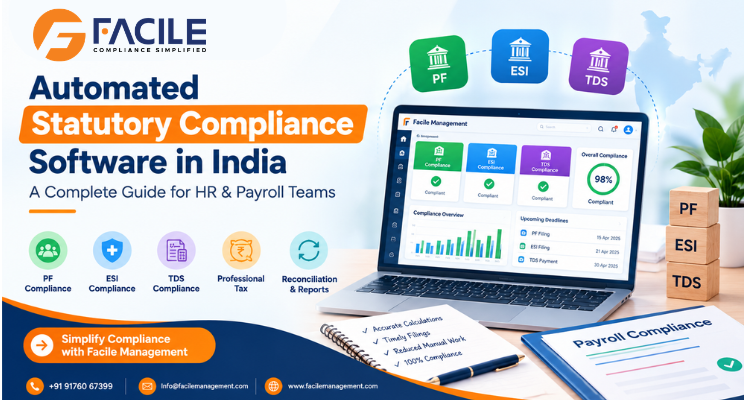
Managing statutory compliance manually can become increasingly difficult as organizations grow.
Payroll teams may need to manage PF, ESI, TDS, Professional Tax, Labour Welfare Fund and other applicable statutory requirements, while also monitoring employee data, calculations, reports, deadlines and supporting documentation.
An automated statutory compliance software solution can bring these activities into a centralized system, reducing repetitive manual work and giving HR, payroll and finance teams better visibility into compliance activities.
Modern payroll software in India commonly automates statutory calculations, compliance reports, deadline reminders and related payroll workflows.
Statutory compliance software is a technology solution designed to help organizations manage, monitor and audit legally required HR and payroll compliance activities.
Instead of maintaining separate spreadsheets, calendars and manual checklists, organizations can use a centralized platform to track applicable compliance requirements.
Depending on the solution, this can include:
The exact requirements applicable to an employer depend on factors such as employee eligibility, location, establishment type and applicable legislation.
Manual compliance management can create several operational challenges.
Payroll teams may need to repeatedly:
Automation can move much of this repetitive work into a structured workflow.
For example, payroll software can automate statutory calculations and generate reports used for filing and review.
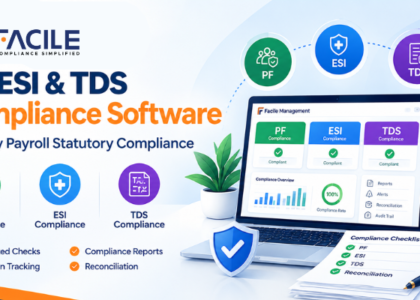
The platform can help payroll teams manage PF-related employee and payroll information, perform validation checks and prepare relevant reports.
Organizations can use automated checks to identify potential discrepancies before completing their compliance process.
ESI compliance involves applicable employee information, contribution calculations and related compliance activities.
An automated system can help payroll teams maintain ESI information and identify records that require review.
TDS is a critical component of payroll compliance.
The Income Tax Department’s current guidance states that the Income Tax Act, 2025 applies to relevant TDS events from April 1, 2026, and that payroll/ERP systems need to be updated to reflect the new section numbering, terminology and reporting requirements.
This makes configurable and regularly updated payroll software particularly useful for organizations managing salary TDS.
Professional Tax requirements can vary by state.
A suitable compliance platform can associate employees with their applicable work location and apply configured state-specific rules.
This becomes especially valuable for companies with employees working across multiple states.
A centralized compliance calendar can help teams track:
Instead of relying on individual spreadsheets or personal reminders, the organization can maintain a shared compliance workflow.
The system can notify users about:
🔔 Upcoming deadlines
⚠️ Compliance exceptions
📄 Missing documents
📊 Reconciliation differences
⏳ Pending activities
✅ Completed compliance tasks
This helps payroll teams prioritize actions that need attention.
One of the most useful features of statutory compliance software is reconciliation.
The platform can compare:
Payroll Data → Statutory Data → Accounting Data → Payment Records
This can help identify differences before they affect reporting or audits.
A centralized dashboard gives HR and finance teams a quick view of compliance status.
| Compliance Area | Status | Exceptions |
|---|---|---|
| PF | Completed | 2 |
| ESI | Completed | 1 |
| TDS | Review Required | 3 |
| Professional Tax | Completed | 0 |
| Reconciliation | Completed | 1 |
The dashboard can allow users to drill down from the overall status to individual employee records.
Not every payroll record requires manual investigation.
Automated compliance software can identify potential exceptions and allow users to follow a workflow such as:
Detect → Assign → Review → Correct → Approve → Close
This creates a more structured compliance process.
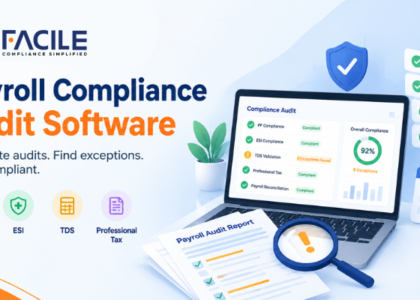
A strong compliance platform should maintain an audit history of relevant activities.
This can help answer questions such as:
An audit trail can improve internal control and make compliance reviews more organized.
Add:
Maintain employee information such as:
The payroll system processes salary and applicable statutory deductions.
The software evaluates the payroll against configured statutory rules.
Potential discrepancies are highlighted for review.
Users can review, correct and close applicable exceptions.
Create compliance, reconciliation and audit reports.
Automate repetitive calculations, checks and reporting processes.
Give HR, payroll and finance teams a centralized view of compliance activities.
Identify potential discrepancies before they become more difficult to resolve.
Maintain compliance reports and historical records in one system.
Assign compliance tasks and monitor their status.
A centralized compliance workflow can be easier to manage as employee numbers, locations and payroll complexity increase.
| Area | Manual Process | Automated Software |
|---|---|---|
| Payroll checks | Spreadsheet/manual | Automated |
| Compliance tracking | Multiple files | Central dashboard |
| Deadline monitoring | Manual reminders | Automated alerts |
| Exception tracking | Email/Excel | Workflow-based |
| Reconciliation | Manual | System-assisted |
| Reporting | Time-consuming | Automated |
| Audit history | Fragmented | Centralized |
| Scalability | Difficult | Easier to scale |
India’s payroll compliance environment continues to evolve.
A notable 2026 change is the transition to the Income Tax Act, 2025 for applicable tax events from April 1, 2026. The Income Tax Department explicitly states that employers need to update payroll systems to reflect the new TDS section numbering and reporting requirements.
This illustrates an important point: statutory compliance software should not simply automate today’s calculations. It should also provide a mechanism for updating rules and payroll configurations when regulations change.
Automated compliance software can be useful for:
It can be particularly useful for organizations with large employee populations or payroll operations spanning multiple states.
Before choosing a solution, evaluate:
Does it support the statutory requirements applicable to your organization?
Can compliance rules be updated when legislation changes?
Can recurring compliance checks run automatically?
Can it integrate with payroll, HRMS, attendance and accounting systems?
Can it produce employee-level and management-level reports?
Can users assign and track compliance issues?
Does it maintain historical changes and compliance activities?
Does it provide appropriate access controls for sensitive employee and payroll information?
Can it support additional employees, locations and entities as the organization grows?
Automated statutory compliance software is a platform that helps organizations manage payroll-related statutory requirements through automated calculations, validation, alerts, reporting, reconciliation and compliance tracking.
Depending on the platform, it may support PF, ESI, TDS, Professional Tax, Labour Welfare Fund, gratuity, bonus-related processes and other applicable payroll compliance requirements.
Key benefits include reduced manual work, better compliance visibility, automated reminders, exception tracking, standardized workflows, reconciliation and easier audit preparation.
Yes. Payroll compliance platforms can support PF and ESI calculations, validation, reporting and tracking, depending on the product’s capabilities and configuration.
Yes. Payroll software can support salary TDS calculations and related reporting. For 2026 onward, the system should account for the Income Tax Act, 2025 requirements applicable from April 1, 2026.
A suitable platform can support state-specific rules such as Professional Tax and Labour Welfare Fund, subject to the software’s coverage and configuration.
No. Automation can handle repetitive calculations, checks, alerts and reporting, but human review remains important for exceptions, approvals, interpretation and corrective action.
Yes. Depending on the solution, it can generate statutory reports, payroll reports, reconciliation reports, exception reports and audit records.
Many compliance solutions can integrate with payroll or HR systems. The available integrations depend on the specific software.
Yes. It can be useful for small businesses when payroll compliance becomes difficult to manage manually. Businesses should select a solution based on their employee count, locations, applicable regulations and operational requirements.
Some solutions provide compliance-rule updates. This capability should be specifically checked when evaluating a product. For 2026, system updates are especially relevant because the Income Tax Department requires payroll/ERP systems to reflect the Income Tax Act, 2025 changes.
Payroll software primarily handles salary processing, while statutory compliance software focuses on ensuring applicable statutory calculations, records, deadlines, reports and compliance workflows are monitored. Many modern payroll platforms combine both capabilities.


Facile Management Services (OPC) Private Limited is committed to delivering seamlessly integrated HR and compliance solutions designed for the evolving