
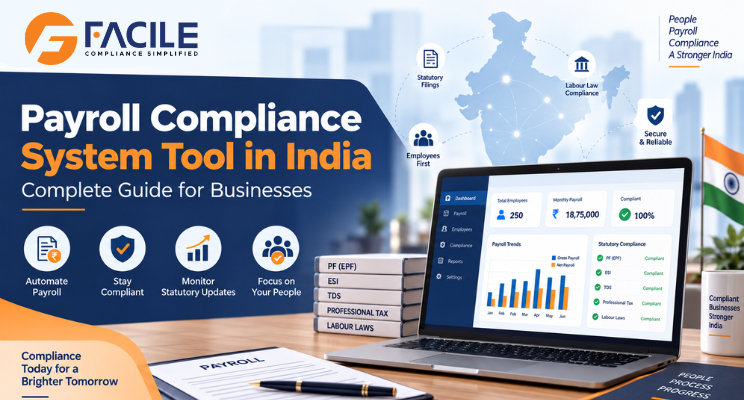
Payroll compliance requires businesses to do much more than calculate salaries. Organisations must ensure that attendance, payable days, wages, minimum wages, statutory deductions, EPF, ESIC, Professional Tax, Labour Welfare Fund, overtime, payslips, wage registers and salary payments are accurate and compliant.
A Payroll Compliance System Tool helps businesses centralise and manage these activities through one digital platform.
For organisations with large workforces, multiple locations or contractor employees, a payroll compliance system can improve accuracy, reduce manual checking and strengthen audit readiness.
A Payroll Compliance System Tool is software designed to manage and monitor payroll-related statutory compliance.
It can help businesses manage:
The objective is to connect payroll data with statutory obligations in one structured system.
Manual payroll compliance can create several problems:
A Payroll Compliance System helps identify and manage these issues before they become larger compliance risks.
The system should maintain:
Accurate employee data is the foundation of payroll compliance.
Attendance should be connected with payroll.
The system can validate:
This helps prevent incorrect salary calculations.
Payroll data can be checked for:
This helps identify discrepancies before payroll closure.
The system should compare employee wages against applicable minimum wages based on:
Any shortfall can be flagged.
The platform can help monitor:
The system can manage:
Where applicable, the system can track:
The platform can monitor:
The system can validate:
Payslip values can be checked against payroll for:
The system can maintain or generate wage registers containing:
The platform can compare:
Payroll Net Pay → Bank Payment → Transaction Reference → Payment Date
This helps confirm that wages were actually paid correctly.
A strong payroll system should reconcile:
Employee Master → Attendance → Payroll → Payslip → Bank Payment → EPF → ESIC → Wage Register
This helps identify mismatches across payroll records.
Principal employers can monitor contractor payroll such as:
The system can track activities such as:
Alerts can be generated for:
A structured payroll audit can review:
When a mismatch is found, the system can raise an exception.
Examples include:
Payroll exceptions can follow:
Issue Identified → Owner Assigned → Correction → Evidence → Revalidation → Closure
This creates a complete audit trail.
Payroll risks can be classified as:
This helps teams prioritise serious issues.
Organisations operating across several States may need different:
A central system can manage these differences.
Payroll compliance can be monitored across:
A dashboard can show:
A structured workflow can look like:
Employee Master → Attendance → Payroll → Minimum Wage Check → Statutory Validation → Payslip → Bank Payment → Wage Register → Audit → Closure
This creates a connected payroll-compliance lifecycle.
Structured validation helps reduce payroll errors.
Teams spend less time comparing spreadsheets manually.
Wage shortfalls can be identified earlier.
Payroll and statutory contribution data can be reconciled.
Net wages can be compared with actual bank payments.
Contractor payroll can be monitored employee by employee.
Payroll records, challans and supporting evidence remain organised.
Different State payroll requirements can be monitored from one system.
Businesses should ensure the system supports:
It is useful for:
FACILE ONE can help organisations manage payroll-related statutory compliance through one centralised system.
Businesses can use FACILE ONE to support:
Payroll compliance involves coordination between HR, payroll, finance, compliance and contractor teams.
FACILE ONE helps bring these activities together into one structured system.
Key capabilities include:
Businesses should evaluate whether the platform supports:
The system should clearly answer:
Is payroll accurate? Are wages compliant? Do statutory contributions match payroll? Has the employee been paid correctly? Where are the payroll exceptions?
A Payroll Compliance System Tool helps businesses replace manual payroll checking with a more structured and auditable approach.
By connecting employee records, attendance, payroll, minimum wages, EPF, ESIC, payslips, bank payments and wage registers, organisations can identify payroll compliance gaps earlier.
For businesses managing large employee populations, contractors or multiple locations, FACILE ONE can help simplify payroll compliance and improve statutory visibility.
It is software used to manage payroll-related statutory compliance such as minimum wages, EPF, ESIC, PT, LWF and payroll validation.
It helps reduce payroll errors, improve statutory compliance and simplify audits.
Yes. Attendance and payable days can be compared with payroll records.
Yes. Employee wages can be compared against applicable minimum wage rates.
Yes. UAN, PF wages, contributions, ECR and challans can be monitored.
Yes. ESIC wages, employee details, contributions and challans can be monitored.
Yes. State-specific PT and LWF requirements can be tracked.
Yes. Approved overtime hours and payroll overtime payments can be compared.
Yes. Payslip values can be reconciled with payroll.
Yes. Net wages can be compared with bank payment records.
Yes. Attendance, payroll, payslips, EPF, ESIC, bank payments and wage registers can be reconciled.
Yes. Contractor attendance, wages, EPF, ESIC, payslips and payment proof can be monitored.
Yes. State-specific minimum wages, PT and LWF rules can be applied.
Yes. Mismatches can be raised as exceptions and tracked until closure.
Yes. Dashboards can display payroll status, statutory compliance and exceptions.
Yes. FACILE ONE can support attendance, payroll validation, statutory compliance, contractor payroll and audit dashboards.


Facile Management Services (OPC) Private Limited is committed to delivering seamlessly integrated HR and compliance solutions designed for the evolving