
Payroll Reconciliation Software Automation Tool in India

Payroll Reconciliation Software Automation Tool

Payroll reconciliation is one of the most important controls in payroll and statutory compliance. Businesses need to ensure that attendance, payroll, payslips, bank payments, EPF, ESIC, deductions, employee records and statutory registers all match correctly before payroll is treated as complete.

A Payroll Reconciliation Software Automation Tool helps organisations automate these comparisons and identify mismatches before they become payroll errors, employee disputes or compliance issues.

Instead of manually comparing multiple Excel files, payroll reports, contribution statements and payment records, businesses can use payroll reconciliation automation to create a structured, faster and more auditable process.

What is Payroll Reconciliation Software?

Payroll Reconciliation Software is a digital tool used to compare payroll information with related attendance, employee, statutory and payment records.

It can help businesses reconcile:

  • Employee master data
  • Attendance
  • Payable days
  • Earnings
  • Deductions
  • Gross wages
  • Net wages
  • Payslips
  • Minimum wages
  • EPF
  • ESIC
  • Professional Tax
  • Labour Welfare Fund
  • Overtime
  • Bank payment proof
  • Wage registers
  • Contractor payroll

The objective is to identify whether payroll data is accurate and consistent across all supporting records.

What is Payroll Reconciliation Automation?

Payroll reconciliation automation uses configured rules and digital workflows to compare payroll data automatically.

A typical automated reconciliation can look like:

Employee Master → Attendance → Payroll → Wage Register → Payslip → Bank Payment → EPF → ESIC

When values do not match, the system can flag the discrepancy for review.

This reduces manual line-by-line checking.

Why Businesses Need Payroll Reconciliation Software

Manual payroll reconciliation can become difficult when a business has:

  • Hundreds or thousands of employees
  • Multiple payroll locations
  • Contractor workforces
  • Different salary structures
  • Multiple statutory deductions
  • Multi-state operations

Common payroll reconciliation problems include:

  • Attendance not matching payable days
  • Gross salary differences
  • Missing employees
  • Duplicate employees
  • Incorrect deductions
  • Payslip mismatch
  • Bank payment mismatch
  • EPF wage mismatch
  • ESIC wage mismatch
  • Incorrect overtime
  • Minimum wage shortfalls
  • Missing statutory contribution records

Payroll Reconciliation Software helps identify these issues faster.

Key Features of Payroll Reconciliation Software Automation Tool

1. Employee Master Reconciliation

The system should compare payroll employees with the approved employee master.

Checks can include:

  • Employee code
  • Employee name
  • Date of joining
  • Date of exit
  • Designation
  • Department
  • Work location
  • UAN
  • ESIC number
  • Bank details

This helps detect missing or incorrect employee records.

2. Attendance vs Payroll Reconciliation

Attendance data should be compared with payroll payable days.

The system can validate:

  • Present days
  • Leave
  • Absence
  • Weekly offs
  • Holidays
  • Overtime
  • Payable days

For example:

Attendance Payable Days = Payroll Paid Days

Any difference can be raised as an exception.

3. Payroll Earnings Reconciliation

The system should compare payroll earning components such as:

  • Basic
  • Dearness allowance
  • HRA
  • Other allowances
  • Incentives
  • Overtime
  • Arrears

This helps identify incorrect calculations or missing components.

4. Payroll Deduction Reconciliation

Deductions can be checked for:

  • EPF
  • ESIC
  • Professional Tax
  • Labour Welfare Fund
  • Income Tax
  • Loan recovery
  • Advance recovery
  • Other deductions

The system can flag unexpected or incorrect deductions.

5. Gross Wage Reconciliation

Gross wages can be compared across:

Payroll → Wage Register → Payslip

All three records should match.

Any difference should be highlighted.

6. Net Wage Reconciliation

Net wages can be compared across:

Payroll → Payslip → Bank Payment

This verifies whether the amount calculated was actually paid.

7. Minimum Wage Reconciliation

The software can compare actual wages with applicable minimum wages based on:

  • State
  • Zone
  • Industry
  • Skill category
  • Designation
  • Effective date

Any wage below the applicable rate can be flagged.

8. EPF Reconciliation

EPF reconciliation can compare:

  • Payroll PF wages
  • ECR PF wages
  • Employee contribution
  • Employer contribution
  • UAN
  • Challan amount

This helps identify contribution mismatches.

9. ESIC Reconciliation

The system can compare:

  • Payroll ESIC wages
  • ESIC contribution wages
  • Employee contribution
  • Employer contribution
  • Insurance number
  • Challan data

10. Professional Tax Reconciliation

PT reconciliation can validate:

  • Employee State
  • Applicable slab
  • Payroll deduction
  • Payment
  • Return data

11. Labour Welfare Fund Reconciliation

The software can verify:

  • State applicability
  • Employee contribution
  • Employer contribution
  • Payroll deduction
  • Payment records

12. Overtime Reconciliation

Overtime can be compared across:

Attendance → Approved OT Hours → Payroll → Wage Register

This helps identify missing or excess overtime payments.

13. Payslip Reconciliation

Payslips should match payroll for:

  • Earnings
  • Deductions
  • Gross wages
  • Net wages
  • Overtime
  • Statutory deductions

14. Bank Payment Reconciliation

Bank payment reconciliation can compare:

  • Employee bank account
  • Net wages
  • Payment amount
  • Transaction reference
  • Payment date
  • Payment status

This verifies whether salary disbursement matches payroll.

15. Wage Register Reconciliation

The wage register should match payroll information for:

  • Wage rate
  • Days worked
  • Earnings
  • Deductions
  • Overtime
  • Net payment

This is important for audit readiness.

16. Contractor Payroll Reconciliation

Principal employers can also use payroll reconciliation for contract workers.

The system can compare:

  • Contractor employee master
  • Attendance
  • Wage register
  • Payslip
  • Bank payment
  • EPF
  • ESIC

This improves contractor payroll visibility.

17. Arrear Payroll Reconciliation

The tool can also help reconcile arrears by:

  • Arrear month
  • Payroll month
  • Employee
  • Earnings
  • Deductions
  • Net payment
  • Statutory impact

This is useful when previous-month salary corrections are processed.

18. Automated Exception Identification

Instead of manually reviewing every employee, the software can show only exceptions.

Examples:

  • Attendance mismatch
  • PF mismatch
  • ESIC mismatch
  • Payslip mismatch
  • Bank payment mismatch
  • Minimum wage shortfall

This allows payroll teams to focus on problem records.

19. Exception Resolution Workflow

Each reconciliation issue can follow:

Exception Identified → Assigned → Corrected → Revalidated → Closed

This creates a structured audit trail.

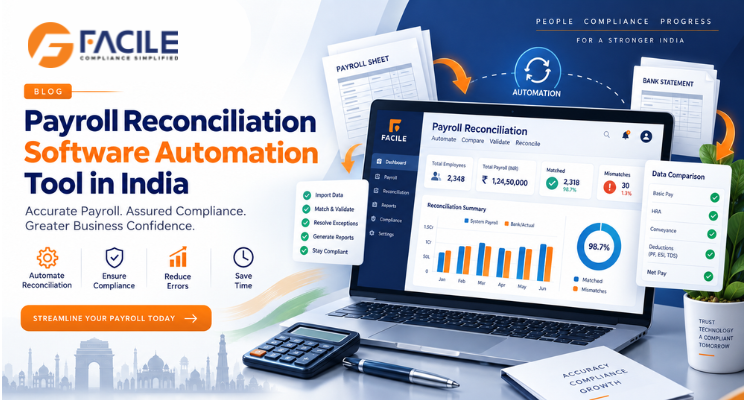
20. Payroll Reconciliation Dashboard

A dashboard can show:

  • Total employees
  • Reconciled employees
  • Employees with exceptions
  • Attendance mismatches
  • EPF mismatches
  • ESIC mismatches
  • Bank payment mismatches
  • Minimum wage issues
  • Open exceptions
  • Closed exceptions

Payroll Reconciliation Process

A strong payroll reconciliation process can follow three stages.

Pre-Payroll Reconciliation

Before payroll processing:

  • Employee master validation
  • Attendance validation
  • Joiner and exit validation
  • Minimum wage validation

Payroll Reconciliation

During payroll:

  • Earnings validation
  • Deduction validation
  • Gross wage reconciliation
  • Net wage reconciliation
  • Overtime validation

Post-Payroll Reconciliation

After payroll:

  • Payslip reconciliation
  • Bank payment reconciliation
  • EPF reconciliation
  • ESIC reconciliation
  • Wage register validation

This provides end-to-end payroll control.

Payroll Reconciliation Workflow

A complete automated workflow can look like:

Employee Master → Attendance → Payroll → Minimum Wage Check → Payslip → Bank Payment → EPF → ESIC → Wage Register → Exception Resolution

This helps ensure all payroll-related records are connected.

Benefits of Payroll Reconciliation Automation

Better Payroll Accuracy

Automated comparisons help identify errors before payroll is finalised.

Reduced Manual Checking

Teams do not need to compare multiple spreadsheets manually.

Faster Exception Detection

Only mismatched records need detailed review.

Better Statutory Compliance

EPF, ESIC and wage-related mismatches can be identified earlier.

Improved Payment Verification

Net wages can be matched with actual bank payments.

Better Contractor Governance

Contractor payroll can be reconciled employee by employee.

Stronger Audit Readiness

Reconciliation records create a clear audit trail.

Improved Management Visibility

Dashboards provide a consolidated view of payroll exceptions.

Payroll Reconciliation for Multi-State Businesses

Multi-state organisations may have different:

  • Minimum wage rates
  • PT rules
  • LWF requirements
  • Payroll configurations

The software should apply State-specific validation while maintaining a central payroll view.

A structure can be:

Organisation → State → Location → Employee → Payroll → Reconciliation → Exception

Payroll Reconciliation Checklist

Businesses should regularly verify:

  • Employee master matches payroll
  • Joiners are included correctly
  • Exited employees are handled correctly
  • Attendance matches payable days
  • Minimum wages are met
  • Earnings are correct
  • Deductions are correct
  • Gross wages match
  • Payslips match payroll
  • Net wages match bank payments
  • EPF wages match payroll
  • ESIC wages match payroll
  • Overtime is reconciled
  • Wage registers match payroll
  • Contractor payroll is reconciled
  • Exceptions are closed

Who Can Use Payroll Reconciliation Software?

It is useful for:

  • Large enterprises
  • SMEs
  • Manufacturing companies
  • Factories
  • IT companies
  • Retail businesses
  • Logistics companies
  • Warehouses
  • Staffing companies
  • Facility management companies
  • Payroll service providers
  • HR teams
  • Payroll teams
  • Finance teams
  • Compliance teams
  • Contractor management teams

How FACILE ONE Helps With Payroll Reconciliation

FACILE ONE can help organisations reconcile payroll and statutory records through a centralised digital framework.

Businesses can use FACILE ONE to support:

  • Employee master reconciliation
  • Attendance vs payroll validation
  • Minimum wage checks
  • Payroll earnings reconciliation
  • Deduction reconciliation
  • Payslip verification
  • Bank payment verification
  • EPF reconciliation
  • ESIC reconciliation
  • Wage register validation
  • Contractor payroll reconciliation
  • Exception identification
  • Corrective-action tracking
  • Multi-location dashboards
  • Reports and audit trails

Why Choose FACILE ONE?

Payroll reconciliation requires coordination between HR, payroll, finance, compliance and contractor teams.

FACILE ONE helps bring these records into one structured reconciliation workflow.

Key capabilities include:

  • Automated payroll comparisons
  • Statutory reconciliation
  • Exception-based validation
  • Contractor payroll checks
  • Minimum wage monitoring
  • Payment verification
  • Audit trails
  • Dashboards and reports

How to Choose the Best Payroll Reconciliation Software Automation Tool

Businesses should evaluate whether the platform supports:

  • Employee master reconciliation
  • Attendance reconciliation
  • Earnings reconciliation
  • Deduction reconciliation
  • Minimum wages
  • EPF
  • ESIC
  • PT
  • LWF
  • Overtime
  • Payslips
  • Bank payment
  • Wage registers
  • Contractor payroll
  • Exception management
  • Revalidation
  • Dashboards

The best tool should clearly answer:

Does attendance match payroll? Does payroll match the payslip? Does the payslip match the bank payment? Do EPF and ESIC match payroll? Which employees have exceptions?

Conclusion

A Payroll Reconciliation Software Automation Tool helps businesses replace manual payroll comparisons with a faster, more structured and auditable process.

By reconciling employee records, attendance, payroll, payslips, bank payments, EPF, ESIC and wage registers, organisations can identify payroll errors and statutory gaps earlier.

For businesses managing large workforces, contractors or multiple locations, FACILE ONE can help simplify payroll reconciliation and improve compliance visibility.

Frequently Asked Questions – Payroll Reconciliation Software Automation Tool

1. What is Payroll Reconciliation Software?

Payroll Reconciliation Software compares payroll with employee, attendance, statutory and payment records to identify mismatches.

2. What is automated payroll reconciliation?

It is the automatic comparison of payroll data with attendance, payslips, bank payments, EPF, ESIC and other supporting records.

3. Why is payroll reconciliation important?

It helps identify payroll errors, statutory mismatches and payment differences before they become larger compliance issues.

4. Can attendance be reconciled with payroll?

Yes. Payable days can be compared with attendance, leave, holidays and overtime.

5. Can payroll be reconciled with payslips?

Yes. Earnings, deductions, gross wages and net wages can be compared.

6. Can payroll be reconciled with bank payments?

Yes. Employee net wages can be compared with actual payment amounts and transaction references.

7. Can EPF be reconciled with payroll?

Yes. PF wages, employee contributions, employer contributions, ECR and payroll records can be compared.

8. Can ESIC be reconciled with payroll?

Yes. ESIC wages and contribution records can be compared with payroll.

9. Can the tool check minimum wage compliance?

Yes. Payroll wages can be compared against applicable minimum wage rates.

10. Can overtime be reconciled?

Yes. Attendance OT hours can be compared with payroll overtime payments.

11. Can wage registers be reconciled with payroll?

Yes. Wage-register values can be checked against payroll employee by employee.

12. Can contractor payroll be reconciled?

Yes. Contractor attendance, payroll, payslips, bank payments, EPF and ESIC can be compared.

13. Can arrear payroll be reconciled?

Yes. Arrear wages and deductions can be linked to the relevant payroll and compliance month.

14. What happens when a mismatch is found?

The system can create an exception for review, correction, revalidation and closure.

15. Can management see payroll reconciliation dashboards?

Yes. Dashboards can show reconciled employees, exceptions and statutory mismatches.

16. Can FACILE ONE support Payroll Reconciliation?

Yes. FACILE ONE can support payroll, attendance, statutory, payment and contractor payroll reconciliation.


About the Author

Leave a Reply

Your email address will not be published. Required fields are marked *

You may also like these

Chat on WhatsApp
HR Compliance Services Made Simple!