
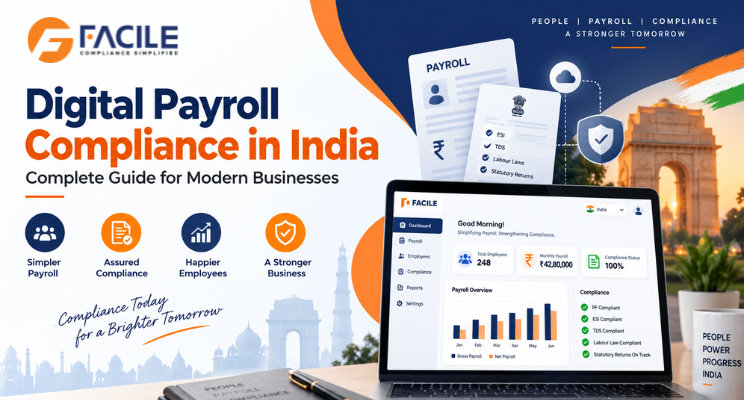
Payroll compliance is becoming increasingly digital. Businesses are moving away from manual spreadsheets, disconnected payroll files, email approvals and paper-based statutory records toward integrated systems that can validate payroll, monitor statutory obligations, maintain documents and identify compliance risks in real time.
Digital Payroll Compliance refers to the use of technology to manage and verify payroll-related statutory requirements such as minimum wages, EPF, ESIC, Professional Tax, Labour Welfare Fund, overtime, attendance, wage payments, payslips, statutory registers and contractor payroll compliance.
For organisations operating across multiple locations, digital payroll compliance can improve accuracy, reduce manual work and create a stronger audit trail.
Digital Payroll Compliance is a technology-driven approach to ensuring payroll is processed in accordance with applicable labour laws and statutory requirements.
A digital payroll compliance system can help businesses manage:
The objective is to bring payroll and compliance into one connected workflow.
Payroll errors can directly create compliance risks.
Common issues include:
A digital system can identify these issues earlier and reduce dependence on manual checking.
A digital payroll compliance system should validate payroll before final processing.
It can check:
This helps identify inconsistencies before payroll closure.
Payroll should be supported by accurate attendance.
The system should compare:
This improves payroll accuracy.
A strong digital system should compare employee wages with applicable minimum wages.
The validation may consider:
This helps prevent underpayment.
Digital payroll compliance should support EPF checks such as:
This improves contribution accuracy.
The system should help monitor:
Professional Tax differs across States.
A digital system should help manage:
The application should track:
Digital payroll compliance should help validate:
This reduces wage-related disputes.
The system should generate or maintain digital payslips showing:
Digital payslips also improve employee access and record retention.
Payroll data can be used to generate statutory wage registers.
The register may include:
Digital payroll compliance should maintain salary disbursement evidence such as:
This helps verify actual payment of wages.
Businesses using contractors should also monitor contractor payroll digitally.
The system should help check:
This gives principal employers better compliance visibility.
Modern payroll systems can generate statutory registers directly from validated payroll and attendance data.
This reduces duplicate manual entry and improves consistency.
A digital compliance calendar should track:
Automated alerts can notify users about:
A digital dashboard can show:
This gives management real-time visibility.
Automated checks reduce calculation and data-entry errors.
Digital workflows reduce repetitive manual tasks.
Payroll can be validated against statutory requirements before filing.
Payroll records, challans, registers and payment proof remain organised.
Potential issues can be detected earlier.
Businesses can monitor payroll compliance across multiple locations from one platform.
Principal employers can monitor contractor payroll and statutory records more effectively.
Payroll compliance becomes more complex when businesses operate across several States.
A digital system can manage different State-specific requirements for:
This allows management to view payroll compliance State by State.
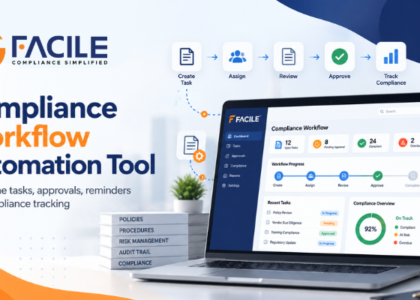
A structured workflow can look like:
Employee Master → Attendance → Payroll → Minimum Wage Check → EPF / ESIC Validation → Payslip → Bank Payment → Statutory Register → Compliance Audit
This provides a complete digital trail.
Businesses should regularly verify:
It is useful for:
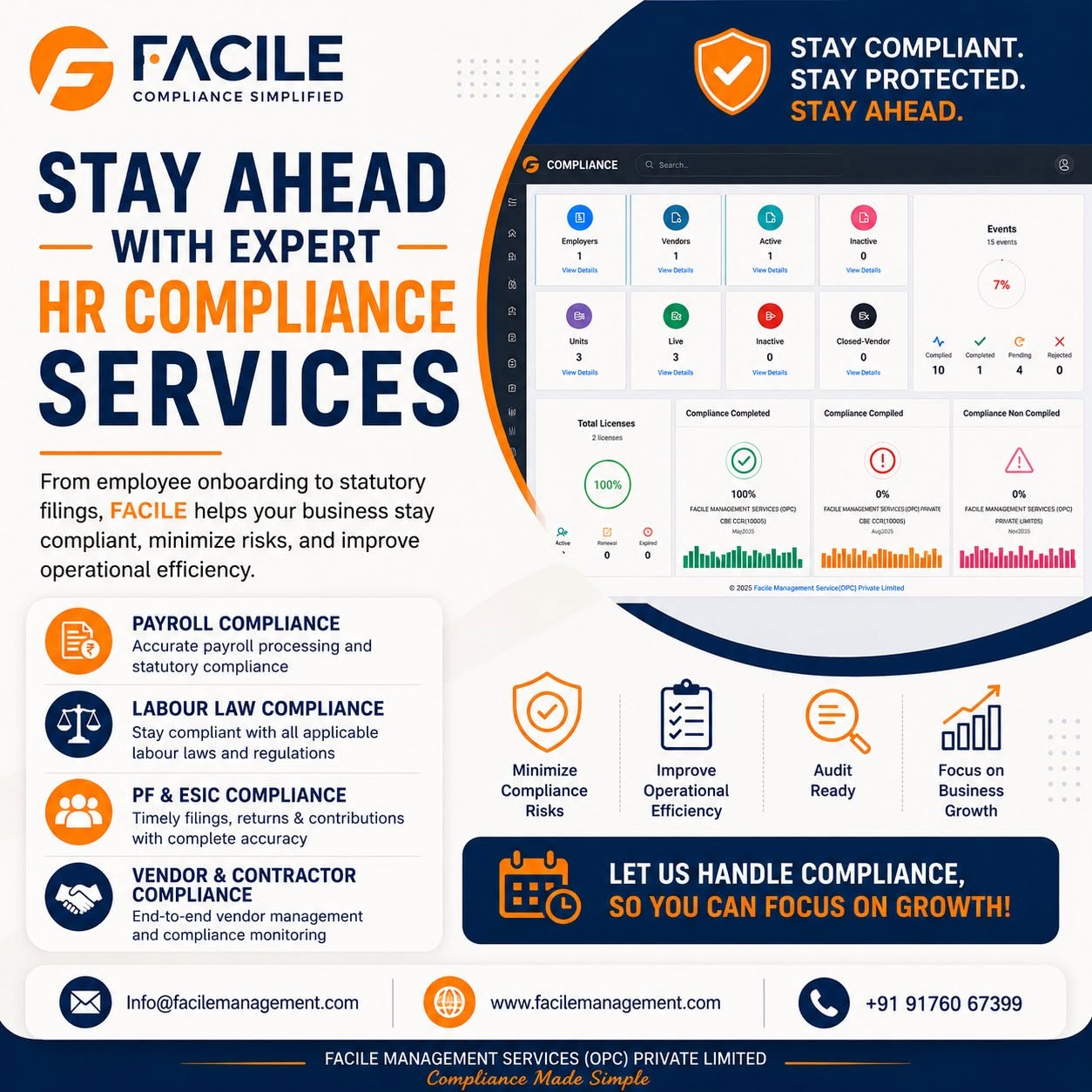
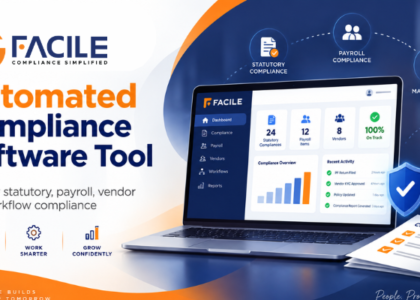
FACILE ONE can help businesses manage payroll and statutory compliance through a centralised digital platform.
Businesses can use FACILE ONE to support:
Digital payroll compliance requires coordination between HR, payroll, finance, compliance and contractor teams.
FACILE ONE helps bring these activities together into one structured workflow.
Key capabilities include:
The future of payroll compliance will increasingly focus on:
This will shift payroll compliance from manual checking toward continuous digital validation.
Digital Payroll Compliance helps businesses improve payroll accuracy, statutory compliance, documentation and audit readiness.
For organisations managing large workforces, multiple locations or contractors, digital payroll compliance can provide a more reliable and scalable way to manage minimum wages, EPF, ESIC, payroll records and statutory obligations.
With a platform such as FACILE ONE, businesses can move from manual payroll compliance to a more integrated, automated and transparent compliance process.
Digital Payroll Compliance is the use of software to manage and validate payroll-related statutory requirements such as minimum wages, EPF, ESIC, PT, LWF, attendance and payroll records.
It reduces manual work, improves payroll accuracy and helps businesses identify statutory compliance gaps earlier.
Yes. Employee wages can be compared with applicable minimum wage rates based on State, zone, skill category and effective date.
Yes. UAN, PF wages, contributions, ECR, challans and payment status can be monitored.
Yes. ESIC employee details, wage data, contributions and challans can be tracked.
Yes. Attendance, payable days, leave and overtime can be compared with payroll data.
Yes. Digital payslips can be generated and maintained for employees.
Yes. Wage registers can be generated from payroll and attendance information.
Yes. Bank payment proof and transaction details can be maintained and compared with payroll.
Yes. Contractor attendance, wages, EPF, ESIC, payslips and payment proof can be monitored.
Yes. Multi-state payroll compliance can be managed through State-specific statutory rules.
Yes. Payroll, attendance, statutory contributions and supporting documents can be reviewed through audit workflows.
Yes. Compliance calendars and alerts can help teams track upcoming payroll and statutory deadlines.
Yes. It is particularly useful for businesses with large workforces, multiple locations and contractors.
Yes. FACILE ONE can support payroll validation, statutory compliance, contractor monitoring, document management, audits and multi-location dashboards.


Facile Management Services (OPC) Private Limited is committed to delivering seamlessly integrated HR and compliance solutions designed for the evolving