

Managing vendors and contractors is a major compliance responsibility for businesses operating across multiple locations. Organisations need to verify whether vendors are following applicable labour laws, wage requirements, statutory contributions, attendance rules, payroll documentation, licences, registers and other contractual obligations.
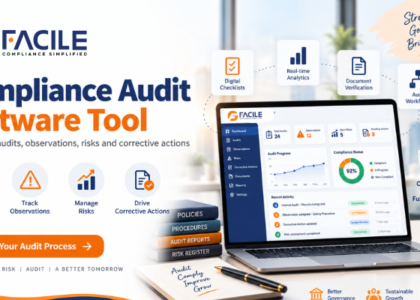
A Vendor Audit Compliance Application helps businesses monitor, audit and manage vendor compliance through a centralised digital platform. It gives compliance, HR, procurement and management teams greater visibility over vendor risks, statutory gaps, audit observations and corrective actions.
For organisations working with multiple contractors, manpower vendors, service providers and third-party agencies, a structured vendor audit platform can significantly improve compliance control and audit readiness.
A Vendor Audit Compliance Application is software designed to help businesses audit, monitor and manage statutory and contractual compliance of vendors and contractors.
It can help manage:
The purpose is to give principal employers a clear view of whether vendors are meeting their compliance obligations.
Vendor compliance can become difficult when organisations work with many contractors across multiple units and States.
Manual vendor audits often depend on:
This can create problems such as:
A Vendor Audit Compliance Application helps centralise the entire audit process.
The application should maintain complete vendor information such as:
This creates a structured base for compliance monitoring.
The system should maintain employee-level data for vendor workers.
Important information can include:
This improves audit accuracy.
Vendor attendance should be checked against payroll and statutory records.
The application should help compare:
Attendance mismatches can directly affect wages and statutory contributions.
The application should help verify whether vendor workers are paid correctly.
Checks may include:
This helps identify payroll discrepancies.
Minimum wage compliance is one of the most important vendor audit areas.
The application should help compare vendor employee wages against applicable rates based on:
This helps identify underpayment before it becomes a statutory issue.
Vendor EPF compliance can be checked through:
The system should help identify missing or incorrect EPF contributions.
The application should support checks such as:
For applicable States, the application should help monitor:
Vendor audits may also include LWF compliance.
The system should monitor:
Payslips should be compared with payroll and attendance records.
A vendor audit application should verify:
Salary payment should be supported by clear bank evidence.
The application should help verify:
This helps establish whether wages were actually paid.
Vendors may be required to maintain various registers.
The application can audit:
Vendor licences should be monitored carefully.
The system should maintain:
Expired licences should be flagged immediately.
Vendor compliance audits may include checking returns relating to applicable labour laws.
The application should track:
A Vendor Audit Compliance Application should provide a central repository for:
This improves audit traceability.
The application should allow businesses to create structured audit checklists.
Audit points can include:
This helps maintain consistent audit standards across vendors.
When an audit issue is identified, the system should record:
Audit observations should not remain open indefinitely.
The application should help track:
This creates accountability.
A vendor score can provide management with a quick view of compliance performance.
The score can be based on:
This helps identify high-risk vendors.
A central dashboard can show:
This provides management with real-time visibility.
Large organisations may work with the same vendor across several factories, branches or project locations.
A central system can organise vendor compliance as:
Company → Location → Vendor → Employee → Compliance → Audit → Observation → Corrective Action → Closure
This allows management to review compliance both vendor-wise and location-wise.
A structured application can provide several benefits.
Businesses can monitor vendor compliance from one platform.
Statutory gaps can be identified earlier.
The same audit checklist can be applied across all vendors.
Compliance documents remain organised and traceable.
Observations can be assigned, monitored and closed systematically.
Principal employers gain better control over contractor compliance.
Historical audits, observations and closure documents remain available.
Businesses should regularly verify:
It is useful for:
FACILE ONE helps organisations manage vendor audit and contractor compliance through a centralised digital platform.
Businesses can use FACILE ONE to support:
Vendor compliance requires continuous coordination between vendors, HR, payroll, procurement, legal and compliance teams.
FACILE ONE provides a structured framework to manage the complete vendor audit lifecycle.
Key capabilities include:
Businesses should evaluate whether the application supports:
The best application should clearly show which vendor is compliant, where the gaps exist, what corrective action is required and whether the issue has been closed.
A Vendor Audit Compliance Application helps businesses systematically audit contractor and vendor compliance across payroll, statutory contributions, licences, documents and employee records.
For organisations managing large vendor ecosystems or multiple locations, FACILE ONE can help centralise vendor audits, improve compliance visibility and maintain a strong audit trail.
It is software used to audit and monitor vendor and contractor compliance across wages, attendance, EPF, ESIC, licences, registers, returns and supporting documents.
It helps principal employers identify statutory gaps, payroll errors, missing documents and contractor risks before they become serious compliance issues.
Yes. Vendor employee wages can be compared against applicable minimum-wage rates.
Yes. UAN, PF wages, contributions, ECR, challans and payment details can be verified.
Yes. Employee ESIC details, wages, contribution records and challans can be checked.
Yes. Attendance and payable days can be compared with wage and payroll records.
Yes. Payslips can be checked against wage registers, deductions and net payments.
Yes. Salary payment evidence can be compared with payroll and employee-wise net wages.
Yes. Licence number, validity, worker limit and renewal status can be monitored.
Yes. Vendor statutory registers can be uploaded, reviewed and audited.
Yes. Observations can be assigned to vendors with risk levels, due dates and corrective actions.
Yes. Vendor responses and supporting documents can be monitored until closure.
Yes. A vendor compliance score can be generated based on audit results and statutory compliance performance.
Yes. Multi-vendor and multi-location monitoring is one of the main use cases.
Compliance teams, HR teams, procurement teams, legal teams, factory management and businesses using large contractor workforces can use it.
Yes. FACILE ONE can support vendor audits, payroll verification, statutory compliance checks, document management, observations, corrective actions and compliance scoring.


Facile Management Services (OPC) Private Limited is committed to delivering seamlessly integrated HR and compliance solutions designed for the evolving