
Managing statutory compliance across employees, contractors, establishments and business locations can be a demanding responsibility. Organisations must identify applicable laws, monitor due dates, validate payroll information, maintain registers, track licences, preserve challans and returns, respond to audit observations and remain prepared for inspections.
When these activities are managed through spreadsheets, emails and disconnected folders, compliance teams may struggle to obtain a clear view of pending tasks. Missed deadlines, incomplete records, incorrect statutory deductions and expired licences can increase regulatory, financial and operational risks.
A statutory compliance tool brings these activities together in a structured digital environment. It helps organisations centralise records, automate recurring tasks, monitor compliance progress and identify discrepancies before they become serious issues.
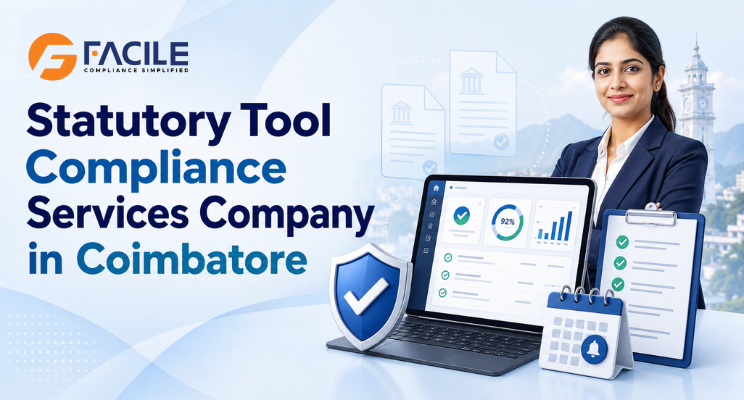
Businesses searching for a dependable Statutory Tool Compliance Services Company in Coimbatore can partner with Facile Management Services (OPC) Private Limited for technology-supported statutory management, payroll validation, contractor monitoring, compliance audits and inspection readiness.
A statutory compliance tool is a digital platform designed to help organisations manage recurring legal and regulatory responsibilities.
The tool may support:
Instead of depending on separate spreadsheets for every establishment or contractor, the organisation can maintain compliance information through one controlled platform.
The tool does not replace the need for accurate legal interpretation or professional review. It strengthens the compliance process by improving visibility, consistency, accountability and document availability.
Coimbatore has a diverse business environment consisting of:
Many businesses operate with multiple employee categories, contractors, shifts, branches and customer locations. Their statutory obligations may differ according to the nature of operations, workforce strength, location, wage levels and applicable Central and State requirements.
A growing organisation may need to answer questions such as:
A statutory tool helps the organisation obtain these answers without manually checking numerous spreadsheets and folders.
Manual compliance systems may work when an organisation has a small workforce and limited statutory responsibilities. However, complexity increases when the business expands.
Common challenges include:
Due dates may be overlooked when they are maintained in separate calendars or depend on individual employees remembering them.
Registrations, licences, returns, challans, payment receipts and registers may be stored across emails, computers and physical files.
Employee deductions, employer contributions, payroll totals and statutory challans may not be reconciled consistently.
Senior management may not have a consolidated view of completed, pending, overdue and non-applicable activities.
Contractor documents may be accepted without verifying employee-level attendance, wage payments and statutory contributions.
Renewal dates may be missed when licence information is not linked to an alert system.
It may be difficult to identify who uploaded, reviewed, approved or modified a compliance document.
Observations may remain unresolved because responsibility and target dates are not clearly assigned.
A centralised compliance tool helps reduce these problems through structured workflows and automated monitoring.
An effective statutory tool should support the complete compliance lifecycle rather than operating as a basic document-storage system.
Not every law, register, return or payment applies to every organisation.
Applicability may depend on:
The tool should maintain an applicability matrix for each establishment.
The matrix may show:
This prevents unnecessary tasks from being assigned while ensuring that genuine obligations are not overlooked.
A compliance calendar provides visibility into recurring activities.
The tool can schedule:
Each event can include:
Automated reminders can notify responsible users before the due date. Overdue activities can be escalated to managers for timely action.
Payroll is closely connected with statutory compliance. Incorrect attendance, wages, employee eligibility or deductions can affect multiple statutory records.
A statutory tool can validate:
The platform may identify:
Automated validation enables payroll and compliance teams to correct errors before statutory submissions are completed.
EPF and ESIC compliance requires accurate employee information, wage identification, contribution calculations, statutory uploads and payment evidence.
A compliance tool may support:
The system can compare payroll deductions with statutory contribution data and highlight employees or amounts that do not match.
This employee-level verification is important because total challan amounts may appear correct even when an employee is omitted or mapped incorrectly.
Minimum wage compliance depends on the employee’s work category, industry, skill classification, location and effective wage notification.
A statutory tool can maintain:
When wage rates change, the platform can compare the revised requirement with payroll data and identify affected employees.
This enables management to update salary structures and calculate differences before the issue results in employee grievances or inspection observations.
Organisations may need to maintain various registers depending on applicability.
These may include:
A statutory tool can use validated employee, attendance and payroll information to prepare applicable registers in a standard format.
Automated generation reduces repeated manual entry and helps maintain consistency across payroll, payslips and statutory records.
Before finalisation, authorised users should review the registers and confirm that the information is complete and appropriate for the relevant establishment.
Businesses may hold multiple registrations, licences and approvals.
The tool can maintain information such as:
Automated alerts can be configured before expiry dates. This gives the responsible team sufficient time to collect documents, file renewal applications and address authority queries.
The system can also preserve previous versions so that the organisation maintains a complete historical record.
Contractor compliance is an important risk area for principal employers.
Contractors may be engaged for:
The statutory tool can create a separate compliance profile for each contractor.
Documents may include:
The platform can track whether the contractor submitted each document, whether it was reviewed and whether discrepancies remain unresolved.
Contractor scores and dashboards can help management identify compliant, partially compliant and high-risk vendors.
A statutory compliance audit evaluates whether required activities have been completed accurately and supported by proper evidence.
The audit may cover:
The tool can record each observation with:
This creates a structured corrective-action process and prevents observations from remaining in emails or informal discussions.
Management needs a clear summary rather than a large collection of raw files.
A statutory dashboard can display:
Reports can be filtered by establishment, contractor, law, period, department or user.
This helps management identify areas requiring immediate attention and compare compliance performance across locations.
During an inspection, customer audit or internal review, organisations may need to produce documents quickly.
A statutory tool can organise documents according to:
Version control and approval history help ensure that users access the correct document.
Inspection folders can be prepared with the relevant:
Digital organisation reduces the time required to collect records during an urgent inspection.
Statutory records contain confidential employee, payroll and business information. The platform should therefore have appropriate security controls.
Important controls may include:
Users should receive only the access necessary for their responsibilities.
For example, a contractor may upload documents without viewing another contractor’s information, while an auditor may review records without being able to modify payroll data.
All applicable activities, documents, licences and observations are managed through one platform.
Automated calendars, reminders, validations and reports reduce repetitive administrative work.
Data checks help identify payroll, contribution and document discrepancies before final submission.
Every task can be assigned to a responsible person with a due date and approval status.
Alerts help teams track payments, returns, licence renewals and recurring compliance activities.
Employee-level contractor records can be reviewed instead of relying only on declarations.
Documents and compliance evidence remain organised and accessible throughout the year.
Dashboards provide a clear view of compliance performance, pending risks and required corrective actions.
The same system can manage multiple establishments, contractors, projects and business units.
Technology alone cannot ensure compliance. Organisations should avoid the following implementation mistakes:
The tool should be supported by defined processes, trained users, periodic audits and professional compliance review.
Facile Management Services (OPC) Private Limited offers technology-supported statutory compliance services for businesses in Coimbatore.
The FACILE Statutory Tool is designed to bring multiple compliance activities into one structured digital platform.
FACILE’s support may include:
The statutory engine can help validate payroll data, detect payment discrepancies and organise inspection-ready compliance records.
The platform is particularly useful for businesses managing multiple units, contractors, large employee populations or recurring statutory obligations across locations.
FACILE combines compliance expertise with structured technology workflows.
Businesses can benefit from:
FACILE focuses on helping organisations move from reactive compliance management to a more controlled, visible and audit-ready process.
Statutory compliance requires more than maintaining a calendar or uploading documents. Organisations must identify applicable requirements, assign responsibilities, validate payroll information, reconcile statutory payments, maintain registers, monitor contractors, renew licences and close audit observations.
Manual systems may make it difficult to achieve consistent compliance across establishments and periods.
A statutory tool creates a centralised compliance framework through automated calendars, alerts, validation controls, document workflows and dashboards. It helps HR, payroll, finance, legal and management teams work with consistent information.
Businesses looking for a trusted Statutory Tool Compliance Services Company in Coimbatore can partner with Facile Management Services (OPC) Private Limited for digital statutory management, payroll validation, contractor audits, licence tracking and inspection readiness.
Facile Management Services (OPC) Private Limited
Phone: +91 91760 67399
Email: Info@facilemanagement.com
Website: www.facilemanagement.com
Statutory requirements depend on the establishment, industry, workforce, location and current Central and State provisions. Businesses should verify current notifications and seek appropriate professional or legal advice where necessary.
A statutory compliance tool is a digital platform that helps organisations manage compliance calendars, documents, payroll validations, registers, licences, contractors, audits and management reports.
Yes. Facile Management Services (OPC) Private Limited provides technology-supported statutory compliance services for businesses in Coimbatore.
Yes. The tool can maintain separate applicability, events, documents, licences, registers and reports for multiple establishments and business units.
Yes. It can support checks involving employee information, attendance, payable days, earnings, deductions, statutory wages and payroll totals.
Yes. FACILE can compare employee classifications and payroll wages with applicable minimum wage requirements and identify potential differences.
Yes. It can assist with employee-level data validation, contribution review, challan tracking and payroll-to-statutory reconciliation.
Yes. Applicable registers can be prepared using validated employee, attendance and payroll information, subject to review and approval.
Yes. Compliance events can be configured with due dates, assigned users, reminders and escalation workflows.
Yes. It can maintain registration and licence details and provide alerts before the relevant expiry or renewal date.
Yes. FACILE can review contractor employee lists, attendance, wage records, bank payments, statutory contributions, challans, licences and supporting documents.
No. The document should be reviewed for the correct establishment, period, employees, amounts and statutory requirement before it is approved.
Yes. Observations can be recorded with risk levels, responsible users, target dates, recommendations and closure evidence.
Yes. Dashboards can show completed, pending, overdue and not-applicable activities, along with licence alerts, contractor performance and open observations.
Yes. FACILE can organise statutory records, identify missing documents, reconcile information and prepare inspection-ready reports.
Yes. The system can be configured according to the actual applicability and compliance scope of a small, medium or growing business.
No. Technology improves tracking and validation, but applicability decisions and complex legal questions still require appropriate professional review.
It provides automated reminders, centralised records, validation checks, approval workflows, audit trails and dashboards that help teams identify gaps earlier.
Yes. Documents can be organised by establishment, compliance period, law, licence, contractor and audit category for future reference.
The compliance scope can be configured according to the organisation’s establishments, applicable laws, employee structure, contractors and reporting requirements.
Call +91 91760 67399, email Info@facilemanagement.com, or visit www.facilemanagement.com to discuss Statutory Tool Compliance Services in Coimbatore.


Facile Management Services (OPC) Private Limited is committed to delivering seamlessly integrated HR and compliance solutions designed for the evolving