
India’s labour law framework is evolving to create a more consolidated approach to wages, social security, industrial relations, and workplace safety. The four New Labour Codes are intended to simplify the regulatory framework while strengthening worker protections and modernising employment practices.
For HR managers, payroll professionals, factory owners, finance teams, and compliance officers, these changes require a review of existing policies, employee records, salary structures, statutory filings, and contractor management procedures.
Businesses operating across multiple states may face additional complexity because applicable rules, notifications, and implementation requirements can vary by jurisdiction.
In this blog, we explore how the New Labour Codes will transform HR and compliance in India, the key areas employers should review, and how digital compliance management can support the transition.
One of the primary objectives of the Labour Codes is to consolidate provisions from 29 central labour laws into four comprehensive Codes.
This framework covers wages, industrial relations, social security, and occupational safety and working conditions.
For businesses, consolidation provides an opportunity to review compliance procedures, eliminate unnecessary duplication where permitted, and establish more consistent internal processes.
Employers should identify the provisions applicable to their establishments and maintain a compliance register covering relevant Acts, rules, notifications, registers, returns, and deadlines.
The Code on Wages, 2019, makes wage-related compliance an important area for review.
HR and payroll teams should assess salary structures, applicable minimum wages, wage payment timelines, overtime calculations, deductions, and statutory benefit calculations.
Key actions include:
Payroll compliance software can help standardise calculations, flag exceptions, and generate reports. However, organisations must ensure that software configurations reflect the applicable legal requirements.
Social security is another significant area under the Code on Social Security, 2020.
Businesses should review the applicability of EPF, ESIC, gratuity, maternity benefits, employee compensation, and other relevant provisions.
HR and payroll teams should pay particular attention to employee eligibility, wage calculations, contribution records, payment deadlines, and supporting documents.
A structured compliance process helps businesses identify discrepancies earlier and maintain evidence for internal and external audits.
Reliable employee records are essential for transparent HR administration and statutory compliance.
Employers should review appointment letters, employment agreements, employee classifications, attendance, leave, wage revisions, overtime records, and separation documentation.
The relevant Labour Codes and rules contain requirements relating to employment documentation, including appointment letters where applicable.
Centralised digital records can help HR teams retrieve documents efficiently, maintain consistent information, and prepare for inspections.
The Occupational Safety, Health and Working Conditions Code, 2020, brings together provisions concerning workplace safety, health, and working conditions.
This is particularly relevant to manufacturing companies, factories, construction businesses, logistics operations, and organisations engaging contract labour.
Employers should review applicable requirements for working hours, rest intervals, welfare facilities, safety training, incident records, medical examinations, and workplace procedures.
Documented processes and regular compliance reviews can help organisations identify risks and improve workplace governance.
The Industrial Relations Code, 2020, addresses matters including trade unions, industrial disputes, and standing orders.
HR teams should assess their grievance procedures, employee communication processes, disciplinary policies, and applicable requirements relating to workforce changes.
Clear policies, consistent documentation, and manager training can support better employee relations and reduce avoidable disputes.
Businesses often engage contractors for housekeeping, security, maintenance, logistics, manufacturing support, and other services.
Depending on the applicable provisions, employers may need to monitor contractor documentation, wage payments, worker records, safety requirements, and other statutory obligations.
A strong vendor compliance process should include:
Vendor compliance management software can help organisations monitor contractors across multiple sites and reduce repetitive manual follow-ups.
Manual compliance tracking can become difficult when an organisation manages several establishments, numerous contractors, and recurring statutory deadlines.
Digital compliance management can support:
Automation improves visibility and workflow consistency, but businesses must still interpret applicable legislation correctly, verify legal updates, and review exceptions.
Employers can begin with the following actions:
Facile Management offers compliance-focused solutions for businesses looking to organise statutory compliance activities, manage vendor audits, monitor licences, and improve digital workflows.
Organisations can explore these solutions to help centralise records, monitor compliance tasks, and improve audit readiness.
Simplify statutory compliance with Facile Management.
Visit www.facilemanagement.com to explore available compliance solutions.
The New Labour Codes represent an important development in India’s labour and employment framework. They affect how businesses manage payroll, employee benefits, workplace safety, industrial relations, and contractor compliance.
Employers should review their current processes, verify the requirements applicable to their locations, and strengthen documentation and monitoring practices.
By combining legal review with effective digital compliance management, businesses can improve visibility, reduce manual effort, and manage compliance responsibilities more systematically.
Disclaimer: This article is for general informational purposes and is not legal advice. Employers should verify applicable legislation, Central and State rules, notifications, and commencement provisions before making compliance decisions.
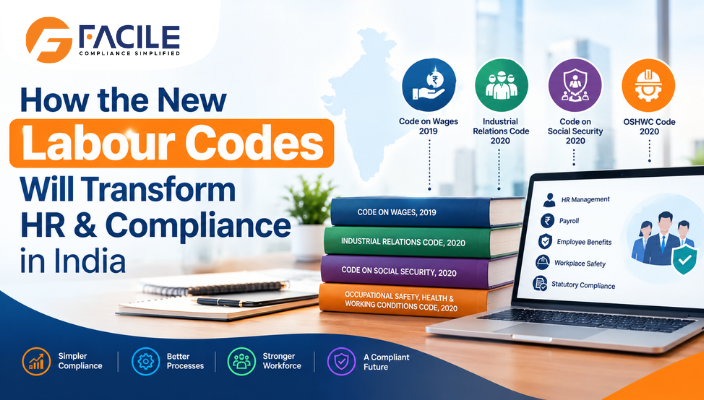
The four Codes are the Code on Wages, 2019; Industrial Relations Code, 2020; Code on Social Security, 2020; and Occupational Safety, Health and Working Conditions Code, 2020.
The four Labour Codes came into effect on 21 November 2025. The Central Rules were notified on 8 May 2026. Employers should also verify the relevant state-level rules and notifications.
Labour.gov.in
+1
They affect wage administration, employment documentation, social security, industrial relations, and workplace safety. HR departments should review policies, employee records, and relevant procedures.
Payroll teams should review wage definitions, salary structures, minimum wage requirements, overtime, deductions, and applicable statutory contributions.
Yes. The Code on Social Security consolidates provisions relating to provident fund, employee insurance, and other social security benefits. Employers should verify applicable coverage, eligibility, contributions, and filing obligations.
The OSHWC Code addresses contract labour and working conditions. Businesses should assess applicable licensing, documentation, wage, welfare, and workplace safety requirements.
Businesses should conduct compliance gap assessments, review payroll structures, update relevant HR policies, verify statutory records, monitor state notifications, and train responsible employees.
Yes. Suitable payroll software can support wage calculations, statutory contribution tracking, payroll reconciliation, exception reporting, and record maintenance. Legal review and correct system configuration remain essential.
Automation can reduce manual follow-ups, improve document visibility, track deadlines, and help identify missing records across multiple establishments and contractors.
Businesses can explore Facile Management’s solutions for statutory compliance tracking, vendor audits, licence management, and digital compliance workflows.


Facile Management Services (OPC) Private Limited is committed to delivering seamlessly integrated HR and compliance solutions designed for the evolving