

Businesses in Salem increasingly depend on manpower agencies, contractors, security providers, housekeeping vendors, transport operators, maintenance teams, canteen contractors, and other outsourced service partners. These vendors help organisations scale their workforce and access specialised services. However, every vendor relationship can also introduce labour-law, payroll, documentation, and operational risks when compliance is not monitored systematically.
HR vendor audit compliance services help employers examine whether their vendors are meeting applicable legal and contractual obligations. The audit goes beyond collecting a few statutory challans. It reviews the connection between deployed employees, attendance, wages, statutory contributions, licences, registers, returns, and supporting records. The objective is to identify gaps early, assign corrective actions, and create reliable evidence for management review, customer audits, and regulatory inspections.
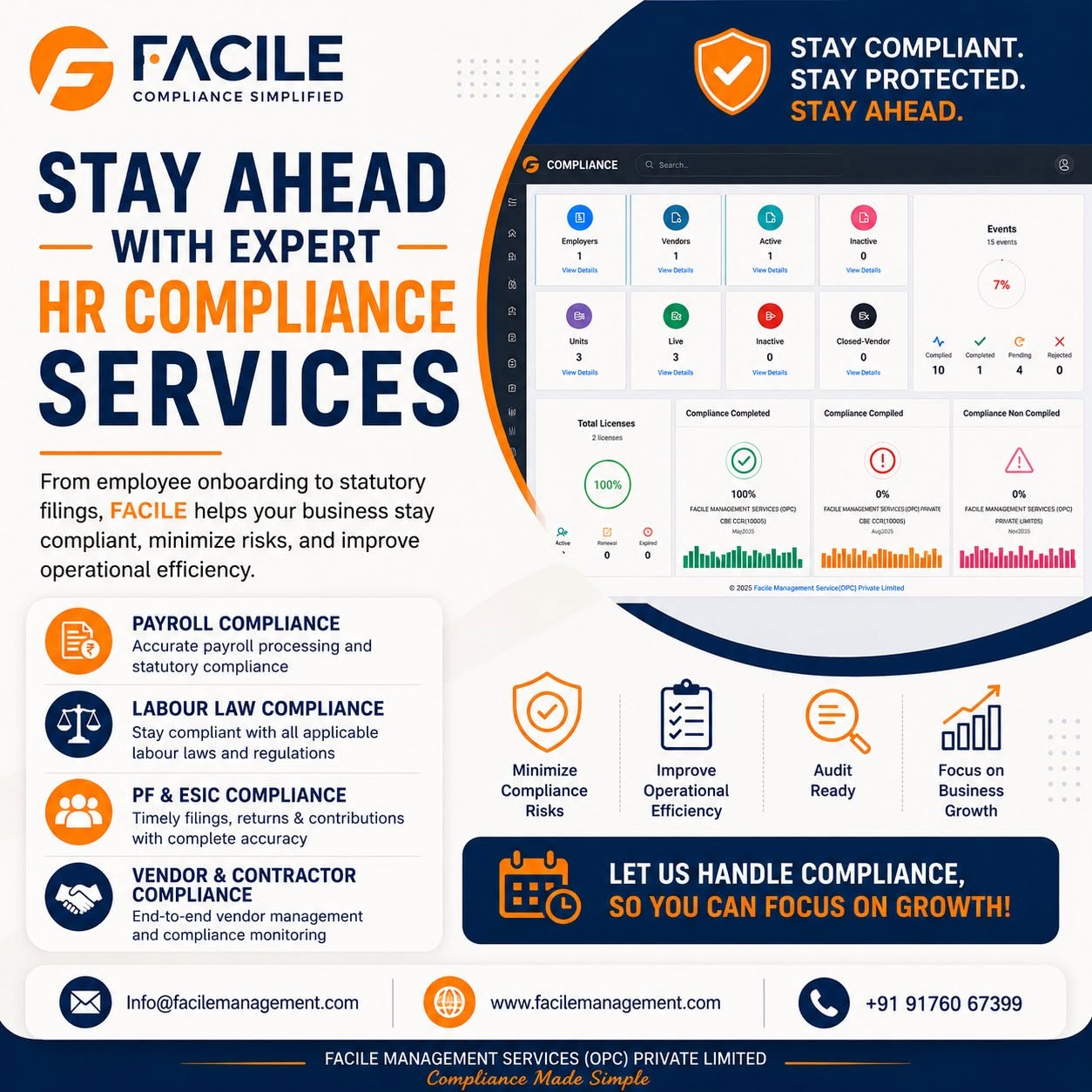
FACILE provides structured HR vendor audit compliance services in Salem for organisations that need greater visibility over contractor and third-party workforce compliance. Through document verification, payroll-linked validation, exception reporting, and follow-up tracking, FACILE supports businesses in building a consistent vendor compliance programme across units and locations.
Salem has a diverse commercial and industrial environment that includes steel, engineering, textiles, garment production, sago processing, logistics, healthcare, education, retail, hospitality, construction, and professional services. Many organisations operating in these sectors use outsourced employees for production support, loading and unloading, security, housekeeping, facility management, equipment maintenance, transport, and administrative work.
The presence of a contractor does not automatically remove every compliance concern from the principal employer. Depending on the applicable law, employment arrangement, establishment coverage, and facts of engagement, the principal employer may have important oversight or payment-related responsibilities. Official EPFO guidance, for example, states that principal employers should ensure that contractors enrol and comply for eligible contract employees before bills are released. EPFO also provides a facility for interlinking principal employers with contract employers and uploading work-order and contract-worker information.
Similarly, the Employees’ State Insurance framework addresses employees engaged directly or through an immediate employer. This makes accurate worker identification and contribution verification essential wherever ESIC applies. Vendor compliance must therefore be supported by records that demonstrate who worked, what wages were paid, what deductions and contributions were calculated, and whether statutory payments were completed correctly.
Without regular vendor audits, an employer may discover missing enrolments, delayed remittances, wage differences, expired documents, or incomplete registers only during an inspection, customer audit, employee grievance, accident, or contract renewal. A planned audit programme turns vendor compliance from a reactive exercise into a measurable management process.
An HR vendor compliance audit is a structured examination of a vendor’s employment-related records and statutory compliance for a defined period. It compares contractual requirements, worker deployment data, payroll information, statutory documents, and operational evidence to determine whether the vendor has complied with the requirements applicable to the engagement.
The audit normally begins with a vendor master and applicability assessment. Each vendor is classified according to its service, number of employees, work location, nature of activity, contract period, and relevant registrations. The auditor then requests documents according to this classification instead of applying one generic checklist to every vendor.
An effective audit does not treat documents in isolation. For example, an EPF challan may show that a payment was made, but it does not by itself prove that every eligible employee deployed at the client location was included. The auditor must compare the employee list, attendance, wage sheet, UAN details, ECR data, and payment proof. The same principle applies to ESIC, minimum wages, overtime, leave, licences, and other records.
FACILE’s audit scope can be configured according to the industry, workforce model, applicable laws, and risk profile of the client. The following areas commonly form part of the review.
A strong compliance process starts before a vendor deploys employees. FACILE can review vendor onboarding documents such as constitutional records, PAN, GST details where relevant, establishment registrations, EPF and ESIC codes, licences, insurance records, bank information, authorised signatory details, and service agreements.
The review also checks whether the contract clearly describes the nature of work, deployment location, workforce responsibility, wage obligations, statutory duties, record-submission timelines, indemnity provisions, audit rights, and consequences of non-compliance. Missing or inconsistent information is recorded as an onboarding exception for correction before or during deployment.
Where contractor or establishment registrations and licences are applicable, the audit verifies their availability, validity period, approved headcount, work location, principal-employer details, contractor details, and nature of work. Renewal acknowledgements, amendments, and supporting applications may also be reviewed.
This prevents common issues such as employees being deployed beyond an approved limit, work continuing after expiry, incorrect establishment details, or a licence being used for a location or engagement it does not cover. Expiry tracking enables the client and vendor to begin renewal action before the validity period ends.
FACILE compares the vendor employee master with site entry records, attendance data, wage registers, joining documents, identity information, and statutory enrolment details. The aim is to confirm that every deployed worker is traceable across the relevant records.
Typical checks include employee name, associate code, date of joining, designation, skill category, department, location, gender, date of birth, bank account details, UAN, ESIC insurance number, wage rate, and employment status. Duplicate records, missing identifiers, inconsistent names, unrecorded joiners, and employees continuing after exit are flagged for clarification.
Attendance is the foundation for wage and statutory validation. The audit checks whether attendance records correspond with access-control data, muster rolls, shift schedules, approved leave, weekly offs, holidays, and wage calculations.
Working-hour and overtime records may be reviewed for proper authorisation, calculation, and payment. Exceptions can include attendance days exceeding calendar possibilities, unexplained differences between site and payroll attendance, missing weekly offs, overtime without supporting records, or employees present at the site but absent from the wage sheet.
The audit examines whether wage rates and salary components are aligned with the category, skill level, location, industry, and period applicable to the worker. It also checks whether revisions have been implemented from the appropriate effective date.
FACILE can compare attendance-based earned wages with amounts shown in the wage register and bank statement. Basic wages, dearness allowance, overtime, incentives, leave wages, deductions, arrears, gross wages, and net pay can be tested for internal consistency. Unauthorised deductions, unexplained short payments, delayed payments, and cash payments without adequate evidence may be reported.
EPF verification connects eligible employees and applicable wages with UAN records, ECR data, challans, and payment proof. The audit can identify employees missing from the filing, differences between payroll PF and ECR contributions, incorrect UAN information, delayed remittances, excluded employees requiring explanation, or contributions calculated on inconsistent wages.
The review is especially important for contract workers because the principal employer needs dependable evidence that the contractor has complied for eligible employees. EPFO’s official principal-employer resources support linking contract employers and maintaining contract-related information to improve coverage and oversight.
ESIC audit checks may include IP registration, employee eligibility, contribution wages, employee and employer shares, contribution records, payment details, joining and exit information, and the treatment of employees whose wages cross the applicable limit.
The auditor compares the employee master, payroll, attendance, ESIC contribution data, and payment evidence. Missing IP numbers, omitted employees, wage mismatches, duplicate insurance numbers, incorrect contribution periods, and delays are documented for corrective action. When an employment injury or benefit claim arises, clean enrolment and contribution records become particularly important.
Depending on applicability, the audit can review Professional Tax, Labour Welfare Fund, and other employment-linked statutory obligations. Checks may cover registration details, employee deductions, employer contributions where applicable, payment schedules, returns, employee coverage, and reconciliation with payroll.
Because applicability and timelines may vary, FACILE builds the checklist around the organisation’s current location, establishment type, workforce profile, and notified requirements rather than relying on a static list.
Statutory registers and employment records provide the audit trail behind payroll and workforce compliance. FACILE can review wage, attendance, overtime, leave, deductions, advances, fines, accident, and employment-related records as applicable. Appointment documentation, wage slips, identity cards, nomination records, notices, and return acknowledgements may also be included.
The audit checks not only whether a record exists, but whether it is complete, updated, signed or authenticated where required, consistent with source data, and maintained for the correct establishment and period.
A wage sheet alone does not prove that employees received the stated net wages. FACILE can reconcile the payroll register with bank-transfer statements or other approved payment evidence. Employee-level comparisons help identify failed transfers, consolidated payments without sufficient support, differences between payroll and bank amounts, delayed credits, or payments made to an account not recorded in the employee master.
Payroll totals may also be reconciled with statutory wage totals, invoice values, service charges, and headcount records. This creates a stronger financial and compliance trail for vendor-bill certification.
For vendors working in factories, warehouses, construction sites, workshops, hospitals, and other higher-risk environments, the audit may cover induction records, personal protective equipment, training, medical examinations, accident reporting, insurance, and welfare documentation, subject to applicability and agreed scope.
The objective is to confirm that outsourced personnel are not left outside the client’s basic site-control system. Findings may be coordinated with the environment, health and safety, facilities, procurement, or operations teams.
Employee exits can create unresolved wage, leave, bonus, gratuity, contribution, or document issues. FACILE can test exit dates, last attendance, wage settlement, recoveries, bank payment, statutory exit updates, and supporting acknowledgements.
The audit also helps identify employees who have stopped working at the site but remain active in vendor records, or workers whose final dues have not been supported with adequate evidence.
FACILE follows a structured process that can be applied monthly, quarterly, half-yearly, annually, or before contract renewal.
The client and FACILE prepare a complete list of active vendors, work orders, locations, services, contract periods, and deployed headcount. Vendors may be classified as critical, high risk, medium risk, or low risk based on workforce size, statutory exposure, work environment, past findings, and service importance.
The audit checklist is mapped to each vendor’s engagement. This reduces unnecessary document collection and ensures that important requirements are not missed. The scope, sample period, employee sample, evidence standard, and submission deadline are communicated clearly.
Vendors submit documents through the agreed process. A document tracker records received, pending, expired, invalid, and not-applicable items. Clear file naming and period-wise organisation reduce repeated requests and make subsequent audits faster.
FACILE reviews the documents and conducts cross-record comparisons. Attendance is reconciled with payroll; payroll is reconciled with bank payment; eligible employees are compared with EPF and ESIC records; licences are checked against location, contract, and headcount; and returns are matched with payment evidence.
Audit observations can be classified by severity. A critical finding may involve missing wage payment, major statutory non-remittance, an invalid licence, or a serious worker-coverage issue. Major and minor findings may cover incomplete records, differences requiring correction, delayed submissions, or documentation weaknesses. Risk grading allows management to focus on issues with the greatest legal, financial, operational, or reputational impact.
Each observation should have a clear requirement, evidence of the gap, responsible owner, target date, and expected closure document. The vendor submits corrective evidence, and the auditor verifies whether the issue has actually been resolved. Repeated findings may lead to escalation, increased audit frequency, payment controls, or contractual action according to the client’s policy.
Management reporting may include vendor-wise scores, open critical findings, ageing of actions, recurring exceptions, document-submission performance, expiring licences, and compliance trends across units. This helps HR, procurement, finance, legal, and operations teams make informed vendor decisions.
Vendor audits frequently reveal gaps that are difficult to see through document collection alone. Common examples include:
Identifying these exceptions early gives both the client and vendor time to correct records, settle genuine shortfalls, and strengthen the process.
FACILE brings vendor documents, findings, due dates, and closure status into a structured review process. This gives decision-makers a consolidated view instead of relying on emails and disconnected spreadsheets.
The audit tests the relationship between workforce data, attendance, wages, bank payments, and statutory records. This is stronger than merely confirming that a challan or return has been uploaded.
A standard checklist, risk-rating method, evidence requirement, and closure process make results comparable across vendors and periods. Consistency also supports internal audits and management review.
Clear observations, owners, target dates, and evidence-based closure help vendors understand what must be corrected. Recurring gaps can be escalated through procurement or contract-management processes.
Period-wise records and closure evidence can reduce the time required to respond to customer audits, internal reviews, due diligence, employee queries, and inspections.
Organisations with multiple plants, offices, warehouses, hospitals, stores, or project sites can apply a common compliance framework while retaining location-specific applicability and documentation.
FACILE’s HR vendor audit compliance services can support a wide range of Salem businesses, including:
The audit programme is customised to the establishment, work arrangement, applicable requirements, and risk exposure of each business.
Vendor compliance cannot be managed effectively through last-minute document collection. It requires accurate vendor masters, applicability mapping, periodic evidence, payroll-linked validation, risk-based findings, and disciplined follow-up.
FACILE helps organisations in Salem establish this end-to-end process. Whether your business manages a small group of service vendors or a large contractor workforce across several units, FACILE can support vendor onboarding reviews, periodic compliance audits, statutory document verification, exception reporting, and corrective-action monitoring.
Strengthen your contractor governance, improve management visibility, and reduce avoidable compliance gaps with a structured HR vendor audit programme.
Contact FACILE Management Services
Email: Info@facilemanagement.com
Phone: +91 91760 67399
Website: www.facilemanagement.com
HR vendor audit compliance services examine whether manpower contractors and outsourced service vendors are meeting applicable employment, wage, social-security, licensing, record-maintenance, and contractual requirements. The audit verifies evidence, reconciles related records, reports exceptions, and monitors corrective actions.
Contractor non-compliance can create workforce disruption, employee grievances, inspection exposure, financial claims, reputational risk, and weak audit evidence. Periodic audits help the principal employer identify missing contributions, wage differences, expired documents, and worker-coverage gaps before they become larger issues.
The audit may cover manpower suppliers, security agencies, housekeeping vendors, canteen operators, transport providers, maintenance contractors, loading and unloading teams, construction contractors, facility-management companies, and other vendors deploying people at the client’s premises.
Frequency depends on the number of workers, nature of work, statutory exposure, previous findings, and client policy. High-risk vendors may require monthly verification, while lower-risk vendors may be reviewed quarterly or half-yearly. Annual audits alone may not be sufficient where payroll and statutory obligations arise every month.
Documents may include agreements, work orders, registrations, licences, employee masters, attendance, wage registers, bank-payment evidence, wage slips, EPF ECR and challans, ESIC contribution records, PT and LWF documents, overtime and leave records, returns, insurance, safety records, and corrective-action evidence. The final list depends on applicability.
No. A meaningful audit compares employee-level and period-level data. FACILE can connect deployment, attendance, wages, bank payments, statutory enrolments, contribution files, and challans to identify omissions or mismatches that a simple document-availability check may miss.
Yes. A common audit framework can be used across units while maintaining separate applicability, licences, attendance, headcount, and findings for each location. Consolidated reporting can show unit-wise and vendor-wise performance.
Each finding is assigned an owner, due date, risk grade, and required closure evidence. The vendor submits corrective documents, and the evidence is reviewed. A finding should be marked closed only when the correction is adequately supported, not merely because a response has been received.
Yes, if the client’s approved policy and contract permit it. Compliance status can be considered during bill certification, payment approval, retention, escalation, or vendor review. The exact control should be documented clearly and applied consistently.
No. An audit provides reasonable assurance based on the agreed scope, period, samples, records supplied, and validation procedures. It does not eliminate every risk or replace legal advice. Changes in law, undisclosed facts, inaccurate source records, and events after the audit can affect compliance status.
FACILE can clarify observations, specify the evidence required for closure, track action dates, and review resubmitted documents. Where specialised legal representation or authority approval is required, the organisation should engage an appropriately qualified professional.
The company can begin by preparing its vendor list, work orders, location details, deployed headcount, current documents, and recent payroll records. FACILE can then help define applicability, risk categories, audit scope, submission checklist, reporting format, and audit frequency.
Disclaimer: This article provides general information about HR vendor audit and compliance services. Legal applicability, obligations, rates, forms, due dates, and procedures may change and can vary according to the establishment, industry, workforce, location, and facts of engagement. Businesses should verify current notifications and obtain professional advice for their specific circumstances.


Facile Management Services (OPC) Private Limited is committed to delivering seamlessly integrated HR and compliance solutions designed for the evolving