
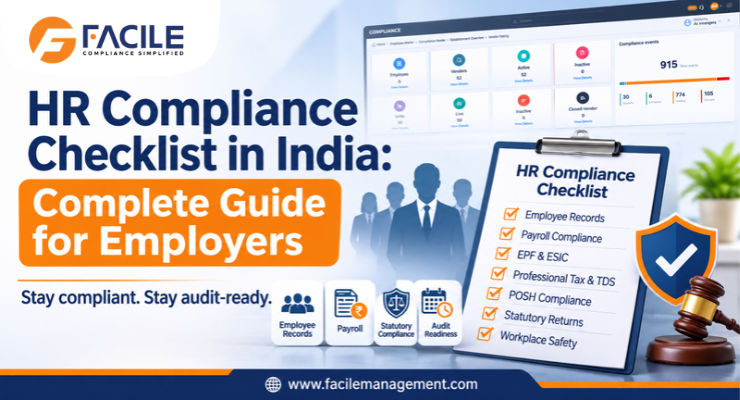
Managing employees involves more than hiring and payroll. Every organisation must follow applicable employment, payroll, social security, workplace safety, and state-specific labour requirements. An HR compliance checklist helps businesses track these responsibilities, maintain proper records, and stay prepared for audits and inspections.
The exact requirements depend on factors such as employee strength, state, industry, wage levels, and type of establishment. The Ministry of Labour & Employment’s compliance handbook highlights foundational, monthly, periodic, and event-based employer responsibilities.
HR compliance is the process of ensuring that an organisation follows applicable laws, regulations, statutory requirements, and employment policies related to its workforce.
A structured HR compliance process typically covers:
Start by checking whether your business has obtained all registrations applicable to its location and industry.
☐ Register the establishment under applicable state laws
☐ Obtain factory or industry-specific licences, where applicable
☐ Complete EPF and ESIC registration when coverage applies
☐ Register for Professional Tax, where applicable
☐ Complete Labour Welfare Fund registration where required
☐ Obtain registrations related to contract labour, if applicable
☐ Track licence renewal and expiry dates
State-specific requirements can differ, so businesses operating across multiple locations should maintain a separate compliance tracker for each state.
Proper employee records form the foundation of HR compliance.
☐ Issue appointment letters or employment contracts
☐ Maintain employee personal and employment records
☐ Collect PAN and bank account details for payroll
☐ Complete statutory declarations and nominations
☐ Maintain attendance and leave records
☐ Keep employee records updated when details change
☐ Maintain documentation for transfers, promotions, and salary revisions
The Ministry of Labour’s compliance guidance includes appointment letters and basic employment records among important employer responsibilities.
Payroll errors can create compliance risks when salary records, statutory deductions, and filed returns do not match.
☐ Pay salaries within applicable timelines
☐ Check applicable minimum wage rates
☐ Maintain accurate salary structures
☐ Generate and issue payslips
☐ Maintain wage and deduction records
☐ Track overtime and working hours
☐ Review payroll calculations before processing
☐ Reconcile payroll with statutory filings
Regular payroll reviews help identify errors before they become audit or inspection issues.
EPF requirements depend on the applicable coverage rules and establishment details.
☐ Verify EPF applicability
☐ Complete establishment registration
☐ Generate and maintain employee UAN details
☐ Calculate contributions correctly
☐ File monthly Electronic Challan-cum-Return (ECR)
☐ Deposit statutory contributions within applicable due dates
☐ Update employee exit information
☐ Reconcile payroll records with ECR data
The government compliance handbook identifies EPF registration, contribution management, and periodic compliance as key employer obligations. Labour India
Businesses covered under ESIC should maintain accurate employee and contribution records.
☐ Verify ESIC applicability
☐ Register the establishment and eligible employees
☐ Maintain employee insurance records
☐ Calculate employee and employer contributions accurately
☐ Deposit contributions within applicable timelines
☐ Reconcile ESIC records with payroll
☐ Update employee information when required
Professional Tax and Labour Welfare Fund requirements vary by state.
☐ Check Professional Tax applicability in each state
☐ Register with the appropriate state authority
☐ Deduct tax according to applicable slabs
☐ Deposit payments on time
☐ File applicable returns
☐ Check Labour Welfare Fund requirements
☐ Maintain payment and filing records
Businesses with employees in multiple states should not rely on a single state compliance calendar.
HR and payroll teams should coordinate with finance teams to ensure salary-related tax compliance.
☐ Collect employee tax declarations
☐ Calculate salary TDS accurately
☐ Deposit deducted tax within applicable due dates
☐ File required quarterly statements
☐ Reconcile tax payments and employee records
☐ Issue applicable tax certificates
Creating a safe and respectful workplace is an important HR responsibility.
☐ Implement a POSH policy
☐ Constitute an Internal Committee where legally required
☐ Display required information and policies
☐ Conduct employee awareness programmes
☐ Train committee members
☐ Maintain complaint and inquiry records confidentially
☐ Complete applicable annual reporting requirements
A proper POSH framework should focus on prevention, awareness, documentation, and a structured complaint-handling process.
HR teams should regularly review statutory and organisational employee benefits.
☐ Maintain a documented leave policy
☐ Track earned, casual, sick, and other applicable leave
☐ Review maternity benefit obligations
☐ Review gratuity applicability
☐ Check statutory bonus requirements
☐ Provide applicable welfare facilities
☐ Maintain benefit and payment records
Safety obligations vary based on the nature of the workplace and industry.
☐ Maintain workplace health and safety measures
☐ Conduct required safety training
☐ Maintain accident and incident records
☐ Provide applicable welfare facilities
☐ Conduct inspections and safety audits where required
☐ Report serious accidents or dangerous occurrences according to applicable requirements
The Ministry of Labour’s compliance guidance includes workplace safety, health, welfare measures, and event-based reporting among core employer responsibilities.
Companies engaging contractors should monitor compliance beyond their own direct employees.
☐ Verify contractor registrations and licences
☐ Maintain contractor and worker records
☐ Review wage payment records
☐ Monitor EPF and ESIC compliance, where applicable
☐ Maintain statutory documents and agreements
☐ Conduct periodic vendor compliance audits
A structured vendor compliance process can help organisations identify gaps before they create legal or operational risks.
Documentation is essential during compliance audits and inspections.
☐ Attendance and muster records
☐ Wage and salary registers
☐ Leave records
☐ Overtime records
☐ EPF and ESIC contribution records
☐ Professional Tax and LWF records
☐ Employee personnel files
☐ POSH documentation
☐ Contractor compliance records
☐ Licences and registration certificates
Keep records organised, accessible, and updated.
The employee exit process should also follow applicable legal and company requirements.
☐ Accept and document resignation or termination
☐ Calculate final salary and benefits
☐ Complete full-and-final settlement
☐ Review gratuity and other statutory benefits
☐ Update statutory portals and records
☐ Issue experience or relieving documents
☐ Secure company assets and access
The government compliance handbook specifically identifies final settlement and employee exit actions as event-based employer responsibilities. Labour India
A practical monthly review can include:
| Compliance Area | Monthly Action |
|---|---|
| Payroll | Process accurate salaries and payslips |
| EPF | Review contributions, ECR and payment |
| ESIC | Review contributions and payment |
| Professional Tax | Deduct and deposit where applicable |
| TDS | Deduct, deposit and reconcile |
| Registers | Update attendance, wages and other records |
| Compliance Calendar | Review upcoming deadlines |
| Audit | Check payroll and statutory data for mismatches |
A well-managed checklist helps organisations:
As organisations grow, managing multiple employees, locations, contractors, registers, and due dates manually can become difficult.
A centralised compliance system can help HR teams:
Facile Management helps businesses simplify statutory and workforce compliance through smarter compliance management and automation.
An HR compliance checklist is a structured list of employment, payroll, statutory, and workplace obligations that an organisation needs to track and manage.
Key areas include employee documentation, payroll, EPF, ESIC, Professional Tax, TDS, POSH, employee benefits, workplace safety, statutory registers, and contract labour compliance.
No. Compliance requirements can vary based on the organisation’s location, employee strength, industry, wage structure, and workforce type.
Businesses should monitor key payroll and statutory activities monthly, while also conducting periodic internal compliance audits.
Important documents can include appointment letters, employee records, attendance registers, wage records, statutory payment records, licences, policies, and contractor documents.
Payroll reconciliation helps identify mismatches between employee salary records, statutory deductions, contributions, and filings before they lead to compliance issues.
Yes. Organisations engaging contractors should maintain appropriate documentation and monitor applicable statutory compliance to reduce workforce-related risks.
HR compliance software can help automate reminders, centralise documents, track statutory tasks, manage registers, and improve audit readiness.


Facile Management Services (OPC) Private Limited is committed to delivering seamlessly integrated HR and compliance solutions designed for the evolving