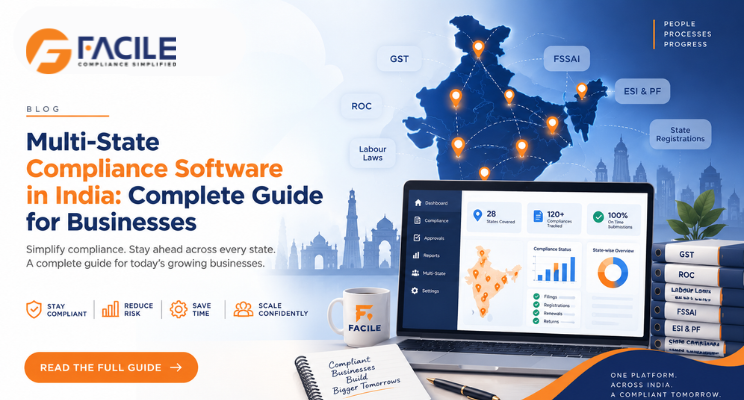
Managing statutory compliance across multiple States in India is complex because labour laws, minimum wages, Professional Tax, Labour Welfare Fund, Shops and Establishments requirements, holidays, registers, returns, licences and local notifications can vary from one State to another.
Multi-State Compliance Software helps organisations manage these State-specific obligations through one centralised digital platform. It gives HR, payroll, legal, compliance and management teams a consolidated view of what is applicable, what is due, what is completed and where compliance risks exist.
For businesses with branches, factories, warehouses, offices, contractors or employees across multiple States, a structured multi-state compliance platform can significantly reduce manual tracking and improve audit readiness.
Multi-State Compliance Software is a digital system designed to manage statutory and labour-law compliance across multiple States and business locations.
It can help organisations manage:
The objective is to give businesses one platform for managing State-specific compliance across India.
Businesses operating in multiple States may face different compliance requirements for each location.
For example, the rules applicable to an office in Tamil Nadu may differ from the requirements applicable to an establishment in Karnataka, Maharashtra, Telangana or Delhi.
Manual compliance tracking can create issues such as:
Multi-State Compliance Software helps centralise and standardise these processes.
The system should identify applicable compliance requirements based on:
This ensures each unit follows the correct State-specific obligations.
The platform should maintain compliance calendars by State and location.
Each activity can include:
This helps businesses avoid missed deadlines.
Minimum wage compliance is one of the most important multi-state requirements.
The software should help manage rates based on:
Employees can then be compared against the applicable rate.
Professional Tax requirements differ across States.
The system should help manage:
LWF requirements may differ by State in terms of:
The software should maintain State-wise LWF configuration.
The platform should support State-specific requirements relating to:
For manufacturing organisations, the software can support:
Businesses operating across multiple States need to track different holiday notifications.
The system should help maintain:
The platform should track:
This improves renewal control.
Different States may prescribe different registers.
The software should support:
The system should help track returns by:
The platform should help validate:
This supports consistent payroll compliance across locations.
Multi-state businesses often engage different contractors in different States.
The software should help manage:
Vendor compliance can be monitored by State and location.
The system can track:
State Governments regularly publish notifications that may affect compliance.
The software should help organise notifications by:
This makes regulatory updates easier to monitor.
The system should help compliance teams identify:
These updates can then be mapped to affected locations.
The software should classify compliance risks as:
Risk can be based on:
Where a compliance gap is identified, the system should record:
A structured workflow can be:
Observation → Action Assigned → Evidence Submitted → Verification → Closure
This improves accountability across locations.
A central dashboard can show:
A structured workflow can look like:
State → Location → Applicable Law → Compliance Task → Due Date → Document → Audit → Risk → Corrective Action → Closure
This gives management both State-wise and organisation-wide visibility.
All State-specific requirements can be managed from one platform.
Teams can monitor deadlines across all locations.
Businesses spend less time maintaining separate State-wise spreadsheets.
Minimum wages, PT and LWF can be mapped correctly by State.
Documents, registers and returns remain organised.
Contractor compliance can be monitored State by State.
Management can quickly identify high-risk locations.
Gazette notifications and State-specific updates can be monitored centrally.
As organisations expand into new States, compliance complexity increases.
A business may need to manage:
Tamil Nadu → Shops & Establishments + PT + LWF + Minimum Wages
Karnataka → Shops & Establishments + PT + LWF + Minimum Wages
Maharashtra → Shops & Establishments + PT + LWF + Minimum Wages
Delhi → Shops & Establishments + Minimum Wages + Local Notifications
A central software platform reduces the need to maintain separate trackers for every State.
Businesses should regularly verify:
It is useful for:
FACILE ONE can help organisations manage State-specific statutory requirements through one centralised platform.
Businesses can use FACILE ONE to support:
Multi-state compliance requires constant coordination between corporate compliance teams and local units.
FACILE ONE helps bring State-specific requirements into one structured system.
Key capabilities include:
Before selecting a platform, businesses should evaluate whether it supports:
The best software should clearly answer:
What applies in each State? What is due at each location? Which activities are completed? Where are the compliance gaps? What needs immediate action?
Multi-State Compliance Software helps organisations manage complex State-specific labour and statutory requirements through one centralised digital platform.
By bringing together minimum wages, PT, LWF, licences, registers, returns, payroll, contractors, notifications and audits, businesses can improve compliance visibility across India.
For organisations operating across several States and locations, FACILE ONE can help standardise compliance management while preserving State-specific requirements and improving audit readiness.
It is software used to manage statutory and labour-law requirements across multiple States from one platform.
It helps businesses manage State-specific laws, due dates, minimum wages, PT, LWF, licences and returns centrally.
Yes. Rates can be mapped by State, zone, industry, skill category and effective date.
Yes. PT applicability, slabs, deductions, payments and returns can be tracked by State.
Yes. State-specific LWF applicability, contributions, frequency and due dates can be monitored.
Yes. Registrations, renewals, registers, working hours, leave and returns can be managed State-wise.
Yes. Factory licences, renewals, working hours, registers, returns and inspections can be monitored.
Yes. State-wise holiday notifications can be maintained year by year.
Yes. Notifications can be organised by State, subject, release date and effective date.
Yes. Contractor licences, workers, payroll, EPF, ESIC and statutory records can be monitored by location.
Yes. Vendor documents, audits, risks and corrective actions can be managed across locations.
Yes. Compliance calendars and alerts can be configured by State and location.
Yes. Risks can be classified and monitored at both State and location level.
Yes. Multi-location monitoring is a core use case.
HR, payroll, compliance, legal, audit and management teams in organisations operating across multiple States can use it.
Yes. FACILE ONE can support State-wise applicability, minimum wages, PT, LWF, licences, registers, returns, contractors, regulatory updates and dashboards.

Facile Management Services (OPC) Private Limited is committed to delivering seamlessly integrated HR and compliance solutions designed for the evolving