Managing compliance across multiple locations, States, departments, contractors, vendors and statutory obligations can become difficult when information is spread across spreadsheets, emails, folders and different software systems.
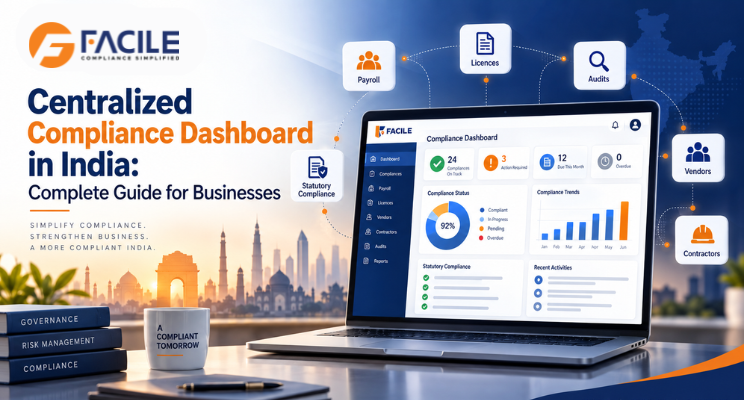
A Centralized Compliance Dashboard helps organisations bring all key compliance information into one place. It provides management, HR, payroll, legal, audit and compliance teams with a consolidated view of pending activities, completed tasks, overdue items, licences, audits, risks, contractor status, vendor compliance and overall compliance performance.
For businesses operating across multiple units, a centralized dashboard can improve visibility, reduce manual reporting and help management take faster action on compliance risks.
A Centralized Compliance Dashboard is a digital interface that displays compliance information from different functions, locations and statutory areas in one consolidated view.
It can help businesses monitor:
The goal is to help management quickly understand where the organisation stands from a compliance perspective.
Without a central dashboard, compliance teams may need to manually collect reports from different departments and locations.
This can create issues such as:
A Centralized Compliance Dashboard solves these problems by presenting important compliance information in one place.
The dashboard should show high-level indicators such as:
This gives management an immediate snapshot.
For businesses operating across multiple States, the dashboard should show compliance status by State.
This can include:
The system should allow filtering by:
This helps identify high-performing and high-risk locations.
The dashboard should show:
This helps teams prioritise activities.
A centralized dashboard can show:
This improves renewal control.
Payroll-related indicators can include:
Principal employers can monitor:
Vendor indicators can include:
Audit information can include:
This gives audit teams better control.
Compliance risks can be classified as:
The dashboard can show risk distribution by:
The dashboard should track:
This improves accountability.
A compliance score can provide a simple performance indicator.
The score can be based on:
Users should be able to filter dashboard data by:
This makes the dashboard more useful for different teams.
Different users may need different views.
For example:
Management may need overall risk and compliance score.
HR may need employee and payroll compliance.
Compliance teams may need statutory deadlines and documents.
Audit teams may need observations and corrective actions.
Role-based dashboards improve usability.
The dashboard can highlight:
A dashboard can show compliance performance over time.
For example:
This helps management understand whether compliance performance is improving.
Multi-state organisations need one central view across all locations.
A dashboard can structure data as:
India → State → Location → Compliance → Status → Risk
This allows management to move from a national overview to a specific unit or compliance activity.
Senior management often does not need every compliance document.
They need concise information such as:
A good dashboard converts complex compliance information into actionable management insight.
All major compliance information is available in one place.
Management can identify problem areas quickly.
Teams spend less time creating Excel and PowerPoint reports.
High-risk items are highlighted early.
Responsible teams and pending actions can be clearly identified.
Management can compare States, units and vendors easily.
Audit status, observations and closure actions remain visible.
Businesses should ensure the dashboard supports:
It is useful for:
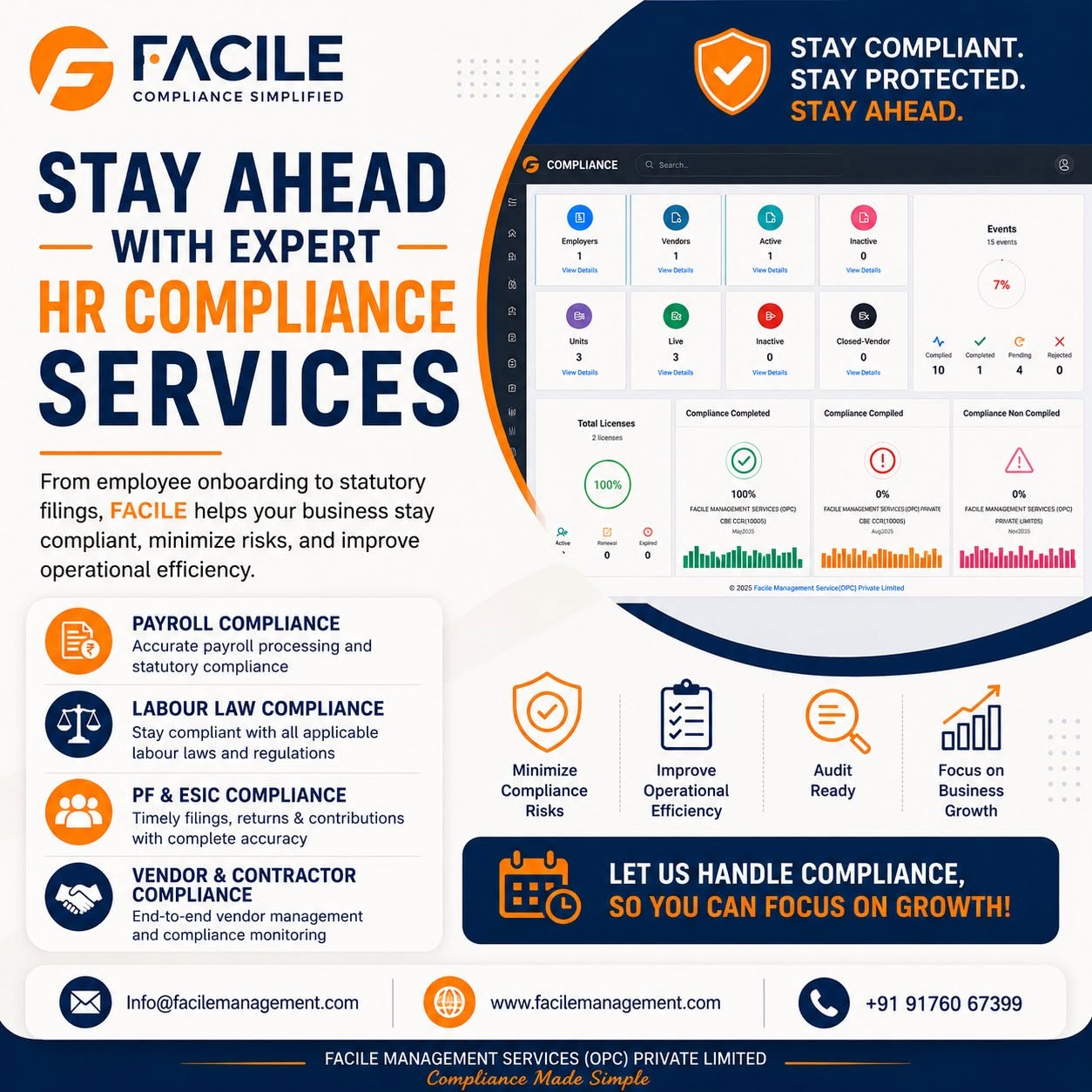
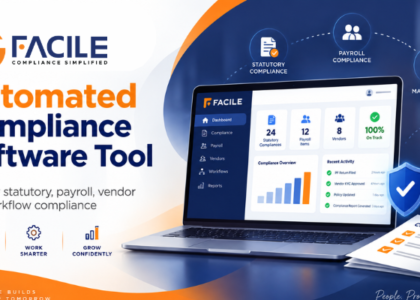
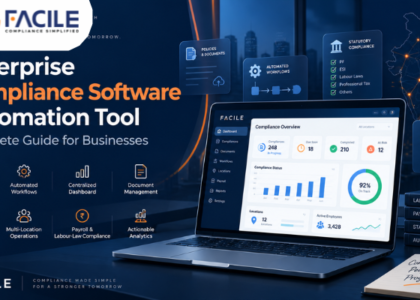
FACILE ONE can help organisations bring multiple compliance areas into a single dashboard.
Businesses can use FACILE ONE to monitor:
Compliance data is most valuable when management can understand it quickly.
FACILE ONE helps convert compliance records into structured dashboards that provide visibility across employers, units, contractors, vendors and compliance periods.
Key capabilities include:
Businesses should evaluate whether the dashboard supports:
The best dashboard should clearly answer:
What is compliant? What is pending? What is overdue? Where is the risk? Which location or vendor needs attention? Who owns the action?
A Centralized Compliance Dashboard helps organisations simplify complex compliance reporting by bringing multiple statutory, payroll, contractor, vendor, audit and risk indicators into one place.
For businesses operating across multiple States and locations, a centralized dashboard can improve visibility, strengthen governance and support faster decision-making.
With FACILE ONE, businesses can move from fragmented compliance reporting toward a more connected, data-driven compliance management approach.
It is a digital dashboard that consolidates compliance data from multiple locations, laws, contractors and business functions.
It gives management a single view of completed, pending, overdue and high-risk compliance activities.
Yes. Compliance data can be grouped and filtered by State.
Yes. Branches, factories, warehouses and project sites can be monitored individually.
Yes. Upcoming and overdue activities can be highlighted.
Yes. Expiring and expired licences can be displayed.
Yes. Minimum wages, EPF, ESIC, PT, LWF and payroll status can be monitored.
Yes. Contractor employees, statutory records, licences and audit status can be displayed.
Yes. Vendor documents, audits, risk levels and compliance scores can be monitored.
Yes. Open, overdue and closed observations can be tracked.
Yes. Risks can be classified as low, medium, high or critical.
Yes. Compliance scores can provide a quick overview of overall performance.
Yes. Different teams can have dashboards tailored to their responsibilities.
Yes. Multi-state and multi-location visibility is one of the main benefits.
Yes. FACILE ONE can support State-wise, unit-wise, contractor, vendor, audit and compliance-risk dashboards.

Facile Management Services (OPC) Private Limited is committed to delivering seamlessly integrated HR and compliance solutions designed for the evolving