
Running an establishment requires more than managing employees and business operations. Employers must understand which labour and employment requirements apply, complete registrations, maintain accurate employee records, process wages correctly, monitor working hours and leave, manage social-security obligations, oversee contractors and retain evidence for inspections. These responsibilities become difficult when information is distributed across HR, payroll, finance, administration, unit managers and external consultants.
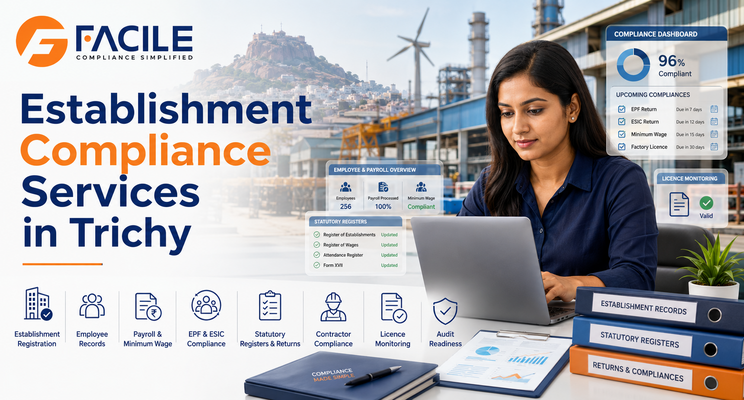
FACILE Establishment Compliance Services in Trichy help businesses create a structured, technology-enabled system for managing these obligations. The service combines applicability assessment, registrations, recurring compliance, payroll-linked validation, statutory records, contractor monitoring, audits and management reporting. It is designed to reduce missed activities, inconsistent documents and compliance gaps while improving visibility and accountability.
Trichy—also known as Tiruchirappalli—is an important industrial, educational and commercial centre in Tamil Nadu. Its economy includes heavy engineering, fabrication, boiler and energy-related businesses, manufacturing, construction, logistics, healthcare, education, hospitality, retail and professional services. Each establishment may have different duties based on its activity, workforce, premises, contractor engagement and legal structure. A reliable compliance programme must therefore be tailored to the actual establishment.
Establishment compliance is the process of identifying and fulfilling legal obligations connected with employing people and operating a workplace. It covers the complete employment lifecycle—from opening the establishment and registering it to onboarding employees, paying wages, maintaining records, filing returns, managing contractors and preparing for inspections.
Depending on applicability, the compliance framework may address:
The exact scope should be confirmed according to the appropriate central or state framework and the facts of the business.
Many organisations initially manage compliance through spreadsheets, email reminders and physical files. This may appear sufficient for a small team, but the risk increases as employee strength grows, contractors are added or more locations are opened.
Common problems include:
FACILE helps replace fragmented tracking with a defined process that records the requirement, owner, due date, status, reviewer and supporting evidence.
FACILE provides end-to-end support based on the customer’s business structure and agreed scope. Services may include:
The purpose is to create an ongoing compliance system rather than a one-time checklist.
The first step is understanding which requirements apply. An office, hospital, educational institution, retail shop, warehouse, engineering company and construction establishment may each fall under a different combination of laws and rules.
FACILE reviews information such as:
An applicability matrix can then record every relevant activity, frequency, responsible person, evidence requirement and due date. It should be updated when the organisation changes its business, workforce, premises or operating model.
Eligible shops and commercial establishments in Tamil Nadu must address registration requirements under the applicable state framework. Accurate information about the business, employer, premises, activity and employee strength is important at the application stage.
FACILE can support:
Changes in the legal name, employer details, address, activity, workforce or constitution should be reviewed to determine whether an amendment, intimation or fresh process is needed. Merely holding an older certificate does not confirm that the present establishment details are accurate.
Compliance begins when an employee joins. Incomplete or inconsistent onboarding data can later affect payroll, social-security contributions, benefits, statutory records and exit processing.
FACILE can help establish controls for:
Employee master data should remain consistent across HR, attendance, payroll and statutory systems.
Establishments must monitor working time according to the applicable legal framework. Shift design, spread-over, weekly rest, overtime and employment of particular categories of workers may require specific controls.
FACILE can support the review of:
The objective is to align actual attendance with approved schedules and payroll treatment. If attendance shows extra hours but payroll contains no corresponding review, the gap should be investigated before records are finalised.
Leave administration should connect employee eligibility, applications, approvals, balances and payroll. Separate manual records often create disputes or inconsistent balances.
FACILE can help maintain or review:
Holiday lists and required notices should be planned before the relevant year and preserved with approval or submission evidence where applicable.
Payroll is a major source of establishment-compliance risk because wages, attendance, deductions, contributions and records are interconnected. Errors may affect many employees and multiple statutory outputs.
FACILE can support payroll checks covering:
Exception reports enable HR and payroll teams to investigate unusual or inconsistent records before filing or payment closure.
Minimum-wage requirements can vary by scheduled employment, category, skill, zone and effective date. Employers must use current applicable rates and map employees according to their actual duties.
FACILE can assist by configuring relevant rates and comparing payroll data with the mapped requirement. Potential exceptions may include:
Complex classifications should be reviewed by a competent professional, particularly when job titles do not clearly reflect actual work.
Provident-fund compliance requires consistent employee information, coverage decisions, wage data, contributions, filing and payment evidence. FACILE may help monitor:
For contractors, contribution evidence should be checked against the employees actually deployed at the Trichy establishment rather than relying solely on a consolidated challan.
ESIC compliance also depends on accurate employee coverage, insurance registration, contribution wages and timely records. FACILE can support review of:
Coverage and wage treatment should be validated under current official requirements and the facts of each employee.
Professional Tax and Labour Welfare Fund obligations may involve prescribed deductions, employer contributions, payment schedules and returns. FACILE can map employees and units to the relevant configuration, calculate or review payable amounts, track due dates and retain challans and acknowledgements.
For multi-state organisations, unit-wise configuration is particularly important because another state’s rates or calendar should not be applied automatically to the Trichy establishment.
Registers and returns provide formal evidence of employment, attendance, wages, leave, overtime, deductions and other compliance information. Preparing them only during an inspection can create inconsistencies with source records.
FACILE can help generate, organise or review records relating to:
The organisation should review every final register or return for correct period, format, data and authorisation before submission or preservation.
Contractor labour can create principal-employer risk when employee records, licences, wages, contributions or registers are incomplete. FACILE can establish a vendor-wise compliance process covering:
Documents can be reviewed each month against a defined checklist. Missing or rejected evidence remains open until the contractor provides an acceptable correction.
An establishment may hold registrations and licences issued by different authorities. Each may have separate validity, amendment and renewal requirements.
FACILE can maintain a central register containing:
Advance alerts and escalation reports help prevent last-minute renewals and identify certificates whose particulars no longer match current operations.
Establishment compliance also includes workplace practices and welfare arrangements. Depending on applicability, organisations may need to address drinking water, sanitation, rest areas, first aid, safety, anti-harassment measures, maternity support, equal treatment and grievance processes.
FACILE can help review policies, committee records, notices, training evidence and welfare documentation. Physical conditions should be verified at the workplace; a written policy alone is not proof that facilities exist or procedures are followed.
An inspection may require the organisation to present certificates, notices, registers, payroll records, attendance, contribution evidence, employee files and contractor documents. Retrieving these from different departments under time pressure is inefficient and risky.
FACILE helps create an audit-ready repository and can support periodic internal reviews. Observations may be classified by risk, assigned to responsible owners and tracked with target dates.
Typical audit checks include:
Closure should be supported by evidence rather than a status update alone.
Regulatory notices and portal queries require timely, accurate and consistent responses. FACILE can support a controlled process for:
Legal representation and interpretation should be obtained from a qualified adviser where the matter requires it.
Understand the entity, locations, activities, workforce, contractors and present compliance process.
Prepare a unit-wise matrix of registrations, payments, filings, registers, returns and event-based obligations.
Compare the required position with available records and classify gaps by risk and priority.
Assign internal target dates, owners, reviewers, evidence requirements and escalation paths.
Collect attendance, payroll, employee changes, contractor records and statutory documents.
Check data consistency, investigate exceptions and obtain approval before closure.
Record payment or filing details and store challans, acknowledgements, returns and registers.
Identify deficiencies, assign actions and verify evidence of closure.
Provide dashboards showing completed, pending, overdue and high-risk matters.
Review applicability and configuration when laws or business conditions change.
Compliance activities, documents, licences and contractor records are organised in one framework.
Advance reminders and escalation reduce dependence on personal calendars.
Attendance, wage and contribution checks identify exceptions before records are closed.
Vendor compliance can be monitored by unit, period, document and risk.
Evidence is easier to retrieve and connect with the relevant activity.
Each obligation and corrective action can have an owner, reviewer and target date.
Dashboards help leadership identify overdue work, repeated gaps and weak-performing contractors.
The approach can support one Trichy establishment or multiple units across India.
FACILE Establishment Compliance Services can support:
The service scope is customised to the organisation’s actual requirements.
Compliance is easier to manage when legal applicability, operational data, responsibilities, deadlines and evidence are connected. FACILE helps Trichy employers move from fragmented tracking to a systematic process covering registrations, payroll, social security, records, contractors, licences, inspections and corrective actions.
Whether you are starting a new establishment, strengthening an existing compliance programme or managing multiple units and vendors, FACILE can help build a practical and audit-ready framework.
Contact FACILE for establishment compliance services in Trichy.
Establishment compliance services help employers identify and manage registrations, employee records, wages, working hours, leave, social-security contributions, statutory registers, returns, licences, contractor obligations and inspection evidence.
Any business employing people may have labour and employment obligations. The exact requirements vary for offices, shops, hospitals, schools, hotels, warehouses, construction sites, engineering companies and factories. Applicability should be assessed for each establishment.
Yes. FACILE can support applicability review, document checklists, application-data validation, submission tracking, certificate review and amendment assessment. Registration approval remains with the competent authority.
Yes. The agreed scope may include payroll and attendance checks, EPF, ESIC, Professional Tax, Labour Welfare Fund, registers, contractor evidence, licence tracking and management reporting.
FACILE can compare payroll and attendance data with configured minimum-wage and overtime requirements. Classification and exceptional cases should be reviewed by a knowledgeable professional.
Yes. FACILE can help monitor employee registration data, contributions, payroll reconciliation, challans, joining and exit information, contractor coverage and open exceptions.
Yes. Contractor work orders, employees, attendance, wages, contributions, licences, registers and audit observations can be tracked through a structured review process.
FACILE can help generate, organise or review applicable records using validated source data. The employer should approve the final format and information before submission or preservation.
FACILE centralises certificates, registers, payroll records, challans, returns and contractor documents. It can also identify missing evidence and track inspection observations and responses.
Yes. Activities and records can be configured by entity, state, unit, law and contractor, allowing consolidated reporting while retaining location-specific requirements.
No consultant or platform can guarantee compliance regardless of the quality of source data and management action. FACILE strengthens monitoring, validation, evidence and accountability; the employer remains responsible for meeting applicable legal duties.
The process generally starts with a discussion about the entity, workplace, employee strength, contractors and existing compliance system. FACILE can then assess the scope, identify gaps, configure activities and establish an implementation plan.
This article is provided for general information and marketing purposes and does not constitute legal, tax or professional advice. Statutory applicability, thresholds, rates, forms, registrations, filing procedures and due dates may change and depend on the facts of each establishment. Employers should verify current requirements with the relevant government authority or a qualified professional before acting.


Facile Management Services (OPC) Private Limited is committed to delivering seamlessly integrated HR and compliance solutions designed for the evolving