

Managing business compliance in India involves much more than completing a few registrations or submitting annual returns. Organisations must continuously monitor labour laws, payroll obligations, statutory contributions, licences, registers, contractor documents, inspections and recurring filing deadlines.
As a company expands, its compliance responsibilities also increase. Multiple establishments, a growing workforce, contractors, vendors and operations across different states can make statutory management increasingly complex. Manual spreadsheets, scattered emails and disconnected documents may result in missed deadlines, incorrect records and limited management visibility.
Partnering with an experienced compliance management services company in Chennai can help businesses organise their statutory responsibilities, reduce compliance risks and maintain audit-ready records.
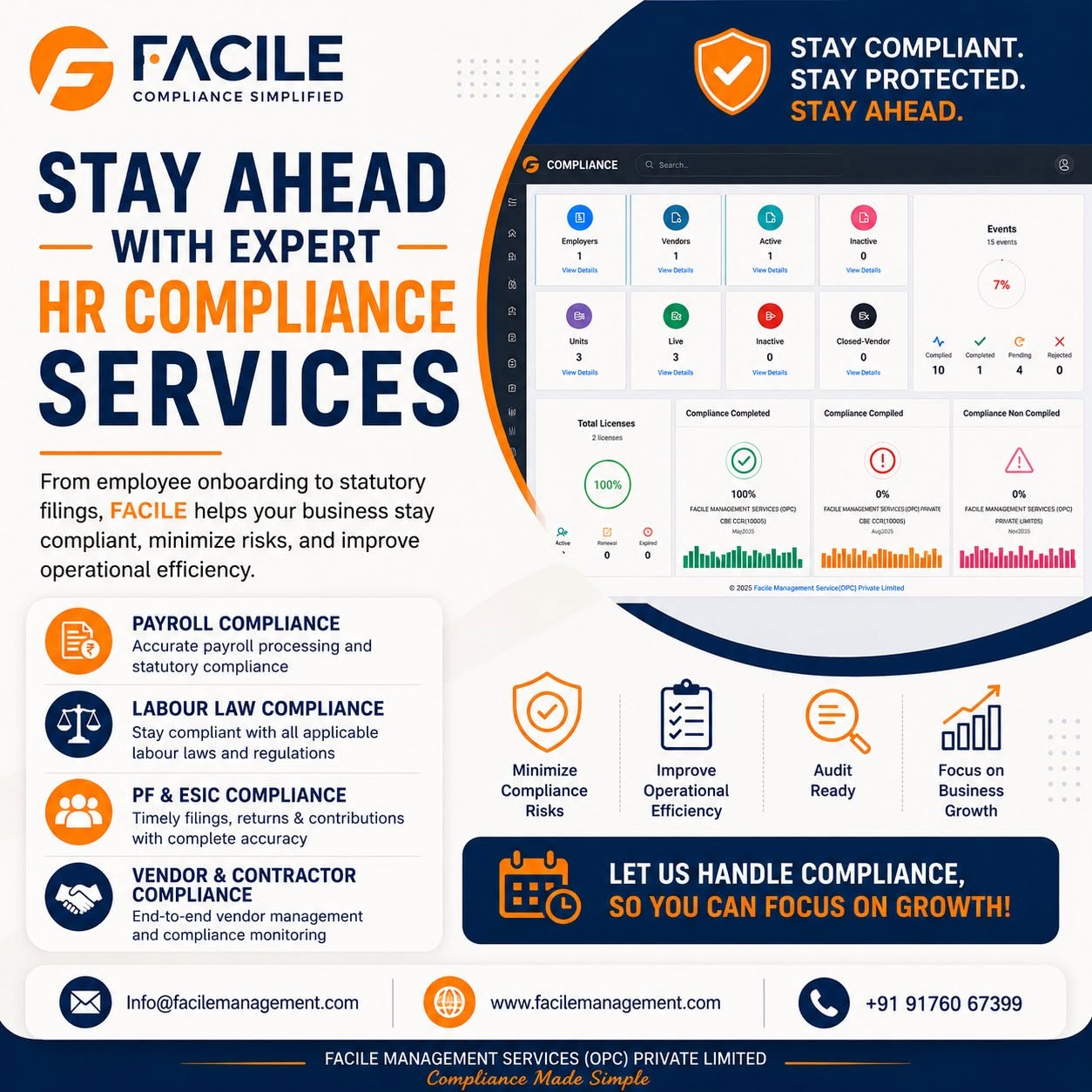
Facile Management Services (OPC) Private Limited provides comprehensive labour law, payroll, statutory, contractor and establishment compliance support for startups, growing enterprises and multi-location organisations.
Compliance management services help an organisation identify, complete, monitor and document the legal and statutory responsibilities applicable to its business.
The service covers the entire compliance lifecycle—from determining applicability and obtaining registrations to monitoring deadlines, verifying records, filing returns and preparing for inspections.
A comprehensive compliance management service may include:
The exact scope depends on the organisation’s industry, employee strength, geographical presence, contractor engagement and nature of business operations.
Chennai is home to manufacturing facilities, IT companies, healthcare organisations, educational institutions, retail establishments, logistics businesses, construction companies, hospitality providers and professional service firms.
Each business may be governed by different statutory requirements. A factory with contract workers will have different obligations from an IT company or retail establishment. Businesses operating from multiple branches may also need to manage location-specific registrations, returns and records.
Effective compliance management is important for the following reasons.
Employers must understand the laws applicable to their establishments and employees. Compliance management ensures that required registrations, payments, returns, registers and renewals are handled systematically.
Delayed payments, missed returns and incorrect statutory calculations may lead to interest, damages, penalties or notices. Regular monitoring helps identify and correct issues before the financial risk increases.
Compliance activities are connected to wages, working hours, leave, statutory contributions and employee benefits. Accurate compliance supports employee rights and helps eligible workers receive their benefits correctly.
Authorities may request licences, returns, challans, registers and employment records during an inspection. Organised documentation enables the business to respond quickly and confidently.
Companies engaging contract workers must maintain adequate oversight of contractor compliance. A structured verification process reduces the risk of accepting incomplete or inaccurate records.
Expired licences, missing registrations and unresolved notices can affect business operations. Proactive compliance monitoring helps prevent avoidable disruption.
Management needs a clear understanding of completed, pending, delayed and high-risk activities. Compliance dashboards and reports provide this consolidated view.
Compliance becomes difficult when responsibilities are spread across HR, finance, administration, legal teams, contractors and external consultants.
Businesses may complete common statutory activities but overlook obligations connected to their industry, location, workforce strength or operating model.
Monthly, quarterly, half-yearly and annual deadlines must be monitored. Depending solely on spreadsheets and individual reminders increases the risk of missing an activity.
Amendments, notifications, wage revisions and filing-process changes must be tracked. Continuing with outdated procedures may create compliance gaps.
Registers may be maintained by HR, challans by finance and contractor records by administration. When information is scattered, verification and reporting become difficult.
Payroll calculations should match statutory contribution files, challans and returns. Differences may arise due to incorrect employee eligibility, wage components or contribution calculations.
Contractors may submit documents without adequate supporting evidence. The principal employer needs a verification process to confirm wage payments and statutory contributions.
Failure to monitor expiry and renewal dates can create operational and legal risks.
Identifying a problem is not enough. The organisation must assign responsibility, establish a target date and verify that the issue has been resolved.
Labour law compliance is a central part of business compliance management. It involves identifying and fulfilling the employment-related obligations applicable to an establishment and its workforce.
The scope may include:
A professional compliance management company creates a responsibility matrix showing each applicable activity, its frequency, due date, owner and supporting evidence.
Payroll compliance connects employee salary processing with statutory obligations. Even when salaries are paid on time, incorrect deductions or incomplete supporting records can create compliance risks.
Payroll compliance services may cover:
Payroll values should be reconciled with attendance, bank records, accounting entries, contribution files and statutory challans. This helps identify missing employees, incorrect deductions and payment differences.
Provident Fund compliance requires accurate employee data, correct contribution calculations, timely payment and appropriate records.
Support may include:
Regular reconciliation helps identify employees omitted from contributions and differences between payable and paid amounts.
ESIC compliance requires careful monitoring of employee eligibility, wage information, contributions and applicable contribution periods.
The service may include:
Changes in employee wages must be reviewed so that coverage and contribution treatment remain consistent with applicable requirements.
Where applicable, businesses must identify the correct deduction or contribution requirements, payment schedules and return responsibilities.
Support may include:
Applicability may differ depending on the state, establishment and employee category. Businesses operating across multiple locations therefore need location-specific compliance tracking.
Registrations and licences are essential for lawful business operations. They may require amendment when the organisation changes its address, employee strength, business activity or other registered particulars.
Licence management services may cover:
A licence tracker should record the licence number, issuing authority, establishment, effective date, expiry date, responsible person and renewal status.
Businesses frequently engage contractors for security, housekeeping, maintenance, manufacturing support, logistics, construction, facility management and manpower services.
The principal employer should not depend only on documents submitted by contractors. Contractor records must be verified against attendance, payroll, bank payment and statutory contribution information.
Contractor compliance management may include verification of:
A monthly contractor audit helps identify missing records, delayed wage payments, contribution differences and expired licences.
A compliance risk audit provides an independent assessment of the organisation’s compliance position. It examines whether applicable activities have been completed accurately and supported by adequate evidence.
A risk audit usually involves:
Observations may be classified as high, medium or low risk according to their potential impact and urgency.
A compliance calendar converts statutory obligations into trackable activities. It provides a structured view of what must be completed, when it is due and who is responsible.
A well-designed compliance calendar may contain:
Automated reminders and escalation alerts can reduce dependence on manual follow-ups.
Completing a compliance activity without maintaining its supporting evidence can create difficulties during an audit or inspection.
A systematic document-management process should cover:
Files should follow a consistent naming and classification system. Access should be restricted according to user responsibilities because compliance documents may contain sensitive employee information.
Manual compliance tracking may work for a small establishment, but it becomes difficult when an organisation manages multiple units, contractors and deadlines.
Technology-supported compliance management can provide:
Technology does not replace professional compliance knowledge. It strengthens execution by improving visibility, consistency and accountability.
Compliance professionals understand statutory processes, payroll records, registrations, licences, returns and audit requirements.
Internal teams can focus on employees, finance and business operations while routine compliance activities are monitored systematically.
Compliance calendars, reminders and review mechanisms help reduce delayed payments, filings and renewals.
Data validation and reconciliation improve the accuracy of payroll, contributions and statutory records.
A professional process ensures that every completed activity is supported by appropriate evidence.
Organised records allow businesses to respond more effectively to inspections, client audits and internal reviews.
An outsourced model can support new locations, additional employees and a growing contractor network.
External professionals may identify compliance gaps that routine internal processes have overlooked.
Businesses should assess service providers carefully before sharing responsibility for critical statutory activities.
Determine whether the provider supports only filings or offers complete compliance management, including applicability, payroll verification, contractor audits and inspection support.
The provider should understand labour law, payroll compliance, statutory contributions, establishment requirements and contractor management.
Ask how activities are assigned, reviewed, approved, documented and reported.
A suitable platform should provide deadline tracking, alerts, dashboards, document storage and audit trails.
Employee, payroll and statutory records must be protected through controlled access and secure document-sharing procedures.
Management reports should clearly show completed activities, pending tasks, risks, observations and corrective actions.
The provider should assist with resolving observations, not merely identify them.
A growing business should select a partner capable of supporting establishments and contractors across different states.
Facile Management Services (OPC) Private Limited helps businesses simplify complex statutory responsibilities through professional expertise and technology-supported compliance management.
FACILE’s services may include:
FACILE focuses on giving management clear visibility into compliance status, risks and pending actions. Its structured approach helps organisations move from reactive compliance handling to preventive and systematic management.
Compliance management services can support organisations across many industries, including:
The service model can be customised according to the organisation’s industry, workforce structure and geographical presence.
Compliance management is an ongoing business responsibility. Registrations, payroll records, statutory contributions, licences, contractor documents and returns must be monitored throughout the year.
When these activities are managed through disconnected spreadsheets and manual follow-ups, businesses may face missed deadlines, incomplete records and poor risk visibility. A structured compliance-management system provides clear responsibilities, timely reminders, accurate documentation and measurable corrective actions.
Businesses looking for an experienced compliance management services company in Chennai can partner with Facile Management Services (OPC) Private Limited for labour law compliance, payroll compliance, licence management, contractor audits, statutory reconciliation and inspection support.
Strengthen your compliance process and keep your organisation prepared with FACILE.
Facile Management Services (OPC) Private Limited
Phone: +91 91760 67399
Email: Info@facilemanagement.com
Website: www.facilemanagement.com
A compliance management services company helps businesses identify, complete and monitor applicable statutory obligations. Its services may cover registrations, payroll compliance, contributions, returns, licences, registers, contractor audits and inspection support.
Outsourcing gives businesses access to specialised knowledge, deadline monitoring, systematic documentation and independent verification. It also reduces the administrative burden on internal HR and finance teams.
Yes. Facile Management Services (OPC) Private Limited supports businesses with labour law, payroll, statutory, contractor and establishment compliance management.
Documents may include establishment registrations, licences, employee records, attendance, payroll sheets, payslips, bank payment proofs, challans, returns, registers and contractor compliance records.
Yes. FACILE can help verify contractor licences, attendance, wage records, bank payment proofs, EPF and ESIC documents, challans, returns and other supporting records.
A compliance calendar is a schedule of applicable statutory activities, their due dates, responsible users, status and supporting documents. It helps businesses monitor recurring obligations.
Technology can centralise calendars, automate alerts, store documents, track licences, reconcile statutory data and provide management dashboards and audit trails.
A compliance risk audit is a systematic review of an organisation’s statutory records and processes. It identifies gaps, classifies risks and recommends corrective actions.
Yes. A professional provider can manage compliance calendars, documents and status reports for multiple establishments while considering location-specific requirements.
Monthly compliance activities should be reviewed during each cycle. Licences, registrations, returns and other obligations should be monitored according to their applicable schedules. Periodic risk audits are also recommended.
Yes. Startups and small businesses can benefit because they may not have dedicated internal compliance teams. The service scope can be customised according to their workforce and requirements.
FACILE supports document verification, payroll reconciliation, contractor audits, compliance calendar tracking and corrective-action monitoring so that required records remain organised and accessible.
Yes. FACILE can support licence-validity tracking, expiry alerts, document preparation, renewal applications and status monitoring based on the applicable requirements.
Yes. Payroll compliance is an important component and may include employee-data verification, statutory deductions, contributions, registers, returns and reconciliation with payment records.
Call +91 91760 67399, email Info@facilemanagement.com, or visit www.facilemanagement.com to discuss your compliance management requirements.


Facile Management Services (OPC) Private Limited is committed to delivering seamlessly integrated HR and compliance solutions designed for the evolving