

Managing third-party vendors, contractors, and service providers is an essential part of modern business operations. Organisations across India depend on external vendors for manpower supply, housekeeping, security services, facility management, transportation, and other outsourced business activities.
However, engaging vendors also introduces various legal, statutory, contractual, and operational compliance responsibilities.
Without proper monitoring, organisations may face challenges such as missing statutory documents, expired licences, incomplete employee records, delayed statutory contributions, wage-related issues, and compliance gaps.
This is where Vendor Compliance Management becomes important.
Vendor Compliance helps organisations ensure that their vendors meet applicable legal requirements, maintain necessary documentation, fulfil contractual obligations, and follow the organisation’s compliance policies.
With digital vendor compliance management software, businesses can simplify documentation, monitor compliance activities, conduct audits, and improve overall compliance visibility.
Vendor Compliance is the process of verifying, monitoring, and ensuring that third-party vendors, suppliers, contractors, and service providers fulfil applicable statutory, legal, contractual, and organisational requirements.
It involves checking vendor registrations, licences, statutory records, employee-related documents, compliance submissions, and other relevant business information.
In India, vendor compliance is particularly important when organisations engage contractors and manpower suppliers who deploy workers at client establishments.
An effective vendor compliance management system helps businesses monitor vendor documentation, verify statutory records, track compliance deadlines, conduct periodic audits, and identify potential compliance risks.
Vendor Compliance is important because organisations need visibility into whether their third-party vendors are meeting applicable requirements.
The major benefits include:
Regular vendor compliance monitoring helps identify missing documents, expired licences, incomplete records, and potential statutory compliance gaps.
Organisations can monitor relevant statutory records and obligations relating to contractors and outsourced service providers.
Clearly defined compliance requirements help vendors understand their responsibilities and maintain proper documentation.
Centralised documentation makes it easier to maintain, verify, retrieve, and update vendor records.
Periodic vendor audits help organisations identify compliance gaps and maintain supporting records for internal and external reviews.
A structured vendor compliance process provides better visibility into pending submissions, completed checks, and outstanding corrective actions.
Digital compliance workflows reduce repetitive manual follow-ups and improve coordination between organisations and vendors.
An effective vendor compliance management process generally includes the following stages.
Collect essential vendor details, including:
Collect and verify relevant vendor documents according to the nature of the business and services provided.
Documents may include:
Verify the applicable statutory compliance records based on the nature of the vendor’s engagement, workforce deployment, establishment, and legal requirements.
For manpower and contractor vendors, relevant checks may include:
Establish a compliance calendar to monitor applicable submission dates, renewal deadlines, statutory contributions, and documentation requirements.
Regularly monitor vendor submissions, statutory records, documentation validity, and pending compliance activities.
Conduct periodic audits to verify the accuracy and completeness of vendor compliance documents.
Identify non-compliance issues, document observations, and communicate corrective actions to the concerned vendors.
Track identified compliance gaps and ensure vendors take appropriate corrective action within agreed timelines.
Generate compliance reports, review vendor performance, monitor outstanding issues, and maintain audit records for management review.
A vendor compliance checklist helps organisations systematically verify relevant documentation and statutory requirements.
| Compliance Area | Documents / Records to Check |
|---|---|
| Vendor Registration | Business registration and PAN |
| GST Compliance | GST registration and applicable records |
| EPF Compliance | EPF registration and applicable ECR/contribution records |
| ESIC Compliance | ESIC registration and applicable contribution records |
| Labour Licence | Applicable contractor licence |
| Wage Compliance | Wage registers and payment records |
| Attendance | Attendance and muster records |
| Employee Records | Applicable employee documentation |
| Insurance | Relevant insurance policies |
| Contractual Compliance | Agreements and SLAs |
| Audit Management | Audit reports and corrective actions |
| Licence Renewal | Applicable registration and licence validity |
Important: The exact checklist depends on the applicable laws, establishment type, workforce strength, location, nature of services, and contractual responsibilities. Not every requirement applies to every vendor.
Organisations managing multiple vendors may encounter the following challenges.
Collecting vendor documents through emails, spreadsheets, and physical files creates administrative difficulties.
Without systematic tracking, important registrations, licences, and certificates may expire or remain incomplete.
Monitoring applicable statutory contribution records across multiple contractors and vendors requires regular verification.
Vendor information stored across different departments makes it difficult to understand the overall compliance position.
Manual vendor audits can make it difficult to track observations, supporting documents, and corrective actions.
Repeated follow-ups for statutory records and supporting documents can delay compliance verification.
Businesses operating across multiple branches and states may need to monitor different location-specific compliance requirements.
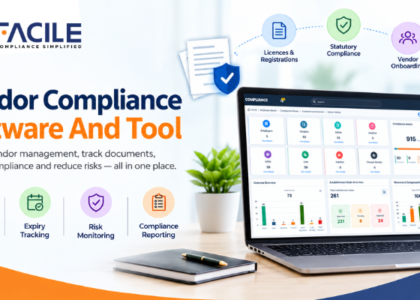
Vendor Compliance Management Software is a digital platform designed to help organisations collect, maintain, verify, monitor, and manage vendor-related compliance information.
It provides a centralised system for tracking vendor documentation, statutory records, audit activities, pending requirements, and compliance status.
These features help organisations improve vendor accountability, reduce manual administration, and strengthen compliance monitoring.
Managing statutory compliance across multiple contractors, vendors, and business locations requires continuous monitoring, proper documentation, and timely verification.
FACILE Management Services provides digital compliance management solutions designed to simplify HR, payroll, labour law, and vendor compliance operations.
F.A.C.I.L.E stands for Fast Automated Compliance & Intelligent Legal Engine.
FACILE helps organisations streamline vendor-related compliance activities through the following capabilities:
Monitor vendor-related compliance activities through a centralised dashboard.
Organise and monitor vendor compliance information, documentation, and pending activities.
Maintain important vendor and statutory compliance documents in a structured digital environment.
Improve follow-up processes through alerts and reminders for pending documentation and applicable compliance deadlines.
Track vendor audit activities, compliance observations, and corrective action requirements.
Improve visibility into compliance activities across multiple branches and business locations.
Generate compliance-related reports to support management monitoring and audit preparation.
With digital compliance management and automated monitoring, FACILE helps businesses simplify vendor compliance administration and improve operational visibility.
Explore FACILE: https://www.facilemanagement.com/
Organisations can strengthen vendor compliance by implementing the following practices:
Vendor Compliance is an important part of business risk management and statutory compliance administration. It helps organisations monitor third-party vendors, verify relevant documentation, track applicable legal requirements, and improve vendor accountability.
For businesses in India, effective vendor compliance management is especially important when engaging contractors, manpower suppliers, and outsourced service providers.
Implementing Vendor Compliance Management Software can simplify vendor documentation, statutory compliance monitoring, audit management, and reporting.
With FACILE Management Services, organisations can move towards smarter vendor compliance administration through digital compliance automation and centralised monitoring.
Simplify Vendor Compliance. Strengthen Statutory Monitoring. Manage Vendors Smarter with FACILE.
Website: https://www.facilemanagement.com/
Email: info@facilemanagement.com
Vendor Compliance means ensuring that third-party vendors, suppliers, and contractors follow applicable legal, statutory, contractual, and organisational requirements.
It helps organisations reduce compliance risks, improve documentation management, monitor statutory obligations, strengthen vendor accountability, and improve audit readiness.
Vendor Compliance Management is the systematic process of collecting, verifying, monitoring, and auditing vendor-related compliance documents and activities.
Depending on the nature of the engagement, documents may include PAN, GST registration, business registration, applicable labour licences, EPF and ESIC records, wage records, attendance records, insurance documents, and contractual agreements.
A Vendor Compliance Checklist is a structured list of documents, registrations, statutory records, and contractual requirements used to verify vendor compliance.
Where applicable, organisations need to monitor relevant contractor EPF registration and contribution records to verify compliance with applicable requirements and contractual responsibilities.
Where applicable, organisations can verify relevant ESIC registration and contribution records relating to eligible employees deployed by vendors and contractors.
It is a digital platform that helps businesses manage vendor documents, statutory records, compliance deadlines, audit activities, and reporting.
The frequency should be based on applicable legal requirements, contractual conditions, vendor risk levels, and organisational policies. High-risk engagements may require more frequent reviews.
FACILE supports digital compliance management through centralised dashboards, vendor compliance monitoring, document management, automated alerts, and vendor audit monitoring.


Facile Management Services (OPC) Private Limited is committed to delivering seamlessly integrated HR and compliance solutions designed for the evolving