
Managing payroll for outsourced, contractual and third-party employees can be challenging. Organizations must coordinate with multiple contractors, staffing agencies and payroll vendors while ensuring timely salary processing, accurate deductions, statutory contributions and proper documentation.
When third-party payroll is managed through emails, spreadsheets and disconnected records, businesses may face payroll errors, delayed payments, incomplete employee data and compliance risks.
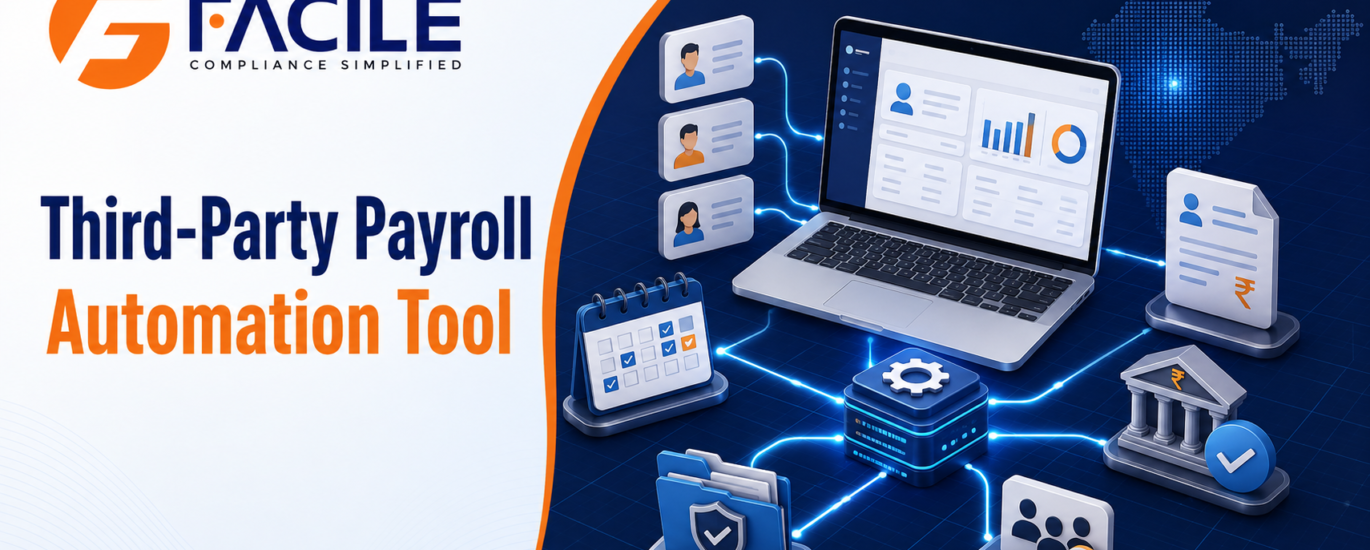
A Third-Party Payroll Automation Tool helps principal employers, contractors and staffing companies centralize payroll operations, automate calculations, validate statutory deductions and monitor payroll compliance. FACILE enables organizations to manage outsourced workforce payroll through structured workflows, real-time dashboards and centralized documents.
A Third-Party Payroll Automation Tool is a digital solution designed to manage the payroll of employees hired through contractors, staffing agencies or other external service providers.
It connects employee information, attendance, salary calculations, statutory deductions, payroll documents and compliance records within one platform.
The tool can support activities such as:
A company may engage hundreds or thousands of contractual employees through several contractors across multiple locations. Each contractor may follow a different payroll process, file format and document-submission method.
Without centralized control, the principal employer may have limited visibility into:
Third-party payroll automation creates a structured process for collecting, processing, validating and reviewing payroll information.
Missing UAN, ESIC numbers, bank details, identity information or employment records can delay payroll processing and statutory compliance.
Managing separate payroll inputs from multiple vendors and establishments makes consolidation difficult.
Differences between attendance records, deployment data and contractor payroll may result in incorrect wage calculations.
Contract workers must be paid according to the minimum wages applicable to their location, category and nature of employment.
Errors in EPF, ESI, Professional Tax or Labour Welfare Fund calculations can create compliance and employee-relations issues.
Poor coordination between the principal employer and payroll vendor may lead to delayed salary disbursement.
Payslips, wage registers, bank statements, challans and returns may be submitted through different communication channels.
Contractor invoices may not match attendance, payroll records, statutory contributions or the number of employees deployed.
Scattered payroll and compliance documents make contractor audits and inspections time-consuming.
FACILE provides a structured payroll workflow for outsourced employees and contractors.
A typical workflow includes:
This workflow improves coordination between HR teams, payroll teams, principal employers, contractors and finance departments.
Maintain employee information, contractor details, work locations, statutory numbers, wage structures and employment records.
Connect each outsourced employee with the relevant contractor, principal employer, establishment and project location.
Import attendance, leave, weekly-off, holiday and overtime details for payroll processing.
Calculate earnings, allowances, deductions, overtime, statutory contributions and net salary according to configured rules.
Compare payroll data with configured minimum-wage requirements based on state, category, zone and employment type.
Track employee eligibility, contributions, challans, returns and payment acknowledgements.
Generate structured payslips for third-party and contractual employees.
Prepare payroll registers and reports required for operational and compliance review.
Maintain bank advice, transaction references and payment proofs to demonstrate wage disbursement.
Compare contractor invoices with attendance, payroll records, employee deployment and statutory amounts.
Identify missing employee records, attendance differences, wage shortfalls, unusual deductions and payment discrepancies.
Manage payable wages, leave encashment, recoveries and other configured settlement components when an employee exits.
Store payroll registers, payslips, challans, returns, bank proofs, invoices and supporting documents centrally.
Route payroll records through defined preparation, review and approval stages before payment.
Send reminders for payroll cut-off dates, wage payments, contribution deadlines and document submissions.
Provide appropriate access to HR teams, contractors, payroll processors, finance departments, auditors and management.
Monitor payroll processing and compliance status across contractors, clients, establishments and locations.
Maintain a record of payroll changes, submissions, approvals and supporting-document uploads.
Automated calculations and validations reduce errors in wages, overtime, deductions and statutory contributions.
Structured cut-off dates, workflows and reminders help payroll teams process employee salaries on time.
Principal employers can monitor contractor payroll status, documents and outstanding activities centrally.
Data imports, automated calculations and standardized reports reduce repetitive spreadsheet work.
The platform helps monitor EPF, ESI, minimum wages, Professional Tax, Labour Welfare Fund and other applicable obligations.
Centralized records make it easier to verify attendance, payroll registers, payslips, challans and payment proofs.
Exception reports help teams identify missing data and payroll differences before salary processing is completed.
Accurate wages, timely payments and accessible payslips help improve workforce confidence.
Organizations can standardize third-party payroll operations across multiple sites, projects and states.
Invoice reconciliation helps identify differences between contractor billing and actual payroll records.
FACILE ONE combines third-party payroll processing, statutory compliance and contractor monitoring within one integrated platform.
Organizations choose FACILE ONE because it offers:
FACILE ONE helps organizations create a transparent and accountable payroll process for outsourced and contractual employees.
FACILE Third-Party Payroll Automation Tool is suitable for:
Third-party payroll should not depend on disconnected spreadsheets, manual calculations and repeated vendor follow-ups.
FACILE helps organizations centralize outsourced employee records, automate payroll calculations, monitor statutory contributions and maintain audit-ready payroll documents.
Your Workforce. Your Payroll. Your Control.
Connect with FACILE to simplify third-party payroll management across your organization.
It is a digital platform that helps organizations manage payroll for outsourced and contractual employees engaged through contractors, staffing agencies or payroll vendors.
A third-party payroll employee is generally employed and paid by a contractor or staffing agency while being deployed to work for a client or principal employer.
Yes. FACILE can organize payroll data by contractor, client, establishment, project and work location.
Yes. Attendance, leave, weekly-off, holiday and overtime information can be imported or integrated according to the configured payroll process.
The platform can automate configured earnings, allowances, deductions, overtime, statutory contributions and net-pay calculations.
Yes. Payroll information can be compared with configured minimum-wage requirements applicable to the employee’s category and work location.
Yes. FACILE can help monitor employee coverage, contributions, challans, returns and related statutory records.
Yes. The platform can generate payslips for outsourced and contractual employees based on processed payroll data.
Yes. Bank advice, transaction references and payment proofs can be maintained for payroll verification and audit purposes.
FACILE can help compare contractor invoices with employee deployment, attendance, payroll and statutory contribution information.
Yes. Authorized principal-employer users can view contractor payroll progress, compliance status, submitted documents and exceptions.
Yes. Payroll can be managed across different clients, branches, factories, projects and states.
Yes. Payslips, wage registers, challans, returns, bank proofs and invoices can be maintained in a centralized repository.
Yes. Reports can be generated by employee, contractor, location, payroll period, wage component and compliance status.
No. Automation improves calculations, tracking and documentation. Payroll and compliance professionals should review exceptions and requirements specific to the organization.


Facile Management Services (OPC) Private Limited is committed to delivering seamlessly integrated HR and compliance solutions designed for the evolving