
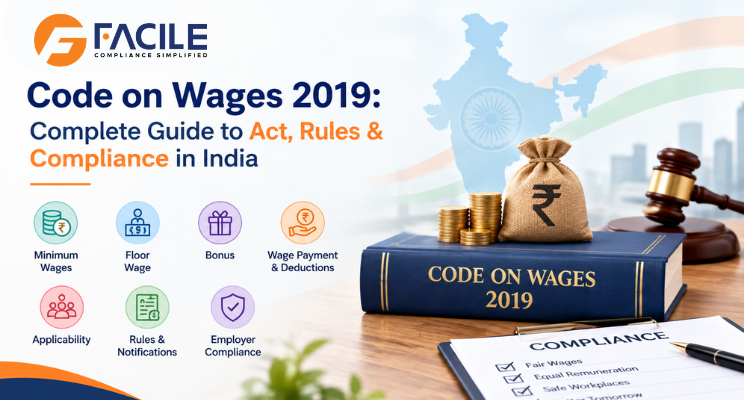
The Code on Wages, 2019 is one of India’s four Labour Codes. It consolidates and rationalises four central wage-related laws into a single framework. The Act was enacted on 8 August 2019 and is administered by the Ministry of Labour & Employment, Government of India.
As of 21 November 2025, the four Labour Codes, including the Code on Wages, 2019, were made effective. The Central Government has also notified the Code on Wages (Central) Rules, 2026.
The Code on Wages consolidates these four Acts:
| Earlier Act | Main subject |
|---|---|
| Payment of Wages Act, 1936 | Timely payment and deductions |
| Minimum Wages Act, 1948 | Minimum wage |
| Payment of Bonus Act, 1965 | Statutory bonus |
| Equal Remuneration Act, 1976 | Equal remuneration and non-discrimination |
The Code primarily aims to:
Under Section 5, an employer cannot pay an employee less than the minimum rate of wages notified by the appropriate government. The Code permits minimum wages to be fixed for time work or piece work, with wage periods including hourly, daily and monthly rates.
The appropriate government considers factors such as:
The Central Government’s floor wage acts as a baseline, and minimum wage rates fixed by the appropriate government cannot be below the floor wage.
The Code provides a common definition of “wages”, which is important for payroll and statutory calculations.
Broadly, wages include:
Certain components are excluded subject to the conditions and limits prescribed under the Code.
This definition is particularly important when calculating statutory benefits and determining whether an employee’s remuneration structure complies with the wage framework.
The Code contains provisions governing:
Employers need to ensure that wages are paid within the applicable statutory time limits and that deductions are legally permissible.
The Code retains provisions relating to statutory bonus.
An employee meeting the prescribed eligibility requirements can be entitled to annual bonus. The Government’s explanatory material states that an eligible employee who has worked for at least 30 days in an accounting year and falls within the applicable wage ceiling is entitled to bonus subject to the Code’s conditions. The minimum bonus rate is 8.33% of wages earned or ₹100, whichever is higher, while the maximum bonus can be 20% subject to the statutory provisions.
The Code prohibits discrimination on the ground of gender, including transgender identity, in relation to wages for the same work or work of a similar nature and in recruitment, subject to the statutory provisions.
The Code on Wages (Central) Rules, 2026 provide, among other things, for an eight-hour workday where the wage period is daily and a 48-hour work week where the wage period is other than daily, subject to the applicable framework.
The Code is relevant to a wide range of establishments and employees, including wage-related compliance for organisations operating in sectors covered by the Code.
For payroll teams, the major areas to review include:
Salary structure → Wage definition → Minimum wages → Overtime → Deductions → Bonus → Wage slips → Records & registers → Returns → State/Central rules
| Compliance area | What employers should review |
|---|---|
| Employee classification | Skill/category and applicable minimum wage |
| Salary structure | Components falling within the statutory wage definition |
| Minimum wages | Applicable Central/State minimum wage |
| Floor wage | Ensure applicable wage rates are not below the statutory floor |
| Wage payment | Pay within prescribed timelines |
| Deductions | Verify statutory permissible deductions |
| Overtime | Apply prescribed overtime requirements |
| Bonus | Check eligibility and statutory calculation |
| Equal pay | Review gender-based wage discrimination |
| Wage slips | Issue prescribed wage information |
| Registers/records | Maintain required employment and wage records |
| Returns | Complete applicable statutory filings |
| State rules | Check the relevant State Government rules |
Labour is a subject in the Concurrent List, so both Central and State Governments have rule-making responsibilities under the Labour Codes. Therefore, organisations should not rely only on the central legislation; they should also check the applicable State/UT rules and notifications for the establishment.
The Ministry’s current framework includes the Code on Wages (Central) Rules, 2026.
Some important areas of the Code include:
The complete statutory text is available through India Code and the Ministry of Labour & Employment.
Official Act: India Code – Code on Wages, 2019


Facile Management Services (OPC) Private Limited is committed to delivering seamlessly integrated HR and compliance solutions designed for the evolving