
Enterprise Compliance Software Automation Tool in India: Complete Guide for Businesses

Enterprise Compliance Software Automation Tool

Managing compliance at enterprise scale is complex. Large organisations often operate across multiple States, business units, factories, offices, warehouses, vendors, contractors and employee populations. This creates hundreds or thousands of recurring statutory obligations that must be tracked, validated, documented and audited.

An Enterprise Compliance Software Automation Tool helps businesses centralise these activities and automate compliance workflows across the organisation.

Instead of depending on spreadsheets, emails, shared folders and manual reminders, enterprises can use a structured platform to manage statutory compliance, payroll compliance, licences, registers, returns, contractor compliance, vendor compliance, audits, risks, corrective actions and dashboards from one system.

What is an Enterprise Compliance Software Automation Tool?

An Enterprise Compliance Software Automation Tool is a digital platform designed to automate and manage compliance obligations across large and complex organisations.

It can help businesses manage:

  • Statutory compliance
  • Labour-law compliance
  • Payroll compliance
  • Multi-state compliance
  • Multi-location compliance
  • Factory compliance
  • Establishment compliance
  • Contractor compliance
  • Vendor compliance
  • Minimum wages
  • EPF and ESIC
  • Professional Tax
  • Labour Welfare Fund
  • Licences and registrations
  • Statutory registers
  • Statutory returns
  • Compliance calendars
  • Regulatory updates
  • Audit observations
  • Corrective actions
  • Compliance risks
  • Enterprise dashboards
  • Reports and audit trails

The objective is to create a single compliance framework across the enterprise.

Why Enterprises Need Compliance Automation

Enterprise compliance becomes difficult when different locations and departments use different processes.

Common challenges include:

  • Multiple compliance calendars
  • Different State requirements
  • Inconsistent records
  • Missed due dates
  • Expired licences
  • Delayed statutory returns
  • Minimum wage errors
  • Contractor non-compliance
  • Vendor compliance gaps
  • Duplicate data entry
  • Manual audit tracking
  • Poor risk visibility
  • Overdue corrective actions
  • Limited management reporting

Compliance automation helps standardise these activities across the organisation.

Key Features of Enterprise Compliance Software Automation

1. Centralized Compliance Management

A central platform should bring together compliance across:

  • States
  • Locations
  • Legal entities
  • Business units
  • Factories
  • Establishments
  • Contractors
  • Vendors

This creates one source of compliance information.

2. Automated Compliance Applicability

The system should identify applicable requirements based on:

  • State
  • Establishment type
  • Factory status
  • Industry
  • Employee strength
  • Contractor workforce
  • Business activity
  • Registration status

This reduces manual applicability mapping.

3. Automated Compliance Calendar

The platform should automatically generate and maintain compliance activities with:

  • Due date
  • Frequency
  • Applicable law
  • Location
  • Responsible person
  • Status
  • Supporting document

This helps enterprises manage recurring obligations at scale.

4. Due-Date Alerts and Escalations

Automated reminders should be generated for:

  • Upcoming compliance
  • Overdue activities
  • Licence renewal
  • Return filing
  • Statutory payments
  • Audit closure
  • Corrective actions

Escalations can be routed to management when deadlines are missed.

5. Multi-State Compliance Automation

Enterprise organisations often operate across several States.

The software should help manage:

  • Minimum wages
  • Professional Tax
  • Labour Welfare Fund
  • Shops and Establishments compliance
  • State registers
  • State returns
  • Holidays
  • Local licences
  • Gazette notifications

6. Multi-Location Compliance Management

Compliance can be structured as:

Organisation → State → Location → Applicable Law → Compliance → Status

This gives management both enterprise-wide and unit-level visibility.

7. Payroll Compliance Automation

The platform should help automate validation for:

  • Attendance
  • Minimum wages
  • EPF
  • ESIC
  • PT
  • LWF
  • Overtime
  • Payslips
  • Wage registers
  • Bank payment proof

This helps identify payroll compliance gaps before closure.

8. Minimum Wage Automation

The system can map minimum wage rates by:

  • State
  • Zone
  • Industry
  • Skill category
  • Designation
  • Effective date

Employee wages can then be automatically compared against applicable rates.

9. EPF Compliance Automation

The platform can help verify:

  • UAN
  • PF wages
  • Employee contribution
  • Employer contribution
  • ECR
  • Challan
  • Payment proof
  • Payroll reconciliation

10. ESIC Compliance Automation

The system can monitor:

  • Employee insurance number
  • Eligibility
  • ESIC wages
  • Employee contribution
  • Employer contribution
  • Challans
  • Payment status

11. Contractor Compliance Automation

For enterprises using large contractor workforces, the software should monitor:

  • Contractor onboarding
  • Contractor licences
  • Worker records
  • Attendance
  • Payroll
  • Minimum wages
  • EPF
  • ESIC
  • Payslips
  • Payment proof
  • Statutory registers
  • Returns

12. Vendor Compliance Automation

Vendor compliance automation can include:

  • Vendor onboarding
  • Document collection
  • Licence monitoring
  • Contract tracking
  • Payroll verification
  • Audit management
  • Risk scoring
  • Corrective actions

13. Licence and Registration Automation

The software should track:

  • Licence number
  • Registration number
  • Effective date
  • Expiry date
  • Renewal status
  • Responsible owner
  • Supporting documents

Automated expiry alerts reduce renewal risk.

14. Statutory Register Automation

The platform should support digital registers such as:

  • Employee register
  • Attendance register
  • Wage register
  • Leave register
  • Overtime register
  • Deduction register
  • Contractor register

Using validated employee and payroll data reduces duplicate work.

15. Statutory Return Management

The system should track:

  • Return type
  • Period
  • State
  • Location
  • Due date
  • Filing date
  • Status
  • Acknowledgement

16. Regulatory Update Management

The platform can help compliance teams manage:

  • Gazette notifications
  • Circulars
  • Amendments
  • Wage revisions
  • Holiday notifications
  • Rule changes
  • Effective dates

Updates can be mapped to impacted locations.

17. Automated Compliance Audits

Enterprise audits can be managed through configurable digital checklists.

Audits may cover:

  • Payroll
  • Contractors
  • Vendors
  • Licences
  • Registers
  • Returns
  • Factories
  • Establishments

18. Audit Observation Automation

Failed compliance checks can generate observations containing:

  • Location
  • Vendor or contractor
  • Compliance category
  • Risk level
  • Responsible person
  • Due date
  • Corrective action

19. Corrective Action Automation

A structured workflow can be:

Observation → Owner Assigned → Action → Evidence → Verification → Closure

Overdue actions can be automatically escalated.

20. Compliance Risk Management

The platform should classify risk as:

  • Low
  • Medium
  • High
  • Critical

Risk can be calculated based on:

  • Missed due dates
  • Licence expiry
  • Payroll gaps
  • Audit observations
  • Contractor issues
  • Vendor issues
  • Corrective-action delays

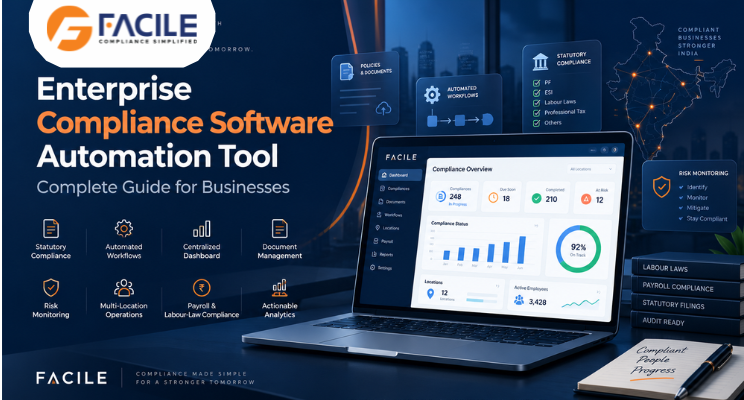
21. Enterprise Compliance Dashboard

A central dashboard can show:

  • Total compliances
  • Completed activities
  • Pending activities
  • Overdue compliances
  • High-risk locations
  • Expiring licences
  • Payroll compliance
  • Contractor compliance
  • Vendor compliance
  • Audit observations
  • Corrective actions
  • Compliance scores

22. Role-Based Access and Dashboards

Different teams may need different information.

For example:

Senior Management: enterprise compliance and risk.

HR: employee and payroll compliance.

Compliance: due dates, laws and documents.

Audit: observations and closure.

Procurement: vendor compliance.

Factory Teams: unit-level statutory compliance.

Role-based access improves governance and accountability.

Enterprise Compliance Automation Workflow

A scalable enterprise workflow can look like:

Applicability → Compliance Calendar → Data Validation → Document → Review → Audit → Risk → Corrective Action → Verification → Closure

This creates a consistent compliance lifecycle across the organisation.

Benefits of Enterprise Compliance Software Automation

Reduced Manual Work

Automation reduces spreadsheet dependency and repetitive follow-ups.

Centralized Visibility

Management receives one enterprise-wide compliance view.

Improved Due-Date Control

Automated reminders help prevent missed statutory deadlines.

Better Payroll Compliance

Wages and statutory contributions can be validated systematically.

Stronger Contractor Governance

Contractor payroll and statutory records can be monitored centrally.

Better Vendor Compliance

Vendor risk and documentation can be tracked consistently.

Improved Audit Readiness

Registers, returns, evidence and audit trails remain organised.

Better Risk Management

High-risk locations, contractors and vendors can be identified earlier.

Scalable Compliance Operations

The same platform can support additional States, units and entities as the business grows.

Enterprise Compliance Software for Multi-State Organisations

Multi-state businesses may need to manage:

  • State-specific labour laws
  • Minimum wages
  • PT
  • LWF
  • Shops and Establishments requirements
  • State licences
  • Registers
  • Returns
  • Holidays

A central system helps standardise governance while preserving local requirements.

Enterprise Compliance Automation Checklist

Businesses should evaluate whether the tool supports:

  • Centralized compliance
  • Applicability mapping
  • Compliance calendars
  • Automated alerts
  • Multi-state compliance
  • Multi-location compliance
  • Payroll validation
  • Minimum wages
  • EPF
  • ESIC
  • PT
  • LWF
  • Contractors
  • Vendors
  • Licences
  • Registers
  • Returns
  • Regulatory updates
  • Audits
  • Corrective actions
  • Risk scoring
  • Role-based dashboards
  • Audit trails

Who Can Use Enterprise Compliance Software?

It is useful for:

  • Large enterprises
  • Manufacturing groups
  • Multi-factory organisations
  • Retail chains
  • IT companies
  • Logistics companies
  • Warehousing businesses
  • Construction companies
  • Healthcare groups
  • Staffing companies
  • Facility management businesses
  • Multi-state organisations
  • Multi-location businesses
  • HR teams
  • Payroll teams
  • Compliance teams
  • Legal teams
  • Audit teams
  • Procurement teams
  • Senior management

How FACILE ONE Helps With Enterprise Compliance Automation

FACILE ONE can help organisations centralise and automate compliance management across multiple business units and locations.

Businesses can use FACILE ONE to support:

  • Statutory compliance
  • Multi-state compliance
  • Multi-location compliance
  • Payroll compliance
  • Minimum wages
  • EPF and ESIC
  • PT and LWF
  • Contractor compliance
  • Vendor compliance
  • Factory compliance
  • Establishment compliance
  • Licence management
  • Statutory registers
  • Statutory returns
  • Compliance calendars
  • Regulatory updates
  • Audits
  • Corrective actions
  • Compliance risk management
  • Centralized dashboards
  • Reports and audit trails

Why Choose FACILE ONE?

Enterprise compliance requires coordination across HR, payroll, legal, compliance, procurement, contractors, vendors and management.

FACILE ONE helps bring these processes into one structured digital environment.

Key capabilities include:

  • Enterprise-wide compliance visibility
  • Automated compliance calendars
  • Payroll and statutory validation
  • Multi-state and multi-location management
  • Contractor and vendor compliance
  • Licence tracking
  • Compliance audits
  • Risk monitoring
  • Corrective-action workflows
  • Management dashboards
  • Reports and analytics

How to Choose the Best Enterprise Compliance Software Automation Tool

Before selecting a solution, businesses should evaluate whether it provides:

  • Enterprise-wide centralisation
  • Workflow automation
  • Multi-state capability
  • Multi-location capability
  • Configurable compliance rules
  • Payroll validation
  • Contractor monitoring
  • Vendor monitoring
  • Licence management
  • Audit workflows
  • Risk scoring
  • Escalations
  • Role-based access
  • Dashboards
  • Audit trails
  • Reports and analytics

The best platform should clearly answer:

What is applicable? What is due? What is overdue? Where is the risk? Which business unit requires attention? Who owns the action? Has it been closed?

Conclusion

An Enterprise Compliance Software Automation Tool helps organisations move from fragmented compliance tracking to a centralised, automated and scalable compliance framework.

By connecting statutory obligations, payroll, licences, contractors, vendors, audits, risks and corrective actions, businesses can improve visibility and strengthen compliance governance.

For enterprises operating across multiple States and locations, FACILE ONE can support a more consistent, audit-ready and technology-driven approach to compliance management.

Frequently Asked Questions – Enterprise Compliance Software Automation Tool

1. What is an Enterprise Compliance Software Automation Tool?

It is software used to centralise and automate compliance obligations across multiple locations, States and business units.

2. Why do large organisations need enterprise compliance software?

It helps standardise compliance processes, improve visibility and reduce manual tracking across complex operations.

3. Can it manage multiple States?

Yes. State-specific compliance such as minimum wages, PT, LWF, licences and returns can be managed centrally.

4. Can it manage multiple locations?

Yes. Offices, factories, warehouses, branches and project sites can be monitored from one platform.

5. Can it automate compliance calendars?

Yes. Applicable activities, frequencies and due dates can be generated and monitored digitally.

6. Can it automate payroll compliance?

Yes. Attendance, minimum wages, EPF, ESIC, PT, LWF and payroll records can be validated.

7. Can it manage contractor compliance?

Yes. Contractor workers, licences, wages, EPF, ESIC and documents can be monitored.

8. Can it manage vendor compliance?

Yes. Vendor onboarding, documents, audits, risks and corrective actions can be managed.

9. Can it monitor licences and renewals?

Yes. Licence expiry and renewal status can be tracked with alerts.

10. Can it manage statutory registers and returns?

Yes. Registers, returns, due dates and acknowledgements can be maintained digitally.

11. Can it track regulatory updates?

Yes. Gazette notifications, amendments and statutory updates can be maintained and mapped to locations.

12. Can it automate compliance audits?

Yes. Digital checklists, observations, evidence and closure workflows can be supported.

13. Can it manage compliance risk?

Yes. Risks can be classified, scored and monitored across units, contractors and vendors.

14. Can management view centralized dashboards?

Yes. Enterprise dashboards can show compliance status, risk, audits and corrective actions.

15. Is role-based access available in enterprise compliance software?

Enterprise systems typically support different views and responsibilities for compliance, HR, audit and management teams.

16. Can FACILE ONE support enterprise compliance automation?

Yes. FACILE ONE can support statutory compliance, payroll validation, multi-state operations, contractors, vendors, audits, risks and central dashboards.


About the Author

Leave a Reply

Your email address will not be published. Required fields are marked *

You may also like these

Chat on WhatsApp
HR Compliance Services Made Simple!