
The Employees’ State Insurance (General) Regulations, 2026 represent an important proposed update to the ESI compliance framework following implementation of the Code on Social Security, 2020.
ESIC approved the framing of the new regulations in June 2026, and draft regulations were subsequently published for stakeholder comments. The draft is intended to replace the Employees’ State Insurance (General) Regulations, 1950 and align ESI administration with the new Social Security Code framework.
For employers, HR teams, payroll professionals and compliance departments, the proposed changes point toward more frequent reporting, digital records, online claims and tighter compliance timelines.
Important: As of September 2026, these are draft regulations, not yet final regulations. Employers should prepare for the proposed changes but continue monitoring the final Gazette notification before treating every draft provision as legally effective.
The draft Employees’ State Insurance (General) Regulations, 2026 have been proposed under the Code on Social Security, 2020.
The draft notification was published in July 2026 and proposed superseding the Employees’ State Insurance (General) Regulations, 1950, subject to the usual saving provisions. Stakeholders were given a 45-day consultation period for objections and suggestions.
The proposed regulations cover areas such as:
One of the biggest proposed changes is a shift toward monthly Return of Contribution filing.
Under the draft framework, employers would be required to submit the contribution return electronically through the specified portal within 15 days from the end of each month. The draft also provides an outer timeline for completing monthly returns for the relevant contribution period.
Businesses may need to move from periodic reconciliation to a much tighter monthly process involving:
This means payroll and compliance teams will need to close ESI data quickly after each payroll cycle.
The draft regulations propose stricter timelines where an establishment closes permanently.
Pending returns and outstanding contributions would need to be completed within 15 days from the date of closure.
Employers should maintain a closure checklist covering:
Waiting until after closure to collect compliance information could create unnecessary risk.
The proposed regulations move ESI contribution payment further toward a fully digital process.
Employers would be required to make contributions electronically into an ESIC-authorised bank through the prescribed system.
Businesses should maintain clear digital evidence such as:
This will improve traceability but also means employers need strong internal controls around payment completion.
The draft regulations provide for electronic Insured Person Cards following employee registration.
Employees would also be able to update certain family details electronically.
HR teams should ensure that employee data is accurate before registration.
Important details include:
Incorrect master data could directly affect employee access to ESI benefits.
The draft framework expands electronic submission for accident-related information and benefit claims.
Claims relating to sickness, maternity, disablement, dependant benefits and funeral benefits could be processed electronically under the proposed regulations.
Employers should review how they currently handle:
HR and compliance teams may need to help employees navigate online submission processes.
The proposed regulations allow prescribed employee and contractor registers to be maintained electronically.
The draft also provides for retention of these records for five years from the date of the last entry.
This is especially important for principal employers working with contractors.
Businesses should ensure their digital records can establish:
Electronic registers improve convenience, but poor data quality can create greater audit exposure.
The draft regulations propose a revised framework for delayed ESI payments.
Delayed contributions would attract interest at the rate notified by the Central Government, while damages may also be levied for delayed payment. The draft summary indicates damages of 1% of the outstanding amount for every month of delay.
Businesses should strengthen payment controls to avoid:
A monthly ESI compliance dashboard can help identify unpaid liabilities before deadlines are missed.
The proposed regulations reflect a broader shift toward digital, frequent and data-driven social-security compliance.
Employers will need stronger coordination between:
The biggest practical change is that ESI compliance may become more closely connected to each monthly payroll cycle rather than being treated as a separate periodic activity.
Payroll teams should prepare for:
The Code on Social Security introduced a new statutory wage definition from 21 November 2025, and ESIC has already advised field units that this may bring additional employees within ESI coverage.
This makes payroll-to-ESI reconciliation even more important.
Principal employers should pay particular attention to contractor data.
If registers and contribution information are maintained digitally, employers should be able to verify:
A missing employee in contractor ESI records can become a significant compliance issue.
Employers should begin preparing by reviewing:
FACILE ONE can help organisations manage ESI compliance through a structured digital compliance framework.
Businesses can use FACILE ONE to support:
For businesses with large employee and contractor populations, centralising ESI data can make monthly reconciliation and audit preparation much easier.
Although the 2026 regulations are still in draft form, the direction of change is clear.
The proposed framework places greater emphasis on:
Employers that prepare their payroll and compliance systems early will be better positioned once the final regulations are notified.
The Draft ESI General Regulations 2026 signal a major modernisation of ESI administration in India.
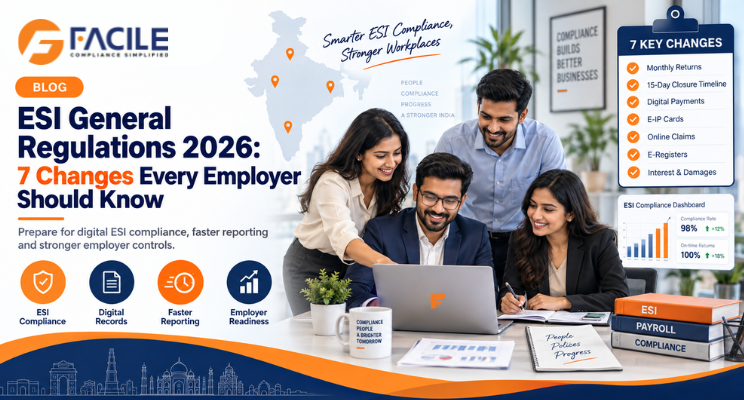
The seven most important proposed changes for employers are:
As of September 2026, employers should treat these as proposed requirements and monitor the final ESIC/Gazette notification before implementing them as final legal obligations.
They are proposed regulations framed by ESIC under the Code on Social Security, 2020 to replace the Employees’ State Insurance (General) Regulations, 1950.
As of September 2026, the regulations are still in draft/consultation status. Employers should monitor the final Gazette notification.
The draft notification was published in July 2026 and invited stakeholder objections and suggestions before final consideration.
The draft proposes monthly Return of Contribution filing through the specified portal within 15 days after the end of the month.
Yes, the draft provides for electronic contribution payments through an ESIC-authorised banking mechanism.
The draft provides for electronic Insured Person Cards and electronic updating of certain family details.
The proposed regulations provide for electronic accident reporting and online handling of several benefit claims.
Yes. The draft allows prescribed employee and contractor registers to be maintained digitally, with a proposed five-year retention period.
The draft proposes that pending contribution returns and outstanding contributions be completed within 15 days from permanent closure.
Delayed contributions may attract applicable interest and damages. The draft proposes a revised damages framework for delayed contribution payments.
Yes. ESIC stated in December 2025 that the wage definition under section 2(88) of the Code on Social Security differs from the earlier ESI Act definition and may bring additional employees within ESI coverage.
Yes. Electronic contractor registers and contribution records make contractor employee and ESI compliance monitoring particularly important.
Employers should review payroll reconciliation, contractor records, employee data, payment controls, digital registers and accident-reporting workflows while monitoring the final notification.
Yes. FACILE ONE can support ESIC employee records, payroll validation, contractor ESI compliance, challan monitoring, document management, due-date tracking and compliance audits.


Facile Management Services (OPC) Private Limited is committed to delivering seamlessly integrated HR and compliance solutions designed for the evolving