
India’s new labour codes require businesses to reassess how they manage wages, social security, employment conditions, workplace safety and contractor compliance. Organizations engaging contractors, staffing agencies and other service vendors must ensure that their third-party workforce practices align with applicable legal requirements.
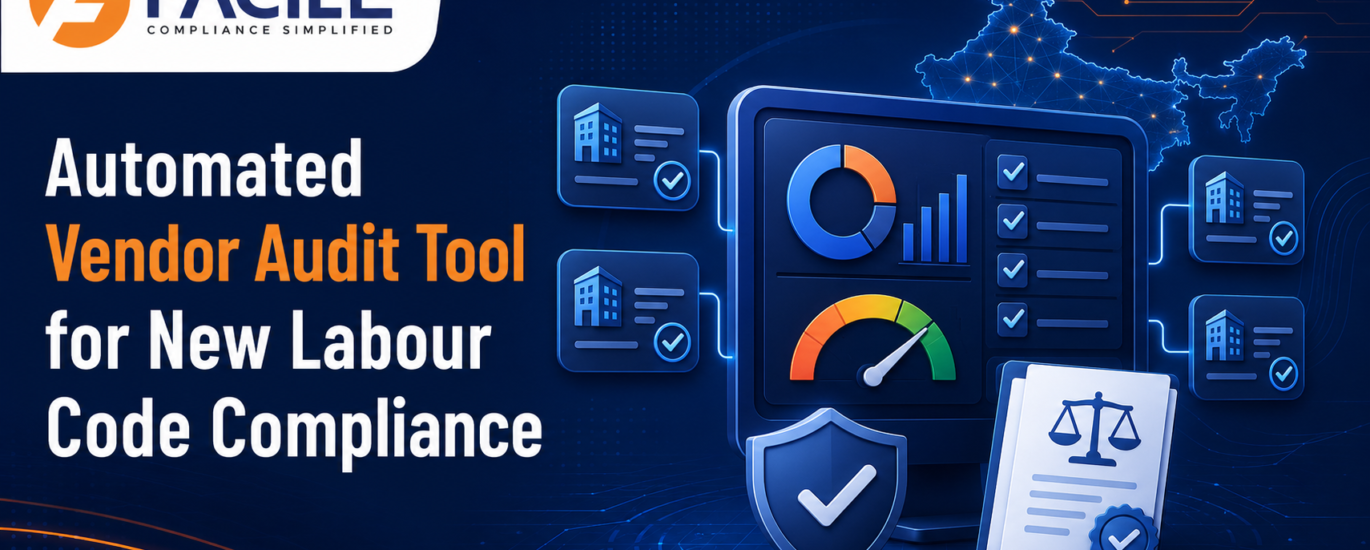
Managing vendor compliance through spreadsheets, emails and physical documents can lead to delayed submissions, inconsistent audits and unidentified compliance risks. An Automated Vendor Audit Tool for New Labour Code compliance helps organizations centralize vendor records, automate document verification, identify compliance gaps and monitor corrective actions through one integrated platform.
FACILE provides a simplified vendor audit automation solution that helps businesses prepare for and manage compliance under India’s evolving labour-law framework.
An Automated Vendor Audit Tool is a digital platform used to monitor and assess the statutory, payroll, HR and employment-related compliance of vendors and contractors.
The software enables organizations to define audit requirements, collect vendor documents, verify employee-level records, calculate compliance scores and track non-compliance until closure.
A comprehensive vendor audit platform may include:
India’s labour-law framework has been consolidated into four major labour codes:
These codes cover important areas such as wages, social security benefits, working conditions, industrial relations, employee classification and contractor responsibilities.
Businesses engaging third-party workers may need to review whether their vendors maintain accurate records, pay wages correctly, complete statutory contributions, follow working-hour requirements and provide appropriate employment documentation.
An automated vendor audit tool helps organizations convert these requirements into structured and measurable audit parameters.
Vendor compliance can directly affect the principal employer. A contractor’s failure to meet statutory obligations may expose the organization to financial penalties, operational disruption, employee grievances and reputational damage.
Vendor profiles, agreements, registrations, licences, employee records and audit documents can be maintained in one secure platform.
Configurable checklists ensure that vendors are assessed consistently according to applicable laws, locations and business requirements.
Automated validations and exception reports help identify missing documents, incorrect payments and other compliance gaps before they become serious.
Vendors receive clear information about document requirements, submission deadlines, audit observations and corrective actions.
Compliance dashboards provide a consolidated view of vendor performance across units, locations and states.
A complete digital audit trail helps organizations respond efficiently to management reviews, client assessments and regulatory inspections.
Every vendor may operate across different establishments and employ workers under different categories. Maintaining individual trackers becomes difficult as the vendor network grows.
Compliance teams often spend considerable time following up for attendance records, wage registers, statutory challans, returns and payment proofs.
Employee-level comparisons between attendance, payroll, statutory contributions and bank-payment records can be slow and error-prone when performed manually.
Compliance requirements may vary according to the state, establishment, industry, employee strength and nature of work.
Organizations may need to evaluate how salary components and allowances align with the applicable definition of wages.
Verifying EPF, ESIC and other applicable contributions for a large contractor workforce requires accurate employee data and payment records.
Attendance, shifts, weekly rest, leave and overtime must be compared with payroll and supporting registers.
Licences, registrations, agreements and employee documents may have different validity periods and renewal dates.
Observations communicated through emails or spreadsheets may lack clear ownership, target dates and closure evidence.
Automation reduces repetitive activities such as collecting documents, comparing data, sending reminders and preparing audit reports.
Auditors can access vendor details, employee records and supporting evidence from one platform.
System-based validations help identify mismatches and missing information more consistently than manual reviews.
Compliance scores help management understand vendor performance and identify high-risk contractors.
Automated alerts help vendors and internal teams monitor submissions, renewals and pending corrective actions.
The platform maintains a history of document uploads, validation results, observations, responses and closure decisions.
Organizations can monitor vendors across branches, offices, factories, warehouses and project sites.
Detailed reports help businesses understand recurring gaps, risk patterns and vendor performance trends.
Create vendor profiles and capture agreements, registrations, licences, service details and applicable compliance requirements.
Maintain and verify contractor employee details, including identification, employment status, designation and statutory numbers.
Create checklists according to the applicable labour code, state, establishment, industry and vendor category.
Review wage calculations, deductions, overtime, benefits and salary-payment evidence.
Compare paid wages with applicable minimum wage notifications and configured wage categories.
Verify attendance days, shift timings, weekly rest, leave, overtime and payroll consistency.
Check employee coverage, statutory identifiers, contributions, challans and supporting records.
Compare payroll net wages with bank statements or salary payment proofs.
Monitor contractor licences, registrations and other statutory approvals.
Receive notifications before licences, agreements or employee documents expire.
Generate vendor-level compliance scores based on applicable requirements and audit results.
Assign findings to responsible vendors, set target dates and track responses until closure.
View vendor-wise, establishment-wise, location-wise and organization-level compliance performance.
An automated vendor audit may cover:
FACILE enables organizations to manage vendor compliance through a structured, transparent and scalable digital process.
FACILE brings vendor records, employee details, statutory documents, audit observations and corrective actions together in one system.
The platform supports systematic verification of compliance data and helps identify missing records, differences and possible non-compliance.
Audit requirements can be configured to help organizations assess vendor processes under the evolving labour code framework.
FACILE supports audits of wages, deductions, overtime, statutory contributions and salary-payment records.
Employee records can be reviewed individually to improve audit accuracy and reduce hidden compliance risks.
Management can quickly identify vendors, units and locations requiring immediate attention.
Audit observations can be assigned, responded to and monitored with target dates and supporting evidence.
Notifications help teams track document submissions, statutory deadlines, renewals and pending observations.
FACILE supports businesses managing contractors across multiple establishments and states in India.
Consolidated dashboards provide actionable insights into compliance performance, risks and unresolved gaps.
FACILE provides solutions covering:
The software is suitable for:
HR, payroll, compliance, procurement, finance, legal and audit teams can use the platform to monitor vendor-related responsibilities.
Vendor audits should not depend on disconnected spreadsheets, repeated email follow-ups or manually prepared reports. Businesses need a centralized solution that provides consistent audits, accurate validations and timely compliance visibility.
FACILE’s Automated Vendor Audit Tool helps organizations monitor contractor compliance under the new labour code framework, automate document verification, identify risks and track corrective actions. It provides a simplified approach to managing multiple vendors, employees and locations across India.
Contact FACILE to learn how our vendor audit automation platform can support your organization’s labour compliance requirements.
It is software that helps businesses collect vendor records, perform compliance audits, identify gaps and track corrective actions through a centralized platform.
The software converts applicable requirements into audit checklists and helps verify wages, social security, working conditions, employee records and contractor documents.
Automation reduces manual work, improves accuracy, provides real-time compliance visibility and helps organizations identify risks earlier.
Yes. It can centrally monitor multiple vendors, contractors, establishments, branches, factories and states.
Yes. FACILE supports the validation of wages, deductions, overtime, minimum wages, statutory contributions and salary-payment records.
Yes. It can help verify employee coverage, statutory identifiers, contributions, challans and supporting records.
Yes. The platform can compare payroll net amounts with available bank salary-payment proof.
A vendor compliance score shows the vendor’s performance based on applicable audit requirements, submitted records, identified gaps and closure status.
Yes. Observations can be assigned with target dates, responses, supporting evidence and closure status.
Yes. Alerts can be configured for compliance submissions, statutory due dates, document expiry and pending corrective actions.
Yes. Licences, registers, challans, returns, employee records and audit evidence can be stored systematically for future reference.
Yes. FACILE supports multi-state, multi-location and multi-vendor compliance management across India.


Facile Management Services (OPC) Private Limited is committed to delivering seamlessly integrated HR and compliance solutions designed for the evolving