
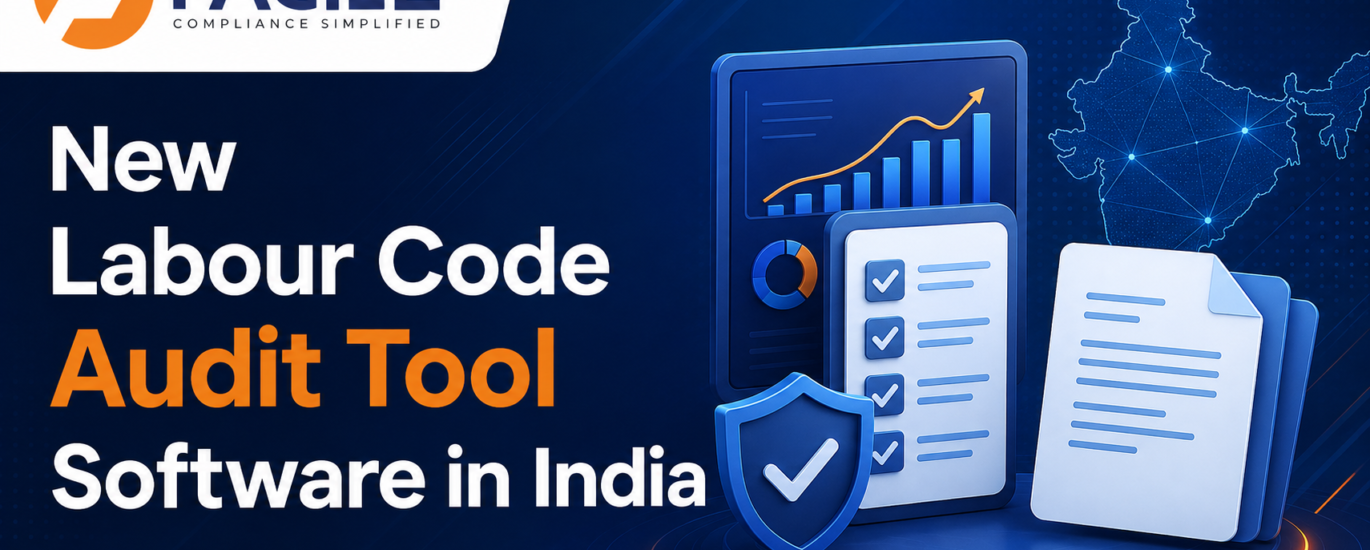
India’s new labour codes have transformed the way businesses approach workforce governance, wage compliance, social security, industrial relations and workplace safety. Companies must now review their existing policies, payroll structures, employment records, contractor processes and statutory compliance systems to align with the revised framework.
For organizations managing multiple employees, contractors, branches or operational units, manual compliance tracking can become difficult and error-prone. New Labour Code Audit Tool Software helps businesses assess compliance gaps, centralize documents, automate audit activities and monitor corrective actions through one integrated platform.
FACILE offers a simplified labour compliance audit solution for businesses in Chennai and across India, enabling organizations to prepare for the new labour code environment with better visibility, accuracy and control.
New Labour Code Audit Tool Software is a digital solution that helps organizations assess and monitor compliance under India’s four labour codes:
The software enables businesses to review existing compliance practices, compare them with applicable requirements, identify potential gaps and maintain supporting records.
A comprehensive labour code audit platform may include:
The new labour codes consolidate several existing labour laws into a simplified statutory framework. However, businesses may still need to evaluate how the revised provisions affect their workforce, payroll, benefits, employment policies and contractor arrangements.
A structured labour code compliance audit helps an organization:
Businesses can compare their existing practices with the requirements applicable to their establishments, employees and contractors.
Periodic audits help identify missing documents, incorrect wage calculations, outdated policies and incomplete statutory records before they result in greater risk.
Changes connected with wages, deductions, working conditions, social security and employee benefits may require updates to payroll configurations and HR processes.
Centralized dashboards help management understand the compliance position of different units, locations, departments and vendors.
Organized documents, observations, responses and closure evidence help businesses remain prepared for internal audits, client assessments and regulatory inspections.
Clear processes and accurate records support consistent treatment of employees and improve organizational accountability.
Transitioning to the new labour code framework may create several practical challenges for businesses.
The requirements applicable to an establishment may depend on its industry, location, workforce strength, employment model and operational activities. Determining applicability accurately is essential.
Businesses may need to examine salary structures, allowances, deductions and benefits to determine whether their payroll practices align with the applicable definition of wages.
Appointment terms, standing orders, working hours, leave policies, overtime rules, disciplinary procedures and separation processes may require review.
Organizations operating across different states must manage location-specific rules, notifications and compliance requirements alongside the central labour codes.
Principal employers may face risks when contractors fail to maintain employee records, pay wages on time or complete statutory obligations.
Incomplete employee master data, attendance records, wage registers and statutory identifiers can affect compliance validation.
Rules, schemes and notifications may be introduced or revised over time. Compliance teams need a reliable mechanism to monitor relevant developments.
Identifying non-compliance is only the first step. Businesses must assign responsibility, collect supporting evidence and confirm that each issue has been resolved.
All labour compliance records, audit findings, policies and supporting documents can be maintained within one platform.
Automation reduces dependence on spreadsheets, physical files, email follow-ups and manually prepared reports.
Configurable checklists and systematic validations help create a consistent audit process across locations.
Exception reports and compliance scores allow teams to quickly identify high-risk areas requiring corrective action.
The system can support the review of wages, deductions, overtime, benefits, statutory contributions and salary-payment records.
Organizations can monitor contractor submissions, employee-level records, compliance performance and pending observations.
Automated notifications help teams track compliance deadlines, document expiry dates and unresolved audit observations.
The platform can maintain a history of submissions, findings, responses, evidence and closure decisions.
Dashboards provide consolidated insights across units, states, contractors and compliance categories.
An effective New Labour Code Audit Tool Software should support:
FACILE helps organizations in Chennai and throughout India simplify labour code readiness and ongoing statutory compliance management.
FACILE allows compliance requirements and audit checklists to be configured according to the establishment, state, industry, workforce and applicable law.
The platform helps verify payroll, attendance, statutory payments, employee records and supporting compliance documents.
FACILE supports systematic reviews of earnings, deductions, minimum wages, overtime, social security contributions and salary disbursement records.
Organizations can monitor contractors, collect statutory documents, record observations and evaluate vendor compliance performance.
Compliance scores provide a clear view of overall performance and help management identify units or vendors requiring immediate attention.
Audit observations can be assigned to responsible teams with target dates, responses, evidence and closure status.
Automated alerts help compliance teams monitor statutory deadlines, document renewals and pending corrective actions.
Policies, registers, returns, challans, employee records and audit evidence can be stored systematically for convenient retrieval.
FACILE enables centralized monitoring of establishments, factories, branches and vendors operating across Chennai, Tamil Nadu and other parts of India.
Management can access location-wise, vendor-wise and compliance-wise reports for informed decision-making.
FACILE provides diversified solutions covering:
The software is suitable for:
Managing new labour code compliance requires accurate records, standardized audits and continuous monitoring. Spreadsheet-based systems may not provide the visibility or control required by organizations managing large workforces and multiple contractors.
FACILE New Labour Code Audit Tool Software helps businesses in Chennai and across India centralize compliance activities, automate validations, identify risks and track corrective actions. With configurable workflows, compliance scores, notifications and management reports, FACILE provides a simplified approach to labour code readiness and ongoing compliance management.
Contact FACILE to learn how our platform can support your organization’s labour code audit and compliance requirements.
It is a digital platform used to assess, monitor and document an organization’s compliance with India’s four labour codes and related rules.
The four codes are the Code on Wages, Industrial Relations Code, Code on Social Security, and Occupational Safety, Health and Working Conditions Code.
A labour code audit helps companies identify gaps in payroll, HR policies, employment records, social security, working conditions and contractor compliance.
Yes. The software can support reviews of wages, deductions, overtime, minimum wages, statutory contributions and salary-payment evidence.
Yes. FACILE helps organizations collect contractor records, verify statutory compliance, record observations and monitor corrective-action closure.
Yes. Businesses can centrally monitor multiple establishments, branches, factories, states, units and contractors.
Yes. Automated alerts can be configured for due dates, pending submissions, document expiry and unresolved observations.
Yes. Registers, returns, challans, policies, licences, employee records and supporting evidence can be maintained in a centralized repository.
Compliance scores help management compare performance, identify high-risk locations or vendors and prioritize corrective action.
No. FACILE can support organizations operating in Chennai, Tamil Nadu and multiple locations across India.
Yes. Checklists can be configured according to applicable laws, states, industries, establishments and organizational requirements.
HR teams, payroll teams, compliance professionals, auditors, legal teams, factory managers and contractor-management teams can use the platform.


Facile Management Services (OPC) Private Limited is committed to delivering seamlessly integrated HR and compliance solutions designed for the evolving