
Running a business in Salem requires more than managing employees, production schedules, customers and finances. Employers must also complete a wide range of labour, payroll and statutory compliance activities every month. Attendance must be verified, wages must be calculated correctly, eligible employees must be covered under applicable social-security schemes, contributions must be reconciled, statutory records must be maintained and deadlines must be monitored. When these activities are spread across departments, contractors and locations, even a small data gap can develop into a serious compliance risk.
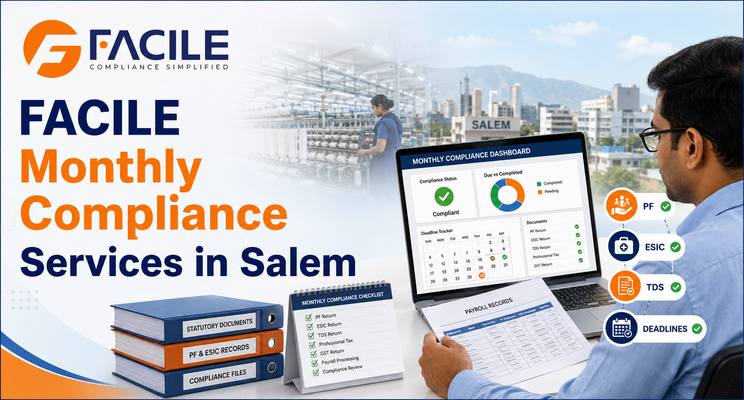
FACILE Monthly Compliance Services in Salem help employers organise these recurring responsibilities through a structured combination of compliance expertise, technology-enabled monitoring and evidence-based review. Instead of treating compliance as a last-minute filing exercise, FACILE supports businesses in building a repeatable monthly cycle that connects employee data, attendance, payroll, statutory deductions, contractor documents, registers, payments and management reports.
This service can support manufacturers, textile businesses, steel and foundry units, engineering companies, food-processing establishments, warehouses, hospitals, educational institutions, retailers, hotels, logistics companies, contractors and other service-sector organisations operating in and around Salem.
Salem has a diverse commercial and industrial environment. A single organisation may employ permanent staff, fixed-term employees, trainees, apprentices, contract workers and outsourced support teams. It may operate several shifts or engage vendors for security, housekeeping, loading, maintenance, transport, catering and production support. Each workforce category can create different documentation, payroll and statutory requirements.
Monthly compliance is important because many obligations arise directly from current workforce and payroll data. New joiners must be identified and enrolled where applicable. Exits must be reflected correctly. Attendance and leave affect wage calculations. Overtime must be supported by authorised records. Statutory deductions must agree with the payroll. Contractor invoices should be supported by wage-payment and contribution evidence. Changes in minimum wages or contribution rules may also require updates to the payroll configuration.
If these checks are postponed, errors can accumulate across several wage months. The result may include incorrect employee contributions, delayed remittances, missing registers, unmatched headcounts, unsupported deductions, incomplete contractor records or poor inspection readiness. A disciplined monthly process helps identify exceptions closer to the source, when they are easier to verify and correct.
Monthly compliance services cover the recurring tasks required to keep an establishment’s employment, wage and statutory records aligned with applicable law and internal policy. The exact scope depends on the organisation’s location, nature of activity, employee strength, wage levels, registrations, contractor arrangements and other applicability conditions.
A typical monthly scope may include:
FACILE can configure the service around the employer’s actual compliance universe rather than applying the same checklist to every business.
Accurate compliance begins with reliable employee information. FACILE reviews relevant employee data such as employee ID, joining date, exit date, work location, department, designation, employment category, contractor name, UAN, ESIC insurance number, bank details and wage structure.
The employee master can be compared with attendance, payroll and contractor deployment records to identify missing employees, duplicate records, inactive workers included in payroll or active workers omitted from statutory calculations. This reconciliation is particularly useful for establishments with multiple units, shift-based operations or high workforce movement.
Attendance is the foundation of monthly payroll. FACILE can review payable days, present days, weekly offs, holidays, leave, loss of pay, overtime hours and shift details before payroll is finalised. Exceptions such as negative days, excessive overtime, missing attendance, overlapping status entries or unauthorised manual adjustments can be flagged for verification.
Where relevant, overtime calculations can be checked against approved attendance and wage data. The review also helps employers maintain consistency between biometric records, muster rolls, leave records, overtime registers and payroll outputs.
Minimum-wage compliance may depend on the scheduled employment, employee category, zone, skill level and the latest notification issued by the appropriate government. FACILE helps map applicable wage categories and compare eligible wage components against the notified requirements.
The review may identify employees whose wage rates fall below the applicable level, categories that have been mapped incorrectly or payroll configurations that have not been updated after a revision. FACILE can also assist the organisation in evaluating wage structures under the prevailing legal framework. Any final decision should be based on the relevant notification, applicable rules and professional advice for the establishment’s circumstances.
Payroll is more than calculating gross and net salary. A compliant payroll process must connect attendance, wage rates, additions, deductions, employer contributions and supporting records.
FACILE can review components such as basic wages, dearness allowance, house rent allowance, incentives, overtime, bonus, arrears, reimbursements, recoveries, leave encashment and final settlements. The objective is to detect unusual or unsupported values, confirm authorised deductions and ensure that payroll totals reconcile with employee-level information.
The review may also compare the payroll register with bank-transfer statements, payslips, statutory contribution files and accounting summaries. This creates a traceable link from attendance input to salary payment and statutory reporting.
For establishments and employees covered under the applicable provident-fund framework, FACILE can support monthly employee and contribution reconciliation. This may include checking UAN availability, joining and exit information, PF wages, non-contributing days, employee contributions, employer contributions, pension allocation and the Electronic Challan-cum-Return data.
FACILE helps compare payroll deductions with the employee-wise contribution statement and payment evidence. Differences such as missing members, incorrect wages, mismatched contributions, duplicate UAN records or delayed exit updates can be reported for action. Timely reconciliation helps employers reduce the risk of employees receiving incorrect credits in their provident-fund accounts.
Where ESIC coverage applies, employee enrolment and monthly contribution details should agree with payroll and workforce records. FACILE can review insured-person numbers, coverage status, wages, contribution days, employee contributions, employer contributions, new registrations, exits and monthly contribution data.
The process can identify eligible employees who may not have been enrolled, insured persons missing from the contribution file, wage differences between payroll and the portal file or contribution records without corresponding payroll entries. Challans and payment acknowledgements can also be tracked as part of the monthly evidence pack.
Professional Tax and Labour Welfare Fund requirements vary by state and may be subject to specific wage slabs, frequencies, exemptions and due dates. For applicable Salem establishments, FACILE can help review employee classification, deduction amounts, payroll totals, payment records and required returns.
Because statutory rates and procedures may change, the monthly checklist should be updated against the latest Tamil Nadu notifications and portal requirements rather than relying on old payroll configurations.
Contractor compliance is a significant area of risk for principal employers. A contractor may submit an invoice even when employee attendance, wage payments, statutory contributions or licences are incomplete. FACILE helps establish a monthly document-verification process before compliance approval or invoice certification.
The review may cover:
Headcount can be compared across access-control records, attendance, payroll, invoice and statutory files. Exceptions are then assigned to the relevant contractor with a target date and supporting evidence required for closure.
Employers may need to maintain registers and records relating to employees, wages, deductions, fines, overtime, leave, accidents, contractors and other matters. The applicable formats and retention requirements depend on the legal framework and establishment type.
FACILE supports the monthly preparation or review of applicable records using payroll and workforce data. This reduces the risk of registers being recreated only when an inspection is announced. Returns and periodic filings can also be tracked through a compliance calendar, even when their filing frequency is quarterly, half-yearly or annual.
Not every compliance activity is due monthly, but registrations, licences and certificates should still be monitored every month. FACILE can maintain a tracker for establishment registrations, factory-related approvals, contractor licences and other applicable permissions. The tracker can include the licence number, coverage, employee limit, issue date, validity period, renewal date, responsible person and document status.
Advance alerts give the business time to gather supporting records and complete the appropriate application. The review can also identify a mismatch between the authorised headcount and the actual workforce deployed.
FACILE can build a calendar covering monthly contributions, returns, payments, renewals and recurring internal reviews. Each task can be assigned to an owner with a due date, status and evidence requirement.
Instead of depending on individual reminders, the organisation receives a central view of completed, pending, overdue and rejected activities. Escalation rules can help management intervene when a responsible department or contractor has not submitted the required information.
Management needs more than a folder of challans. FACILE can consolidate the monthly results into a practical compliance report showing the establishments reviewed, workforce covered, tasks completed, pending documents, overdue obligations, high-risk findings, repeat observations and corrective-action status.
Reports may be organised by unit, contractor, law, compliance area, severity or responsible person. This gives HR, finance, legal, operations and senior management a common view of the organisation’s compliance position.
FACILE first understands the establishment’s business activity, locations, employee strength, wage categories, registrations, contractors and existing compliance process. Applicable work areas are converted into a monthly checklist.
The organisation and its contractors submit employee masters, attendance, payroll files, challans, returns, registers, payment proofs and other required records through an agreed process.
Data is checked across sources. Attendance is compared with payroll, payroll with bank payments, deductions with statutory files and contractor headcount with deployment records.
Findings are classified by subject and risk. Examples include missing document, data mismatch, delayed payment, contribution variance, expired licence, wage shortfall or incomplete employee enrolment.
Each observation is shared with a clear description, responsible owner, required evidence and target date. Critical or repeat issues can be escalated to management.
Submitted evidence is reviewed before the observation is marked as closed. The final dashboard summarises completed obligations, open risks and actions required in the next cycle.
Cross-checking attendance, payroll and contribution data helps identify discrepancies before or soon after filing.
A central compliance calendar, ownership matrix and reminder process reduce dependence on memory and scattered spreadsheets.
Standard document checklists and employee-level reconciliation give principal employers better visibility over outsourced workers.
Monthly records are organised around each obligation, making it easier to retrieve evidence during an internal review, customer audit or government inspection.
Dashboards convert detailed compliance work into clear risk and completion indicators for decision-makers.
A consistent workflow can be extended across multiple units, contractors and employee groups while retaining location-specific requirements.
FACILE coordinates recurring checks and reporting, allowing internal HR and finance teams to focus on employee and business priorities.
FACILE Monthly Compliance Services can be configured for:
Each industry has a different workforce pattern and risk profile. FACILE therefore aligns the checklist with the establishment’s actual operations instead of relying on a generic compliance package.
Manual compliance tracking often creates multiple versions of the same file, inconsistent naming, unclear ownership and limited visibility. Technology can bring tasks, documents, deadlines, observations and reports into a more controlled process.
FACILE’s technology-enabled approach can help authorised users monitor the status of compliance activities, access records, review contractor submissions and follow corrective actions. However, technology does not replace legal judgement. Applicability decisions, unusual employee cases and regulatory interpretations should still be reviewed by qualified professionals.
India’s four labour codes became effective from 21 November 2025, consolidating central labour legislation into frameworks covering wages, social security, industrial relations, and occupational safety and working conditions. Government guidance also highlights simplified electronic compliance concepts, including reduced forms and registers. At the same time, implementation details, rules, schemes and state-specific requirements must be checked carefully.
For Salem employers, the practical response is to keep the compliance process adaptable. Employee definitions, wage structures, appointment documentation, social-security coverage, contractor arrangements, working-time controls and record formats should be reviewed against the latest applicable notifications. FACILE can assist businesses in assessing changes and updating the monthly checklist when requirements evolve.
Monthly compliance should provide confidence, visibility and evidence—not a rush to collect documents just before a deadline. FACILE helps Salem businesses establish a structured cycle for collecting data, validating payroll, monitoring statutory payments, reviewing contractors, maintaining records and closing exceptions.
Whether your organisation operates one establishment or manages several units and contractors, FACILE can tailor the service around your workforce, industry and compliance responsibilities.
To discuss FACILE Monthly Compliance Services in Salem:
Email: Info@facilemanagement.com
Phone: +91 91760 67399
Website: www.facilemanagement.com
Monthly compliance services are recurring reviews and activities that help an employer manage applicable labour, payroll and statutory obligations. They may include workforce reconciliation, payroll validation, EPF and ESIC checks, contractor-document review, register maintenance, payment tracking and management reporting.
FACILE can support factories, textile companies, steel and foundry units, engineering businesses, warehouses, hospitals, educational institutions, retailers, hotels, logistics organisations, contractors and service companies. The scope is customised according to the business and applicable requirements.
The scope can include payroll processing, payroll validation or both, depending on the agreed service. FACILE can review attendance inputs, salary components, deductions, employer contributions, net pay and reconciliation records.
Yes. FACILE can assist with employee data, UAN or insured-person records, contribution calculations, payroll reconciliation, ECR or monthly contribution data, challans, payment evidence and exception follow-up, subject to the establishment’s coverage and agreed scope.
Yes. FACILE can verify contractor attendance, wage records, bank-payment proof, EPF and ESIC evidence, licences, registrations, returns and other applicable documents. Findings can be tracked until suitable closure evidence is provided.
FACILE compares data and documents across employee master, attendance, payroll, bank payments, statutory contribution files, contractor records and licences. Differences are recorded as observations and classified according to their nature and potential impact.
Yes. The monthly checklist and reporting structure can be organised by company, establishment, branch, unit, contractor or location. This helps management compare completion and risk across operations.
No service provider can responsibly guarantee that outcome. Compliance depends on accurate information, timely management action, legal applicability and regulatory interpretation. FACILE helps establish controls, identify gaps and maintain evidence, which can improve compliance readiness.
Common documents include employee master data, attendance, leave and overtime records, payroll registers, payslips, bank-payment proof, statutory contribution files, challans, contractor records and corrective-action evidence. The exact list depends on applicability and service scope.
FACILE can help organise relevant records, review requested documents, identify gaps and support responses within the agreed engagement. Legal representation or formal opinions may require coordination with an appropriately qualified legal professional.
The timeline depends on the number of establishments, employees, contractors, existing registrations, data quality and required compliance areas. An initial assessment is generally needed before the monthly calendar and document checklist can be finalised.
Businesses can email Info@facilemanagement.com, call +91 91760 67399, or visit www.facilemanagement.com to discuss their monthly compliance requirements.
This article provides general information and does not constitute legal, tax or regulatory advice. Labour-law applicability, rates, thresholds, due dates, forms and procedures may vary by establishment, employee category, industry, location and subsequent notification. Employers should verify current central and Tamil Nadu requirements and obtain professional advice before making compliance decisions.


Facile Management Services (OPC) Private Limited is committed to delivering seamlessly integrated HR and compliance solutions designed for the evolving