


The Ministry of Labour and Employment has inserted a new clause (iii) in Paragraph 7(1) of the Employees’ Pension Scheme, 2026. Here is what it says, who it covers, and what employers need to do.
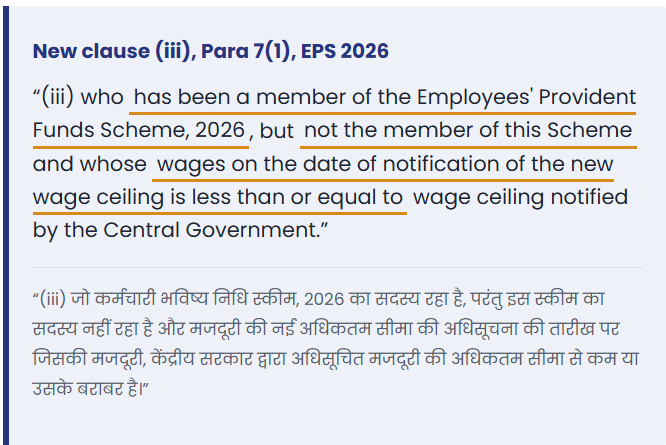
The amendment is short. It adds one new category of person to sub-paragraph (1) of Paragraph 7 of the Employees’ Pension Scheme, 2026 (the paragraph that deals with who becomes a member of the pension scheme). The inserted text reads:
New clause (iii), Para 7(1), EPS 2026
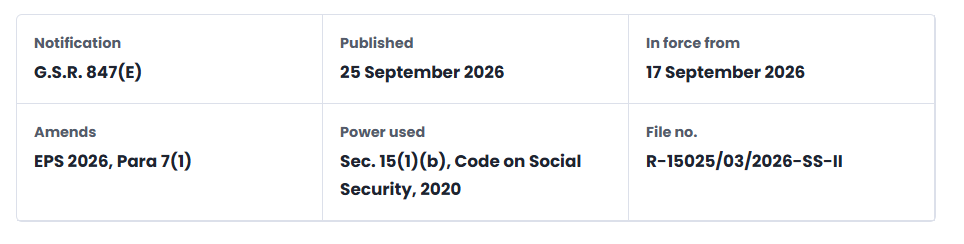
Paragraph 2 of the notification states that it comes into force on 17 September 2026, even though it was published in the Gazette on 25 September 2026. In other words, it applies retrospectively by eight days, so that it lines up with the date the new wage ceiling took effect.
The Central Government raised the statutory wage ceiling for EPFO coverage from ₹15,000 to ₹25,000 per month, effective 17 September 2026, through a separate Gazette notification (S.O. 5109(E) dated 17 September 2026, issued under the Code on Social Security, 2020).
Under the earlier ceiling, many employees who joined with wages above ₹15,000 were enrolled in the Provident Fund but kept outside the pension scheme. Raising the ceiling on its own would not automatically bring these existing PF-only members into EPS. Clause (iii) closes that gap: if such a member’s wages on the notification date fall within the new ceiling, they now become an EPS member.Beforetill 16 Sep 2026EPF + EPSEPF onlythe gapEPF onlyor voluntaryFrom17 Sep 2026EPF + EPSup to ₹25,000EPF onlyor voluntaryClause (iii) moves them in₹0₹15,000₹25,000₹35,000+Monthly PF wages (basic + DA) of members who joined after 1 Sep 2014
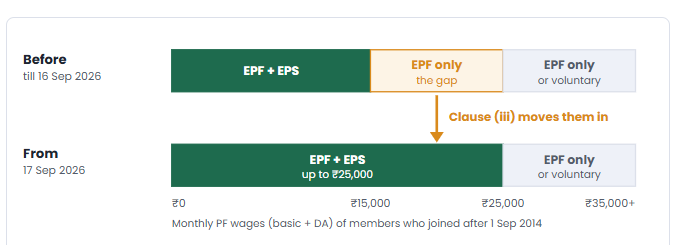
PF-only members in the ₹15,000–₹25,000 band were outside the pension scheme. Clause (iii) brings them in from 17 September 2026.
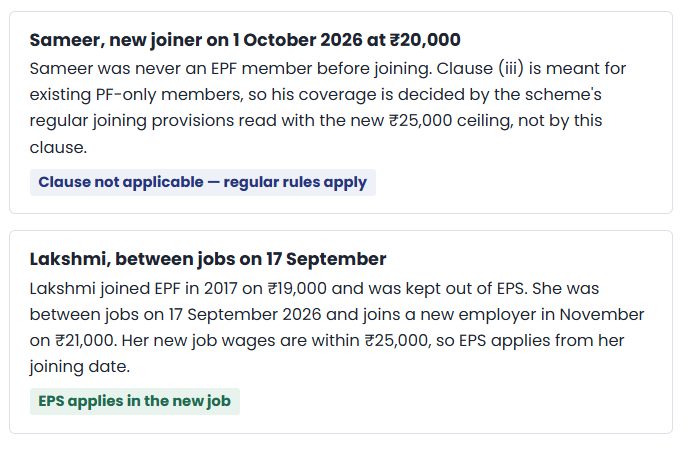
A person falls under the new clause (iii) only when all three conditions are met.
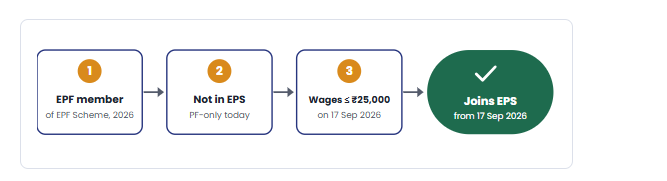
1EPF memberof EPF Scheme, 20262Not in EPSPF-only today3Wages ≤ ₹25,000on 17 Sep 2026Joins EPSfrom 17 Sep 2026All three must be true. Missing any one means clause (iii) does not apply.
The test date is fixedEligibility under clause (iii) is judged on wages as on the date of notification of the new ceiling, not on wages at the time of joining and not on wages in later months.
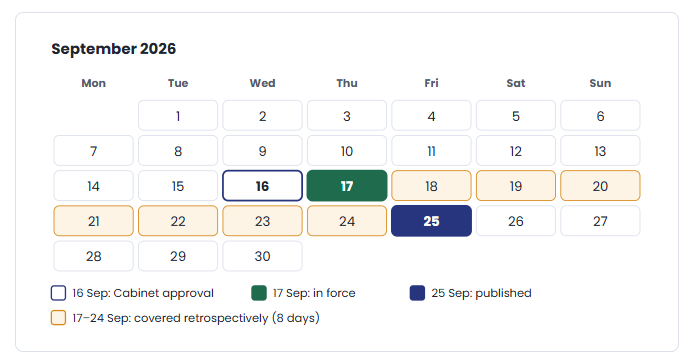
The notification was published on 25 September but takes effect from 17 September, so the eight days in between are covered retrospectively.
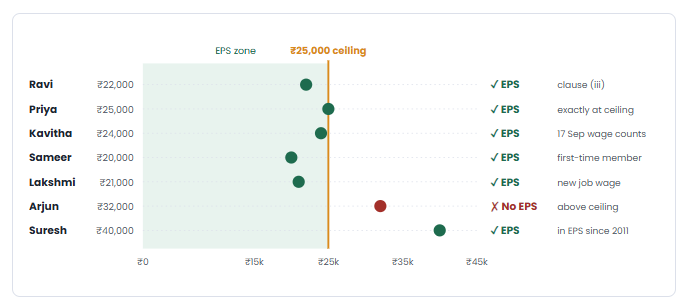
Suresh is above the ceiling but keeps EPS because he joined in 2011. Meena is not shown because she is already an EPS member at any wage.
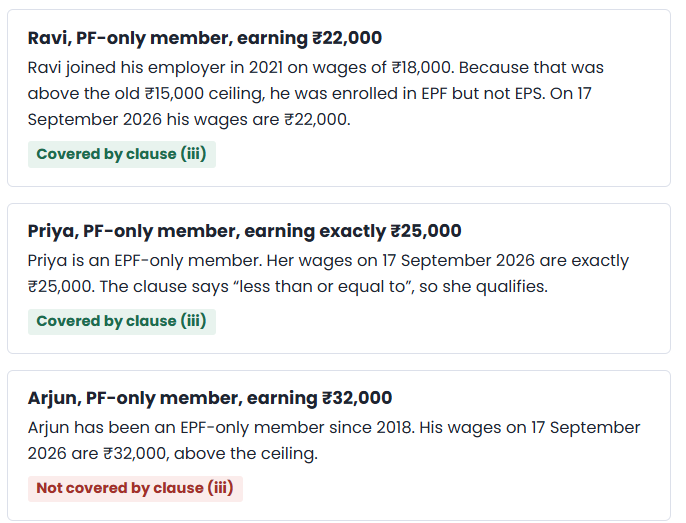
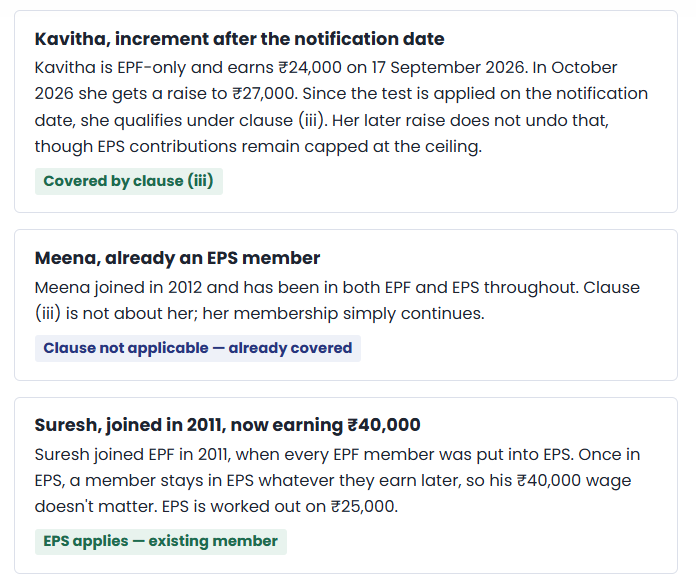
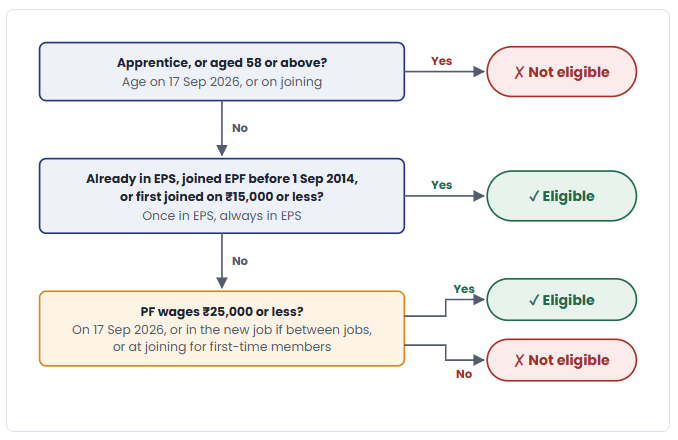
How EPS eligibility is decided from 17 September 2026. The checker below walks you through the same steps.
Answer every question. The checker first cross-checks your answers against each other and against your wages. If something doesn’t add up, it tells you what to correct before giving a result.
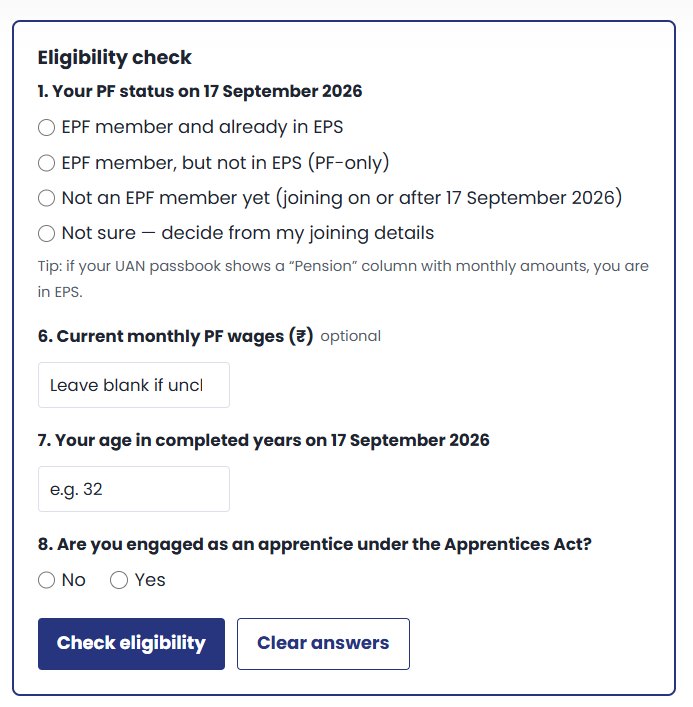
The checker relies on what you enter and cannot see your EPFO records. Age and apprentice rules follow long-standing EPF/EPS practice; confirm them against the full Employees’ Pension Scheme, 2026 and EPFO circulars. This is an indication, not a legal determination.
Joining EPS does not increase the employee’s own deduction. The employee still contributes 12% of wages to EPF. What changes is the employer’s 12% share: 8.33% of wages (up to the ceiling) now goes to the pension fund, and only the balance stays in the employee’s PF account.
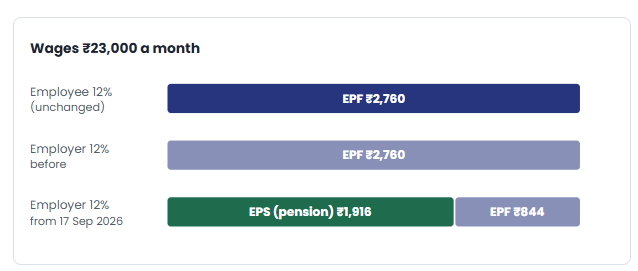
| Wages | Status | Employee EPF (12%) | Employer to EPS (8.33%) | Employer to EPF |
|---|---|---|---|---|
| ₹22,000 | Before (PF-only) | ₹2,640 | ₹0 | ₹2,640 |
| ₹22,000 | After clause (iii) | ₹2,640 | ₹1,833 | ₹807 |
| ₹25,000 | Before (PF-only) | ₹3,000 | ₹0 | ₹3,000 |
| ₹25,000 | After clause (iii) | ₹3,000 | ₹2,083 | ₹917 |
So the take-home salary stays the same. The trade-off for the employee is that a smaller amount builds up in the PF account each month, in exchange for pension eligibility under the scheme’s service and age conditions.
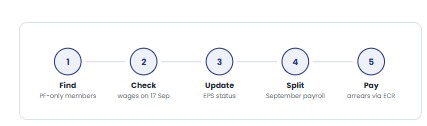
The full checklist follows.


Facile Management Services (OPC) Private Limited is committed to delivering seamlessly integrated HR and compliance solutions designed for the evolving