
Factories and manufacturing businesses must coordinate a wide range of operational, workforce, and statutory compliance responsibilities. These may include factory-related licences, applicable labour law requirements, employee records, contract labour documentation, payroll-related obligations, statutory returns, and audit preparation.
The challenge becomes more complex when a business operates multiple facilities or engages several contractors and third-party service providers. Each location and workforce arrangement may involve different responsibilities, documents, deadlines, and approval processes.
Managing these activities through spreadsheets, email reminders, and manual registers can lead to incomplete records, missed deadlines, duplicate data entry, and limited visibility into compliance status.
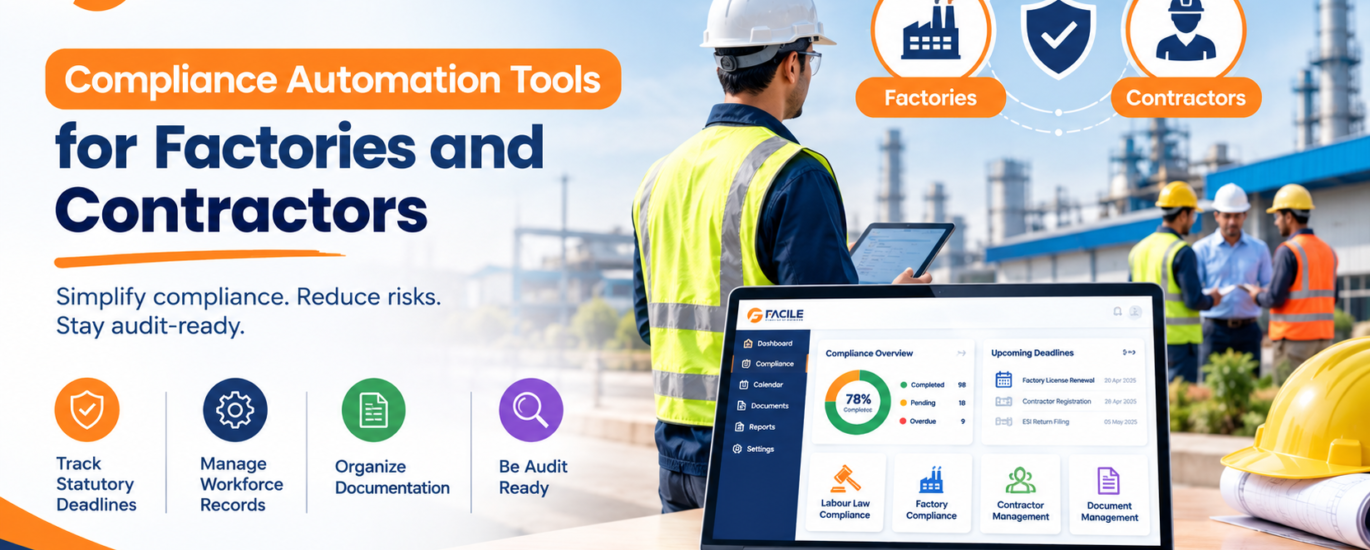
Compliance automation tools for factories and contractors help organizations centralize compliance information, standardize workflows, track statutory deadlines, and coordinate responsibilities across internal teams and external service providers.
For Indian businesses, the right solution can support a more structured approach to factory compliance, contractor compliance, labour law management, and audit readiness.
Compliance automation tools are digital platforms that help businesses organize, monitor, and manage recurring compliance activities through centralized records and automated workflows.
For factories, these tools may support the tracking of applicable licences, statutory registers, returns, inspections, renewals, and compliance documentation.
For contractors, they may help coordinate workforce records, contractor documents, applicable registrations, payroll-related information, and other required compliance evidence.
Depending on the platform, common features include:
The specific requirements supported will depend on the software, business activities, location, and applicable laws.
Manufacturing facilities may need to manage several categories of statutory and operational compliance. The exact requirements depend on factors such as the nature of operations, workforce, location, and applicable legislation.
Compliance management software can help teams maintain an organized list of obligations, assign responsible persons, and monitor completion.
Certain licences, registrations, certificates, and other documents may have validity periods or renewal requirements. A centralized system can record relevant dates and send reminders before action is required.
This helps reduce dependence on manual calendars and individual follow-ups.
Factories may need to organize inspection reports, statutory documents, registers, and supporting evidence. Digital document management makes these records easier to locate and review when required.
Organizations operating several factories or establishments may find it difficult to consolidate compliance status across locations.
A suitable platform can provide centralized reporting while allowing teams to monitor location-specific responsibilities.
Contractor compliance involves coordinating the documents, records, and obligations associated with third-party service providers and their workforce.
Depending on the engagement and applicable legal requirements, businesses may need to monitor contractor registrations, workforce details, wage-related records, statutory contributions, licences, or other supporting documentation.
A centralized repository can help organizations record document details, identify missing information, and monitor expiry or renewal dates.
Businesses can use structured workflows to track applicable contractor-related obligations and supporting records. Task ownership and review stages help establish accountability.
Where relevant, compliance workflows can coordinate contractor workforce information with payroll-related documents and statutory records.
The organization should verify applicable responsibilities and confirm that required payments, filings, and other legal obligations are completed.
Dashboards and reports can help management identify incomplete documentation, outstanding tasks, and recurring compliance gaps across contractors.
Compliance automation can connect HR, procurement, factory administration, finance, and contractor management teams through shared workflows and clearly assigned responsibilities.
Look for a system that organizes obligations, deadlines, responsible persons, and task statuses in one place.
Notifications help responsible employees prepare for upcoming deadlines, while escalation rules can flag overdue activities for management review.
The platform should support the relevant establishment information, applicable compliance obligations, document records, and location-specific reporting required by your business.
Evaluate whether the software can maintain contractor profiles, track supporting documents, identify missing records, and monitor relevant compliance tasks.
A searchable repository can simplify document retrieval and help organize licences, certificates, returns, registers, challans, acknowledgements, and audit evidence.
Integration with existing systems may reduce repeated data entry and improve coordination between employee information, payroll records, and compliance workflows.
Look for reports that show pending and completed tasks, outstanding documents, approval history, and other indicators relevant to compliance monitoring.
Factories and contractors may exchange sensitive workforce and business information. Suitable access controls, security practices, and audit logging are therefore important selection criteria.
Automated reminders, task assignments, and document tracking can reduce repetitive administrative work and follow-ups.
Centralized calendars and alerts help teams identify upcoming and overdue activities.
Digital records make it easier to organize, search, and retrieve supporting evidence.
Clearly assigned responsibilities and approval workflows help teams understand who must complete and review each activity.
A centralized view of contractor documentation and compliance tasks can help businesses identify outstanding items and follow up more systematically.
Organized records and available audit trails can reduce the effort involved in gathering evidence for internal reviews and external audits.
Standardized workflows can support business expansion across new facilities, locations, and contractor relationships.
Automation can improve monitoring and reduce preventable process errors, but it cannot guarantee compliance on its own.
| Activity | Manual approach | Automated approach |
|---|---|---|
| Deadline tracking | Spreadsheets and manual reminders | Configured calendars and notifications |
| Contractor documents | Emails and shared folders | Centralized records and status tracking |
| Licence renewals | Individual follow-ups | Expiry tracking and reminders |
| Task ownership | Informal coordination | Assigned owners and escalation workflows |
| Audit preparation | Manual collection of documents | Organized evidence and searchable records |
| Management reporting | Consolidating information manually | Dashboards and reports where supported |
The value of automation depends on data quality, correct configuration, user adoption, and the capabilities of the selected platform.
Factories and contractors should evaluate software against their actual operational and statutory requirements.
Consider these factors before selecting a solution:
Request a demonstration using realistic factory and contractor compliance scenarios before making a decision.
Identify relevant obligations for each establishment and contractor arrangement, including task owners and required evidence.
Check licences, registrations, employee details, contractor documentation, and other source data for missing or outdated information.
Define task assignments, document requirements, review stages, approval rules, and escalation procedures.
Set up appropriate notifications, renewal alerts, dashboards, and management reports based on actual compliance deadlines.
Provide clear instructions on document submission, task completion, verification, and exception handling.
Review overdue tasks, missing records, recurring issues, and audit findings regularly. Update workflows as business operations and applicable requirements change.
Compliance automation tools can help factories and contractors manage complex compliance activities with greater consistency and visibility. From tracking statutory deadlines and factory documentation to organizing contractor records and supporting audit preparation, automation can reduce repetitive work and improve coordination.
For Indian manufacturing businesses, the most suitable solution is one that reflects their actual legal obligations, workforce arrangements, locations, and operational processes.
By combining appropriate technology with accurate records, clear accountability, periodic reviews, and qualified compliance oversight, organizations can build a more efficient and reliable compliance management process.
These are software solutions that help factories track applicable statutory obligations, manage deadlines, organize documents, assign tasks, and monitor compliance activities from a centralized platform.
Factories can benefit from better deadline tracking, organized documentation, reduced manual follow-ups, clearer task ownership, improved reporting, and more efficient audit preparation.
Contractor compliance management software helps businesses organize contractor profiles, track required documents, monitor applicable compliance tasks, and identify missing or outstanding records.
Some platforms support licence and certificate tracking, expiry dates, and automated renewal reminders. Businesses should verify the specific features available and ensure that renewals are completed as required.
Automation can help organize contractor workforce information, track applicable documents, assign compliance tasks, and monitor supporting records. Legal applicability and the responsibilities of the relevant parties must still be verified.
Yes. Suitable platforms can provide centralized visibility across multiple facilities while tracking location-specific obligations, documents, deadlines, and task owners.
No. Software can organize records and workflows, but it does not replace required inspections, legal interpretation, verification, or professional compliance oversight.
Important features include compliance calendars, automated reminders, licence tracking, document management, contractor monitoring, role-based access, reporting, and audit trails.
Yes. Smaller factories can use automation to standardize recurring tasks, maintain records, and track deadlines. The appropriate solution depends on operational complexity, compliance requirements, and budget.
Businesses can monitor overdue tasks, document completion rates, recurring compliance gaps, time spent on manual follow-ups, audit findings, and completion of applicable obligations by their deadlines.


Facile Management Services (OPC) Private Limited is committed to delivering seamlessly integrated HR and compliance solutions designed for the evolving